
Aluminum ladder components need separate cutting identities for rails, rungs, steps and other members. A broad request for “ladder profiles” leaves the supplier guessing which section, length and delivery stage belongs to each part. Start with the ladder manufacturer’s controlled component drawings and bill of materials.
This guide organizes five handoffs in a manufacturing inquiry: component identity, length reference, section orientation, later processing and kit quantities. It helps a buyer prepare information for a cutting review. The ladder manufacturer remains responsible for the approved design, assembly, validation and product requirements.
On this page
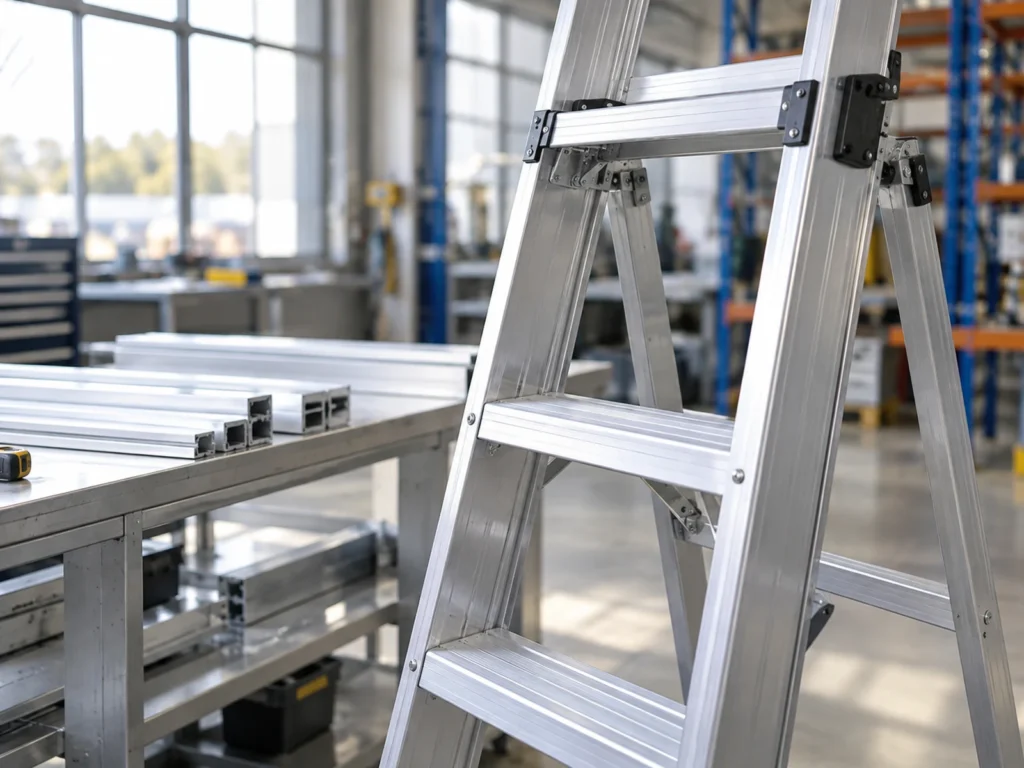
Aluminum ladder components: start with the exact member
Name the part by its role in the approved design. Give a side rail its own reference, and give each rung or step variant another reference. Add the section code, component drawing, material requirement and required quantity. A shared application does not make the members interchangeable.
Werner’s TradePRO extension-ladder overview provides a concrete example of component variety: it describes box-section stiles and separate square-rung and D-rung ladder styles. Those descriptions belong to that manufacturer’s range. They do not define a universal rung section for other ladders.
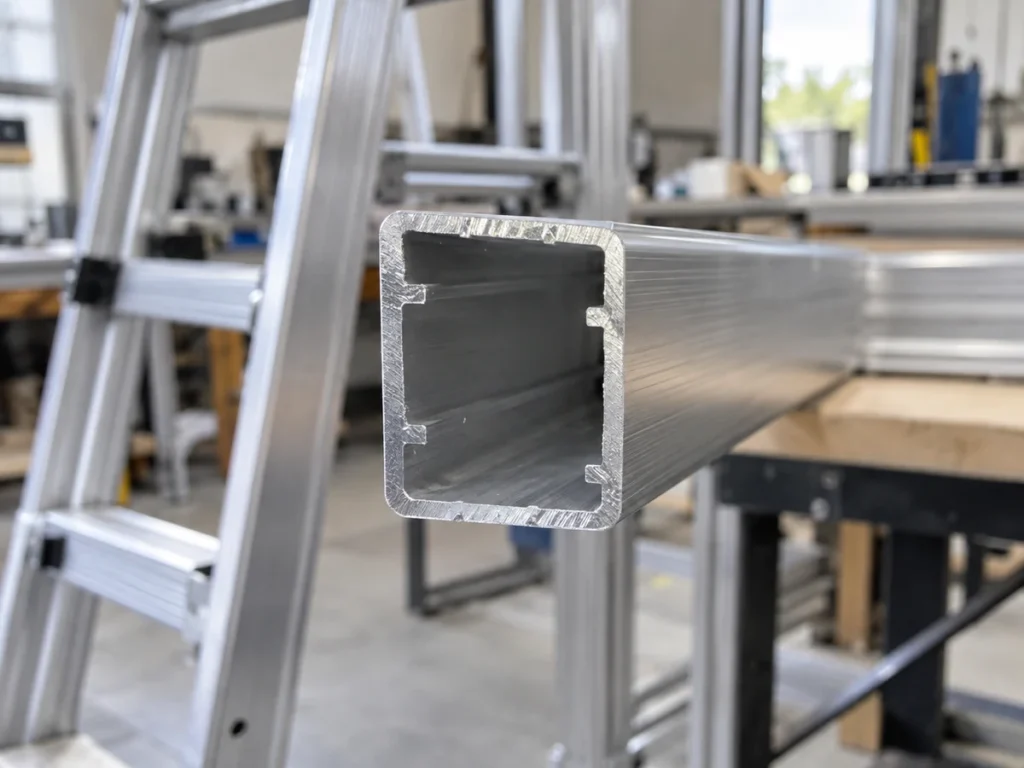
Use the actual cross-section drawing for the inquiry. Show internal ribs, channels, openings and the intended contact faces where relevant. Preserve the component’s identity when sending both a drawing and a photo; the photo alone cannot define the required section.
Keep similarly named members separate when their drawings differ. For example, a left rail and a right rail may share a section but have different later feature requirements. Link each cutting row to its own delivered part reference.
Handoff 2: use the component’s length reference
Take the cut length from the controlled component requirement. Do not enter the ladder’s advertised size or reach height as a rail’s cutting length. The assembled product description and the individual blank drawing answer different questions.
Werner’s climbing-equipment FAQ distinguishes ladder size from actual height and explains that overlapping extension sections affect the relationship. That is a reason to use the member drawing for cutting, not to calculate new rail lengths from a marketing dimension.
Identify the length reference and the supplied stage. Is the row for a raw cut blank, a member after end processing or a completed component ready for the specified assembly operation? Record the relevant tolerance and units beside that requirement.
If end processing changes the reference, have the drawing owner define the blank and finished dimensions. Our finished-length datum guide explains how to keep the measured feature tied to a named reference. Do not supply an unapproved allowance to make the numbers look complete.
Handoff 3: keep the section orientation visible
Show how the member is identified in the drawing, including the relevant face or direction. A ribbed section can look similar after rotation while presenting different faces to later operations. Keep those face references with the component record.
For a saw review, provide the real incoming cross-section and the intended cut. Ask the supplier to confirm the proposed support and locating arrangement for that stock. The drawing requirement and the proposed machine setup should both remain recognizable.
Avoid describing the section only by its largest outside dimensions. Add the section geometry and material condition. Where the part has thin walls or internal ribs, give the supplier the actual drawing rather than replacing it with a generic square-tube image.
Handoff 4: assign the later processing
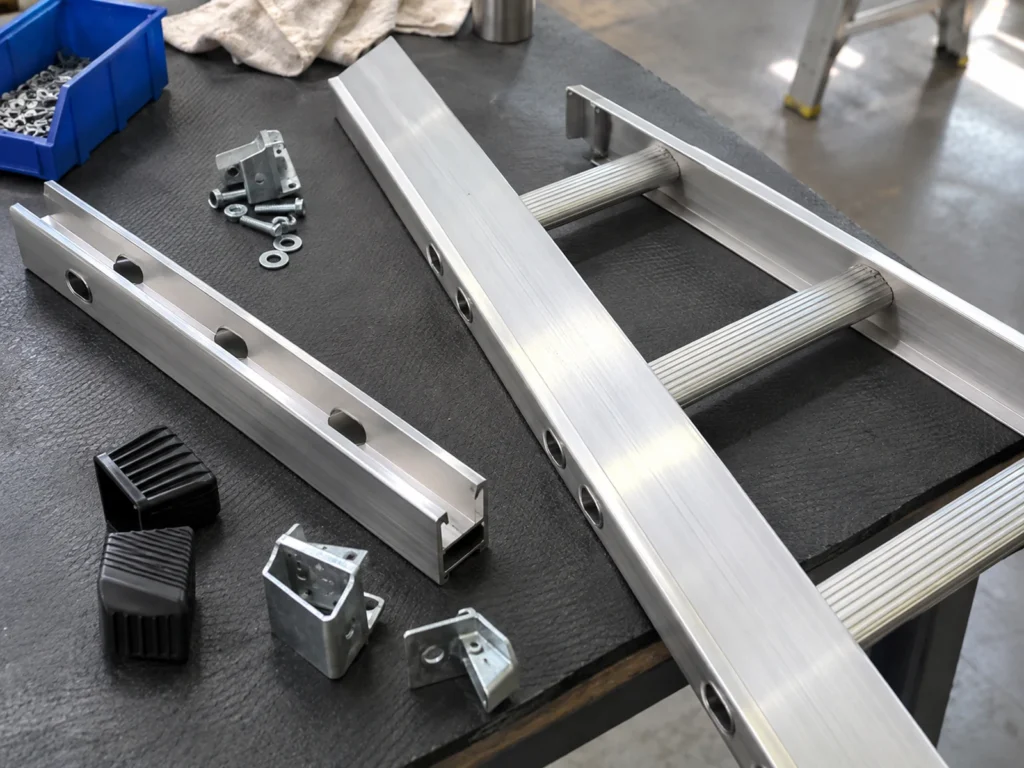
Separate cutting from the operations needed to produce the approved component. Where applicable, identify later holes, end features, joining preparation, finishing and assembly. Put the required operations and their owners in the quotation review.
A cut-to-length offer is incomplete as a finished-component offer if later work remains outside its scope. Ask the supplier to list what it includes and what it excludes. Keep the ladder manufacturer’s joining and assembly requirements attached to the appropriate process stage.
| Handoff | Record to keep |
|---|---|
| Stock to cutting | Section identity, material condition and controlled blank dimensions. |
| Cutting to later processing | Part identity, required end condition and the applicable feature drawing. |
| Processed parts to assembly | Confirmed component stage, part quantities and assembly references. |
| Assembly to product release | The ladder manufacturer’s required validation and release records. |
Use our cutting-and-drilling route guide for that separate processing-scope question. It does not establish an approved rung attachment or certify a complete ladder.
Handoff 5: count parts by kit identity
Give each kit or ladder variant its own bill-of-materials reference. Record the required quantity of every member, including parts sharing a cut length but differing in section or later features. Keep cut-piece count separate from the number of complete component sets.
Count only pieces at the required accepted stage as available for the next handoff. A rail waiting for its specified holes is not the same inventory item as a released rail ready for assembly. Keep rejected, pending and released pieces distinguishable.
For mixed production, identify which kit each part serves. The component-kit guide explains the general connection between a parts list and a complete set. Use the ladder’s own approved bill of materials for the actual counts.
A fictional 24-kit planning example
Suppose a fictional planning record L8, revision D, defines one component set as two identified rails and eight identified cross-members. An order for 24 such sets would require 48 rails and 192 cross-members under that invented bill of materials.
The 240-piece total is useful for counting, but it is not a complete cutting list. Separate the rail and cross-member rows and add their individual section references, dimensions and process stages. If there are left and right rail variants, retain their separate quantities.
Now suppose the inventory contains 48 released rails and 190 released cross-members. The arithmetic supports at most 23 complete sets of those two part types, with other parts and acceptance requirements still to be checked. The total pieces present do not establish 24 ready sets.
These counts are a fictional inventory example. They prescribe no rung spacing, member dimensions, joining method, rated load or approved ladder design. The manufacturer’s controlled design supplies those requirements.
Review the sample and release records
Agree the component checks before comparing machines: part identity, drawing revision, cut dimension, specified end condition and required processing stage. Let the responsible manufacturer identify the acceptance requirements and the appropriate verification methods.
Keep dimensional sample results with the actual component record. They support review of that sample; they do not establish the complete ladder’s performance. Product validation and release remain separate from a cutting trial.
Werner’s literature page directs readers to product-specific resource documents and lists ladder inspection and safety-training resources separately. The distinction is useful: a generic cutting article cannot replace the actual product’s documentation.
Prepare the machine inquiry
Send the approved section and member drawings, material condition, cut list, quantities, expected part mix and required delivered stage. Identify open questions and the later operations that remain elsewhere. Add representative stock for a proposed cutting review.
Contact JiurunCut to discuss a cutting arrangement for the actual sections. Ask the supplier to confirm the proposed support, operating scope and sample-review plan. Keep any complete-ladder design or validation commitment with the responsible manufacturer.
Buyer questions
Can one row describe every ladder member?
Use separate references for members with different sections, dimensions or processing requirements. Link each row to the controlled component drawing.
Is ladder size a usable rail cutting length?
Use the approved component length requirement. Product size, reach and assembled dimensions should not be substituted for the blank drawing.
Does a successful cutting sample certify a ladder?
No. It records the agreed component checks for that sample. The ladder manufacturer controls the complete product’s validation and release.
Can this guide be used to repair a damaged ladder?
This is a manufacturing-inquiry guide. For an existing ladder, follow its manufacturer’s directions; Werner’s FAQ specifically states that it does not recommend repairing a damaged ladder.