
Skived vs extruded heat sinks describes two ways of creating the fins and base. Extrusion forms a continuous profile through a die. Skiving forms fins by partially slicing material from a base and raising those slices. Both routes can produce aluminum heat sinks, but the process name alone does not define a finished part or its cooling performance.
If you are buying heat sinks or planning a cutting stage, start with the approved geometry and the supplied part condition. Then compare what each offer includes. This guide explains five RFQ checks that keep a manufacturing-route comparison clear without assuming that one route is always the better choice.
Compare the delivered part, not just the route
- Identify how the fins are made and what material is offered.
- Define the complete fin and base geometry.
- Separate cutting, later features and thermal evaluation.
On this page
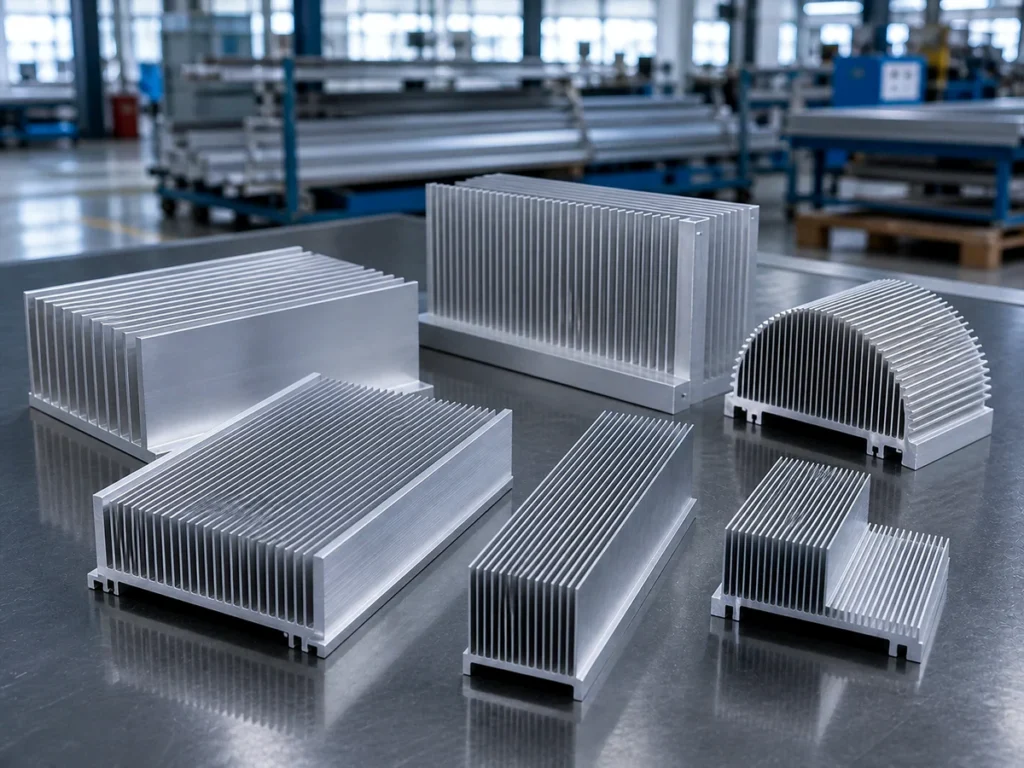
Skived vs extruded heat sinks: understand the manufacturing difference
Boyd’s heat-sink fabrication guide describes extrusion as pushing softened aluminum through a profile die to produce a long section. The resulting stock is cut to length and can receive further machining and finishing. Its skiving description uses partial slices from the base that are raised to form fins.
| Route | Basic fin-forming description |
|---|---|
| Extruded | The die forms the profile, including its fin and base cross-section. |
| Skived | Partial slices from a metal base are raised to form fins. |
This distinction separates fin formation from a later cut-to-length operation. A saw that cuts an existing finned section is not performing the skiving process merely because the part is a heat sink. Define the operation you want the equipment to supply.
Also confirm that an offer actually concerns one of these routes. A bonded-fin assembly, for example, uses separately attached fins and is a different construction. Ask the heat-sink supplier to identify the offered route instead of interpreting it from a marketing photograph.
Check 1: define the fins and base completely
Outside length, width and height are a useful start, but they do not describe the whole part. Include the base thickness, fin height, fin thickness, fin spacing and any changes across the section. Where a dimension is critical, show its reference and acceptance limits on the controlled drawing.
Keep fin spacing and fin pitch distinct in the inquiry. Say whether a number refers to the clear gap between adjacent fins or the distance between corresponding points on repeated fins. If the description is ambiguous, request a marked drawing rather than letting two suppliers interpret it differently.
A flat rectangular envelope can hide very different fin arrangements. Ask each supplier whether the requested geometry is included in the offer or whether a revised drawing is proposed. Record the proposed change explicitly so the design reviewer can assess it.
For an existing finned section that will be sawed, use the thin-fin cutting review to define support, handling and part checks. That review addresses the cutting operation after the stock geometry has been identified.
Check 2: keep the material identity visible
Specify the material required for the part and ask what the supplier is offering. Aluminum and copper offers should not be grouped as though the manufacturing-route label makes them the same product. Within an aluminum order, retain the complete alloy and condition required by the approved specification.
Wakefield Thermal’s SKV data sheet describes skived heat sinks made from either copper or aluminum. It also explains that finished parts can be machined. These are useful reminders that “skived” alone identifies neither the material nor every operation included in a supplied part.
Keep finish information in its own field. If the quotation offers a finished heat sink, identify the finish and which surfaces it covers. If it offers stock for later processing, describe that supplied condition clearly. A generic photo of bright metal does not establish either field.
Use the T5 versus T6 purchasing guide when a proposed aluminum condition differs from the specified one. Review any alternative through the part requirements before treating two quotations as equivalent.
Check 3: state what leaves each production stage
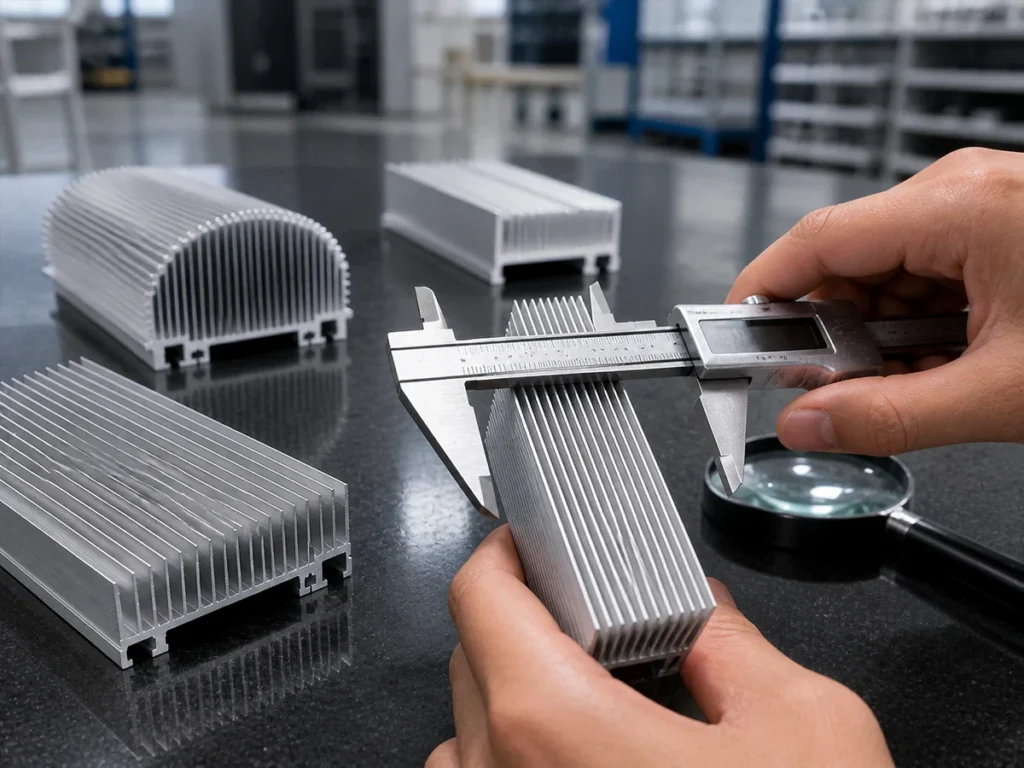
A quote may cover a raw section, a cut blank or a completed heat sink. Put that delivery stage beside the price. If one offer includes drilled mounting holes and another does not, the two prices describe different work even if the outer dimensions match.
List the required features at handoff: cut ends, mounting holes, threaded features, contact-face preparation, cleaning and finishing where specified. Assign each feature to the operation or supplier responsible for it. Do not assume that cutting a finned profile supplies all finished-part features.
For a cutting-machine inquiry, identify the stock that arrives at the saw and the part condition expected at its exit. If skived stock is proposed, provide its actual drawing and a representative sample for the machine review. Approval of an extruded profile does not automatically approve another fin arrangement.
Wakefield’s data sheet notes that its thin fins require care during handling. For your own part, agree the handling and packing requirements with the supplier. Keep those requirements connected with the actual delivered stage rather than copying a protection method from a different product.
Check 4: ask for thermal evidence with its conditions
A manufacturing-route comparison and a thermal-performance comparison answer different questions. Request the evidence for the identified design under the intended operating conditions. Do not approve a heat sink merely because the fins look dense in a picture.
The Wakefield sheet presents separate thermal-resistance entries for natural convection and specified forced-air conditions. When reviewing a quoted figure, keep the part number, material and stated airflow condition with it. A number detached from those labels is difficult to compare fairly.
Ask the thermal reviewer which operating information and evaluation are required for the application. Keep that requirement distinct from a dimensional inspection of saw-cut blanks. A caliper check can address a specified dimension; it does not demonstrate cooling performance.
If a supplier proposes a different fin geometry, request the relevant design evidence. Describe the thermal review as pending until the responsible reviewer has assessed the intended application. This guide gives no universal thermal-resistance target or performance ranking.
Check 5: compare the same order scope
Send the same drawing revision, batch quantity and delivery-stage description to the suppliers being compared. Ask them to identify any additional preparation, tooling, sample work or later operations included in their offer. Obtain job-specific terms rather than assuming the route alone determines price or lead time.
Where the job uses an existing section, include its exact supplier reference. Where an alternative is proposed, keep the proposal separate from the requested design. State what requires review before the production order is released.
Separate sample acceptance from series delivery. A sample can answer agreed questions about the identified part, but it does not resolve every requirement for every future variant. Keep the approved identity and inspection scope available when repeat batches are ordered.
A fictional RFQ comparison
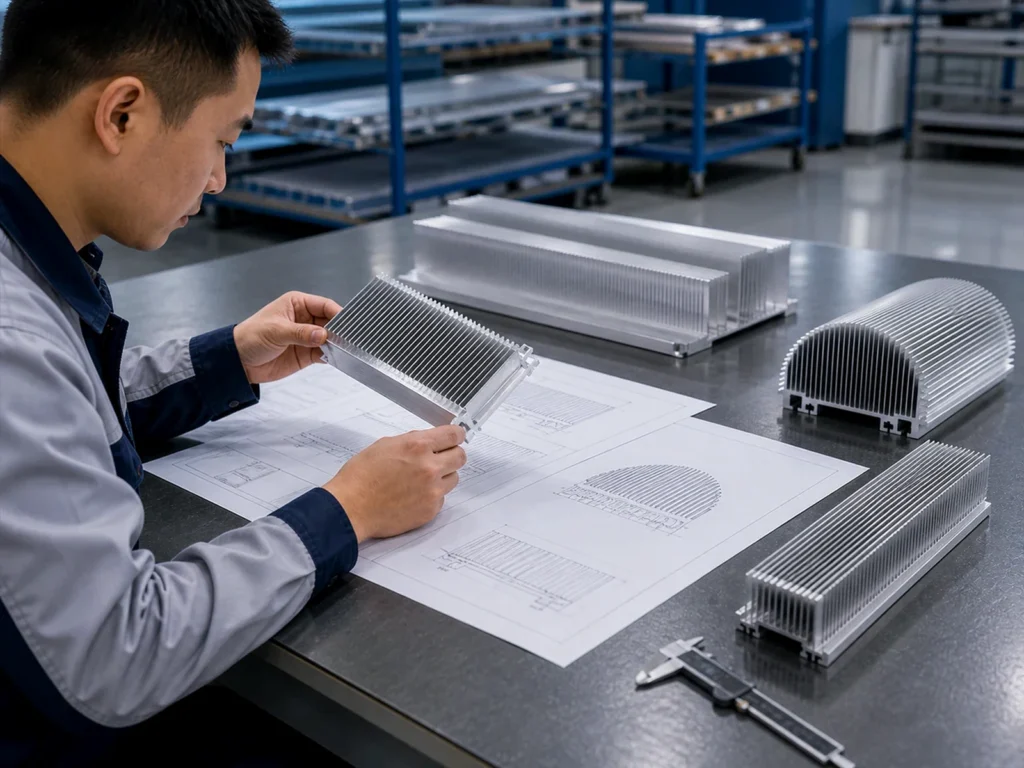
Imagine an inquiry requests 200 aluminum heat sinks with finished mounting holes. Offer A provides an extruded cut blank without holes. Offer B provides a skived finished part with holes but proposes a different fin arrangement. This is a fictional example with no actual prices or test results.
The first difference concerns supplied work; the second concerns geometry. Clarify both before comparing total cost. Ask Offer A to price the required later operations, and ask the design reviewer to assess Offer B’s proposed geometry and supporting evidence.
Neither route name resolves those gaps. A useful comparison shows the requested design, offered design, delivered stage and unresolved questions in separate fields.
Buyer questions
Is a saw-cut heat sink automatically extruded?
No. Cut-to-length describes an operation. Confirm the fin-forming route and supplied stock identity separately.
Are skived heat sinks always the better option?
Choose against the application’s approved requirements and relevant evidence. The process name alone does not establish suitability.
What should accompany a cutting-machine inquiry?
Provide the actual stock drawing, material identity, required cut length and end condition, batch quantity and expected delivery stage.
Define the heat-sink cutting stage clearly
Send JiurunCut the finned-section drawing and cutting requirements. Identify how the stock is supplied and what the saw should deliver so the equipment review addresses the intended operation.