
Aluminum profile weight can be estimated from the metal cross-sectional area, length and density. Use a documented area or mass-per-length value for the actual profile. An outside width and height alone do not establish the metal area of a hollow or slotted section.
In this guide, “weight” means mass in kilograms, as it commonly does in purchasing. The calculations are ideal examples for understanding the inputs. They are not measured stock weights, shipment declarations or approval of a feeder, rack or lifting arrangement.
Keep three quantities separate
- Cross-sectional metal area, usually in square millimeters
- Mass per length, such as kilograms per meter
- Total mass of the identified stock, parts or packaged load
On this page
1. Use the correct area for aluminum profile weight
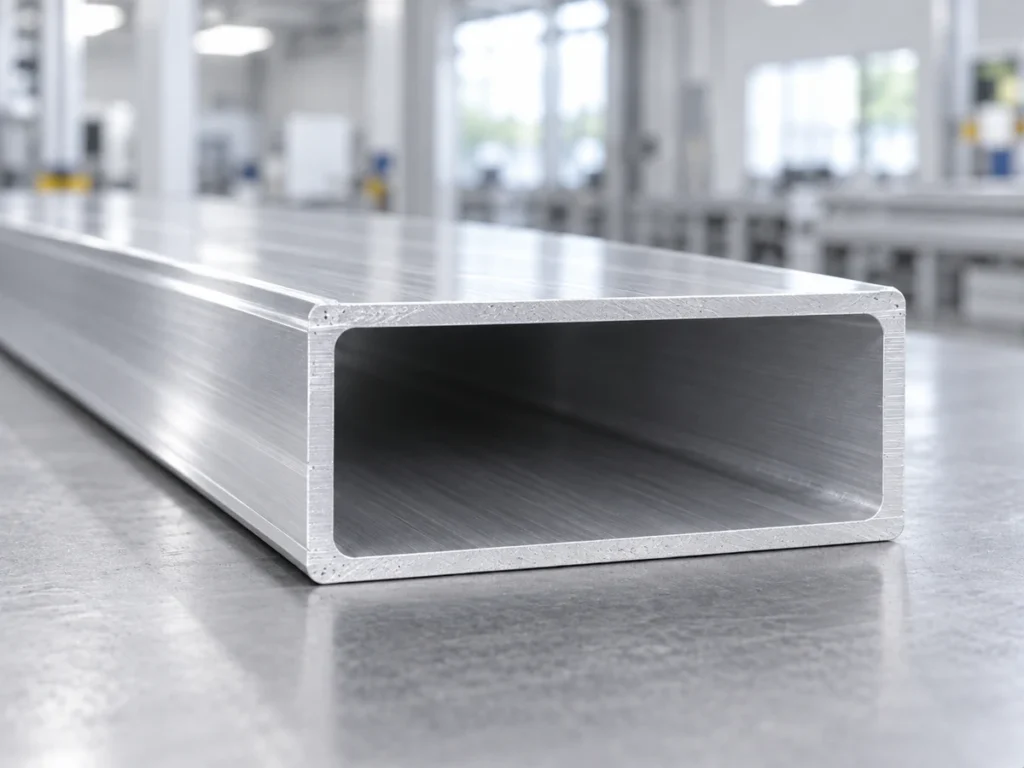
For a solid rectangular bar, the ideal cross-sectional area is width multiplied by height. For a hollow section, the void must be excluded. Slots, webs, corner radii and other features also change the area.
A profile’s outside envelope describes the space it occupies. It is not necessarily the area of aluminum in that envelope. Treating a hollow section as a solid rectangle overstates its ideal metal volume.
For a complex extrusion, request the cross-sectional area or documented mass per meter from the profile supplier. Identify the section number and revision associated with the value. A similar-looking profile may have a different wall arrangement and a different mass per length.
If the supplier provides mass per meter for the correct profile, you can multiply that value by the stated length without reconstructing every geometric feature. Retain the source and the assumptions. Do not confuse a nominal catalogue value with an actual weighing result.
Our tube-dimension guide explains why outside dimensions, inside dimensions and local wall details need separate labels. The same distinction matters when estimating the amount of metal present.
2. Keep area, length and density units consistent
The basic relationship is mass = volume × density. For a uniform straight section, volume equals cross-sectional area multiplied by length. Every value must use compatible units.
The NIST SI guide defines mass density as mass divided by volume and gives kilograms per cubic meter as its SI unit. It also distinguishes scientific weight, a force, from the everyday commercial use of weight to mean mass.
For area in mm², length in meters and density in kg/m³, use:
Mass in kg = area in mm² × length in m × density in kg/m³ ÷ 1,000,000.
The divisor converts square millimeters to square meters. The NIST units and prefixes guide helps distinguish area, volume and density units. A linear unit conversion should not be reused unchanged for an area.
Label density with its source and applicable material condition. The worked example below assumes 2,700 kg/m³ solely for arithmetic. It is not a certified density for your alloy, temperature, composite profile or supplied batch.
If you instead use a supplier’s kg/m value, the calculation becomes mass = kg/m × m. Do not multiply by density again. That would apply the material-density factor twice.
3. Work through one ideal rectangular-tube example
Assume an invented straight rectangular tube with an outside width of 40 mm, outside height of 20 mm and uniform 2 mm wall. For this calculation only, assume sharp corners, no extra webs and a concentric rectangular interior.
The ideal inside dimensions are 36 mm by 16 mm. The metal area is (40 × 20) − (36 × 16) = 224 mm². Actual rounded corners or additional features require the actual section area instead.
With the assumed density of 2,700 kg/m³, the ideal mass per meter is 224 × 2,700 ÷ 1,000,000 = 0.6048 kg/m.
| Example item | Ideal calculated mass |
|---|---|
| One 6 m length | 0.6048 × 6 = 3.6288 kg |
| One 500 mm piece | 0.6048 × 0.5 = 0.3024 kg |
| Ten 500 mm pieces | 0.3024 × 10 = 3.024 kg |
The 500 mm length becomes 0.5 m in this formula. Entering 500 as meters would produce a thousandfold error. Keep the original unit beside each input before doing the calculation.
These values describe the ideal material in the named items. They do not specify a feasible cutting plan for the 6 m stock. Saw kerf, trimming, the remaining stock and any part rejection need their own records.
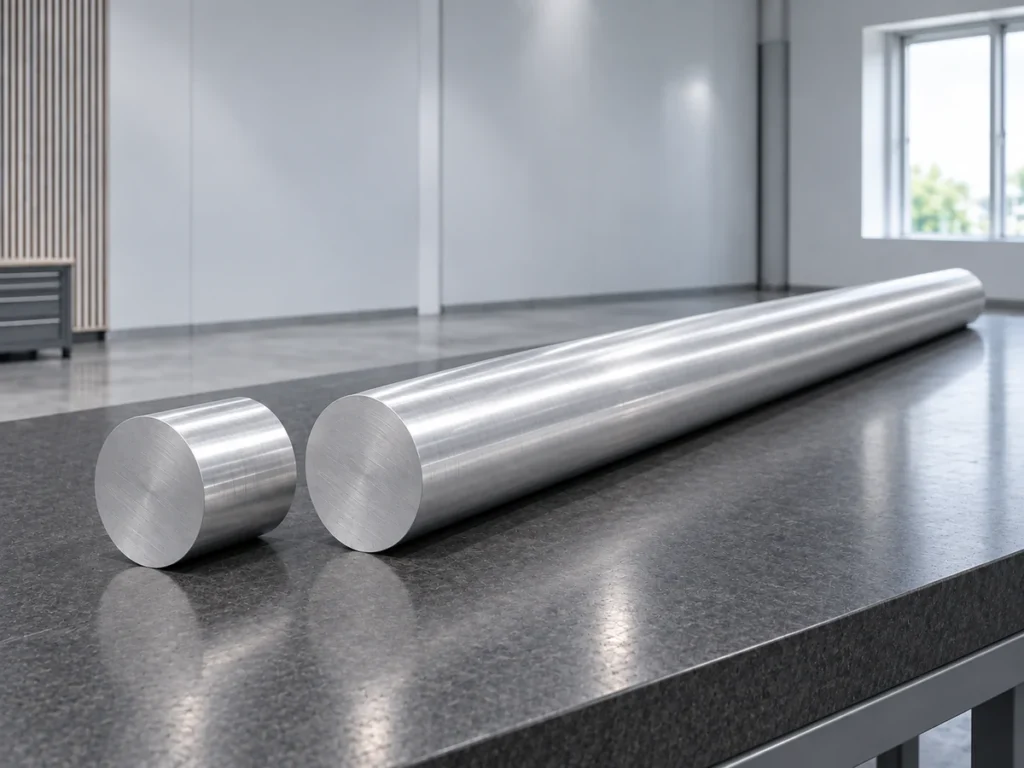
For comparison, a solid ideal 40 × 20 mm bar has an area of 800 mm². Under the same assumed density, its ideal mass per meter is 2.16 kg/m. Equal outside dimensions therefore do not establish equal mass.
4. Name the stock, part or package being counted
A mass estimate needs a clear boundary. State whether it concerns one incoming bar, one finished part, a batch of released pieces or a packaged shipment. Those quantities cannot be used interchangeably.
For a uniform straight member with square ends, area multiplied by length gives the ideal volume. An angled or later-machined member may need a more complete geometric model. A long-point length multiplied by area does not automatically represent its exact volume.
Keep approved blanks and finished parts separate if later operations remove material. Our machining-allowance guide explains why their lengths and completion stages may differ. The same stage distinction applies to their mass estimates.
For a package, add the relevant packaging, pallets, fixtures or other contents when gross mass is required. A calculation for the aluminum alone is not the gross shipment mass. Label net and gross quantities so the receiving team can understand the record.
Composite sections also need all included materials represented. An aluminum-only area and density do not account for an insulating strip or other component. Our thermal-break profile guide explains why the complete material combination belongs in the application review.
5. Confirm the actual requirement before equipment selection
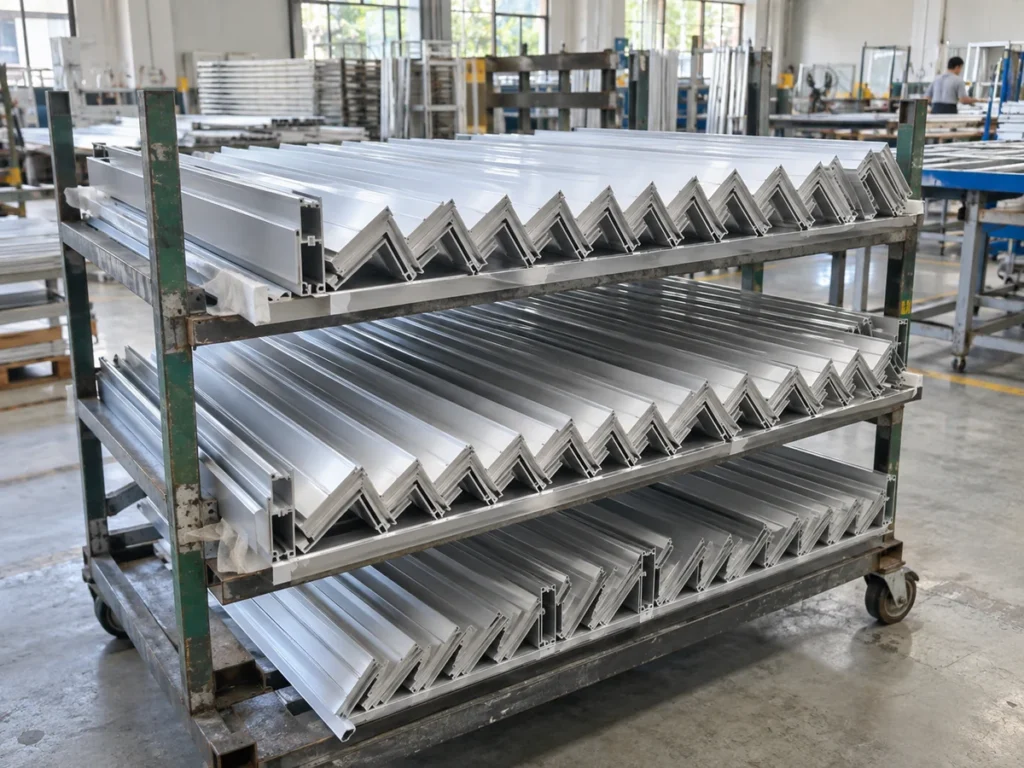
Send the actual stock lengths, section identities and documented mass information with a machine inquiry. Include any bundle configuration being proposed. Let the equipment supplier assess the complete handling requirement for the selected configuration.
An estimated piece mass alone does not establish a feeder or support’s suitability. The arrangement, dimensions and application conditions also need review. This guide gives no permitted load, bundle size, support spacing or handling procedure.
Where the decision requires actual mass, use the responsible team’s appropriate weighing process and record the identified item and condition. Keep the calculation and the measured value labeled separately. A difference is a reason to review the inputs, not proof of a machine fault.
Possible input differences include the real section area, actual length, material identity, included components or packaging. Review those records before comparing numbers. Do not infer alloy or wall thickness from mass alone.
Round only after preserving the calculation inputs and working values. For instance, the ideal 6 m example may be summarized as about 3.63 kg, while its unrounded arithmetic result remains 3.6288 kg. Extra displayed digits do not turn an assumed model into a more accurate measurement.
Keep the value’s purpose visible: preliminary material planning, a supplier comparison or an actual load record. Use the applicable documented requirement for each decision. The examples here are teaching calculations, not equipment or shipment approvals.
Common questions
Can I calculate profile mass from outside width and height?
Only when those dimensions and the stated geometric assumptions define the material area. Hollow and slotted sections need the excluded spaces and other features accounted for. A documented section area or kg/m value is often a clearer input.
Is the assumed density valid for every aluminum profile?
No. The numerical example uses an explicit assumption for arithmetic. Use the appropriate documented material information or a mass-per-length value for the actual profile.
Does theoretical mass approve the machine’s loading capacity?
No. Provide the actual stock, arrangement and relevant mass information for the supplier’s application review. A calculation does not establish the selected equipment’s permitted load or handling method.
Send stock details with the cutting requirement
Ask JiurunCut to review your material and handling inputs. Include the section drawing, stock lengths, material identity, documented mass information and required cut pieces. Request an assessment for the proposed configuration.