
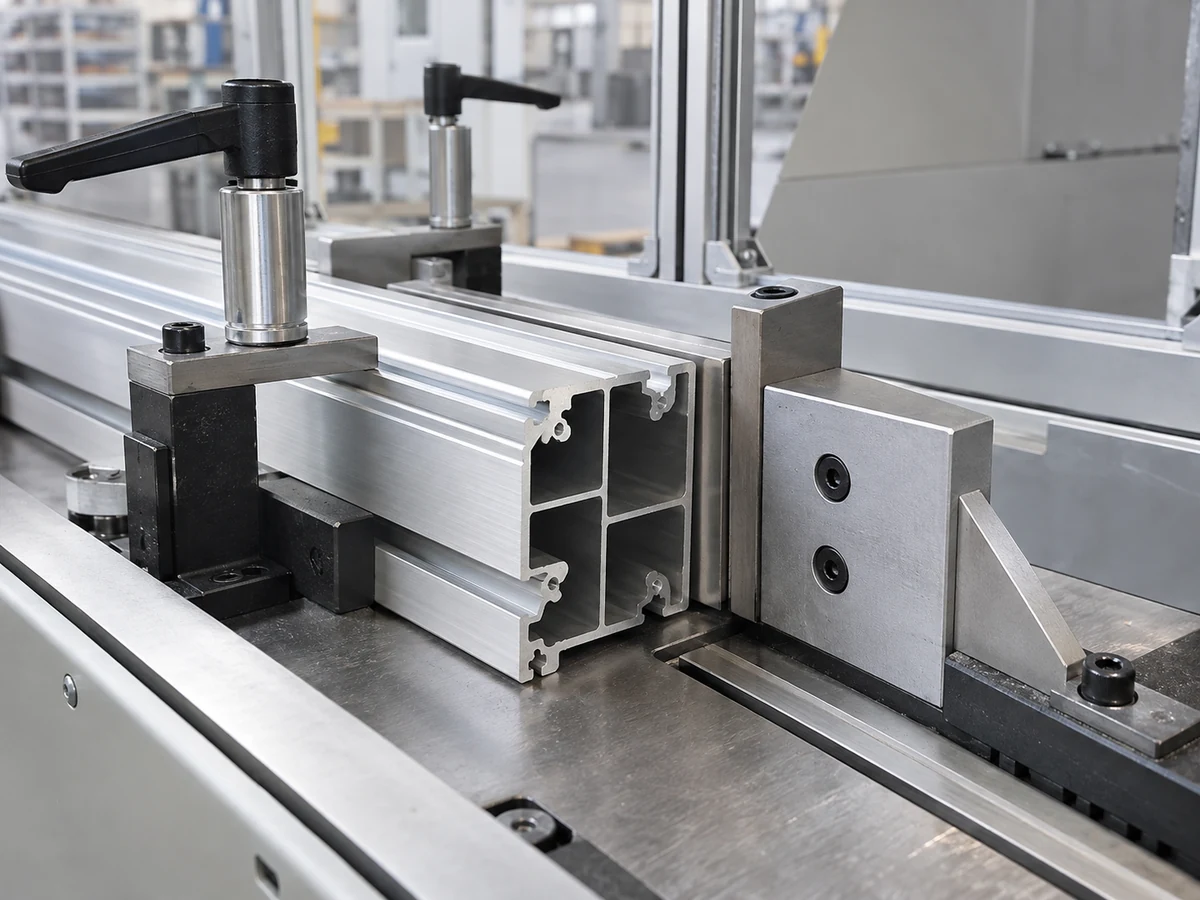
Welding screen aluminum frame cutting starts with a member schedule, not a saw speed claim. A portable screen may combine uprights, crossbars, feet, connectors, a curtain, and optional wheels. The buyer needs cut blanks that assemble into the specified frame without forcing the curtain supplier to compensate for wrong lengths or rough ends. This guide sets out seven checks to put in an RFQ for aluminum profiles. The featured photo shows related industrial partition frames and loose extrusions; it is an illustrative frame view, not a welding screen or a customer project. It addresses cutting and inspection of frame members; the finished screen’s welding protection must be specified and verified separately.
Real products show why the assembly details matter. Goff’s weld screen information describes an extruded aluminum frame, curtain attachment, panel connections, and optional hinges or casters. Elliotts’ welding frame and screen kit sheet describes an aluminum frame, extension pieces, legs, and joiners. These are examples of product architectures, not specifications for a JiurunCut customer order.
1. Identify every frame member and its joint
Give each cut part a name: left and right upright, top and bottom rail, foot, brace, and any extension. On a simple rectangle, the outside width does not necessarily equal the rail cut length. A connector may sit inside a profile, a butt joint may subtract one or two section widths, and a mitered corner uses a different reference point. State whether length is measured to the long point, short point, or square end. Mark the intended joint and quantity for every part in a drawing or cut list.
In welding screen aluminum frame cutting, the cut list is a manufacturing document rather than a copy of the outside dimensions. For a multi-panel screen, separate the common members from the panel-specific pieces. That makes a quotation easier to audit and prevents a single dimension change from silently changing every blank.
2. Welding screen aluminum frame cutting: check the cross-section
A label such as “aluminum tube” is too broad for a reliable cutting plan. Send the section drawing, wall thickness, alloy and temper if specified, finish condition, and a short physical sample when available. Identify grooves, channels, screw ports, and the face that must stay free of clamp marks. A T-slot style extrusion, a hollow rectangular section, and a thin open channel can require different support and locating faces.
Ask the saw supplier to show how the profile is supported at the cutting position. A stop that contacts a decorative lip instead of the chosen datum can create inconsistent lengths even when the feed position repeats.
3. Define finished lengths and the inspection datum
For each member, list the required finished length, tolerance, end geometry, and quantity per screen. Specify whether the accepted dimension is measured immediately after cutting or after any later deburring, drilling, coating, or assembly operation. Do not assume a generic machine accuracy figure equals an accepted part tolerance: stock straightness, section shape, support, stop contact, and inspection method all affect the result.
For welding screen aluminum frame cutting, a useful first-article sample checks more than a single piece. Compare several blanks from the same setup, then test a representative frame assembly against the agreed outer dimensions. Keep the measurement record tied to the drawing revision and the actual batch.
4. Separate cutting from holes, slots, and hardware fitting
Frame assemblies may need curtain attachment points, corner connectors, feet, hinges, or caster brackets. A saw cut only establishes a blank and its end. Tell the supplier which features are already present in the extrusion and which need later drilling, milling, tapping, or hardware work. For each hole or slot, call out its datum and distance from the cut end so the downstream operation does not inherit an ambiguous reference.
If the curtain uses grommets, rings, or other fasteners, the mounting layout belongs in the assembly drawing. Confirm clearance for the curtain and the direction it opens before freezing rail length and attachment positions.
5. Agree on end-face and surface acceptance
Define what “clean cut” means for the frame member: maximum allowable burr, visible tear-out, squareness to the specified datum, and any requirement to protect a coated or anodized face. A small burr may interfere with a connector, scratch a curtain, or prevent a rail from seating fully. Ask for a sample cut and a close-up of the acceptance edge under practical lighting. If cosmetic faces matter, identify them on the drawing instead of asking for an undefined “no marks” result.

6. Check the assembled screen footprint
Feet, joiners, and casters can change the finished footprint and the way adjacent panels meet. Ask the frame designer for a simple assembly view showing the rail-to-upright joints, foot orientation, wheel locations if used, and the clear curtain span. For welding screen aluminum frame cutting, check a sample set of cut parts against that view. This catches an RFQ that lists correct individual lengths but misses a connector offset or a different panel hand.
The cutting supplier can verify cut-member dimensions and visible end condition. Stability, welding radiation protection, curtain material, and local safety compliance require review by the finished-screen designer or competent safety party. Gigant’s aluminum-frame screen listing illustrates how curtain choices and wheels are separate system details.
7. Send a quotation package that can be checked
Include a drawing revision, profile section drawing, cut list with part IDs and quantities, joint sketches, chosen length datum, tolerance and end acceptance criteria, finish protection requirements, sample quantity, annual or batch volume, packaging method, and delivery destination. Mark operations beyond sawing separately. A welding screen aluminum frame cutting quote should say what is included in the cutting scope and what remains with the profile fabricator or screen assembler.
For a first run, request a short setup and sample inspection plan: how the profile will be located, what will be measured, and which sample parts will be shipped for assembly. That gives both sides a practical basis for comparing a proposed aluminum cutting machine workflow with the actual part requirements.
Related equipment video
The video below shows one Jiurun Machinery cutting-equipment scene. It illustrates equipment motion only; it does not show the welding screen material, this frame design, a customer trial, a verified model configuration, or performance evidence for the RFQ above.
Ready to quote the frame blanks?
Send your section drawing, member schedule, joint detail, tolerance, finish requirement, and target batch size through the JiurunCut contact page. We can discuss a cutting setup around the actual stock and acceptance criteria. The finished welding screen’s protective specification remains a separate design and approval decision.