
A vertical blind headrail can be cut to the requested overall length and still fail its real job. The last carrier may catch at the cut end, a tilt shaft may no longer seat, an end cap may refuse to fit, or the installed vanes may not rotate and traverse freely. For a buyer, the useful acceptance question is therefore not simply “Is the rail the right length?” It is “Which parts of the approved blind system must work after the rail is cut?”
For vertical blind headrail cutting, this guide is for a fabricator buying straight cut aluminum headrail blanks or evaluating a circular-saw operation for a named vertical-blind system. It is not a design for the blind mechanism, a retrofit instruction for an unknown brand, or a claim that a JiurunCut machine produces a finished blind assembly. The system owner’s drawing and assembly instructions control the final geometry and function.
The featured image shows related aluminum extrusion sections, not a vertical-blind headrail, a customer assembly or a trial result.
The purchase boundary: loose extrusion or working headrail?
Put one of three deliverables on the purchase order. A cut blank is the identified aluminum section cut to an agreed end geometry and length. A prepared headrail may add specified holes, end preparation, cleaning, identification, or finish protection. A working headrail assembly includes the approved carriers, drive or control components, stops and end parts and has a functional test. A saw quotation should not silently become a promise to supply the third state.
That distinction matters because vertical-blind tracks are system-specific. Hunter Douglas identifies different legacy headrail families with different end-cap shapes and carrier arrangements, and says its new track components are not compatible with those legacy systems. This is a manufacturer example of why a section that looks similar cannot be substituted on appearance alone; it is not a specification for another brand’s blind or for JiurunCut equipment.
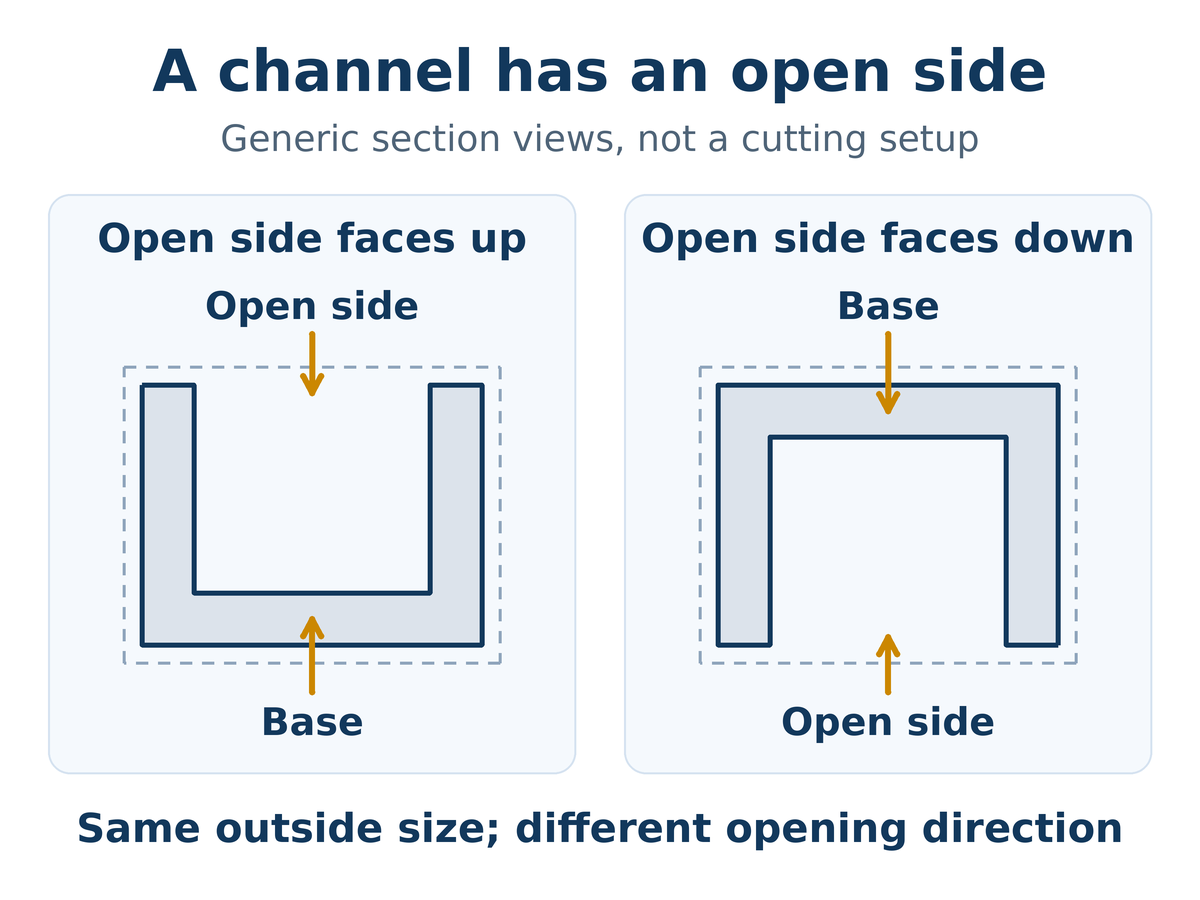
Start the drawing at the carrier path, not at the outside width
A workable vertical blind headrail cutting RFQ identifies the approved profile code and revision, extrusion material and finish, visible face, open-channel direction, stock length and finished cut length. It also names the mating carrier, end cap, control side, mounting bracket and any valance interface. Mark the datum used to measure length: the aluminum end faces, a bracket reference, or an assembled outside dimension. Those are different measurements. Do not convert one to another using a generic allowance.
On a section view, highlight the internal running surfaces and the surfaces that locate the end components. A supplier can then check whether a proposed clamp touches a visible face or squeezes the channel lips. If the part is already drilled, punched or fitted, mark each feature’s required distance from the retained end. A saw length that is correct relative to the wrong end will move every downstream interface.
LEVOLOR’s vertical-blind installation instructions distinguish inside and outside mounting, show valance clips engaging the top channel, and direct installers to check that vanes move smoothly in both directions. Those details illustrate the types of interfaces a system owner may need to verify. Do not copy LEVOLOR’s clip spacing, dimensions or assembly method into an unrelated system.
What vertical blind headrail cutting can change
In vertical blind headrail cutting, the saw does not make the rotation mechanism, but its cut can affect that mechanism’s boundary. Inspect the cut end for a burr protruding into the carrier channel, a folded lip, crushed or spread walls, chips trapped in the track, finish damage on the visible face and a cut angle that prevents the intended end part from seating. State which of these conditions the saw supplier must control and which are handled by later cleaning or assembly operations.
A simple pass/fail sheet is more useful than a claim of “burr-free cutting.” Photograph the actual cut end and note the surface or channel where a defect appears. Measure the agreed overall length and end geometry with the agreed method. Then use the approved carrier and end component to check clearance. A clean-looking outside face cannot prove that the hidden travel path is clear.

A two-stage trial prevents a false pass
Stage 1: release the blank
For a vertical blind headrail cutting trial, use actual stock from the approved headrail family, including the intended finish if appearance matters. Record the extrusion lot, section revision, retained face, cutting direction, blade and fixture used in the trial. Cut at least the representative short and long lengths from the proposed production mix. Check length from the agreed datum, end squareness or angle, open-channel shape, visible-face condition and loose chips. If the material bows or the section changes along a bar, include a piece from the condition that creates the greatest handling problem; do not assume one short coupon represents a full stock bar.
Stage 2: release the system interface
Hand the accepted blanks to the system assembler. With the approved parts and procedure, confirm that the first and last carriers can travel over the intended range, the tilt/rotation action works across the vane set, the end component seats and the specified mounting and valance parts still engage. Record any fit failure against the exact profile end and component. This is an assembly test by the system owner, not a circular-saw performance number.
If the system owner supplies only a loose extrusion and will not provide mating parts, the saw trial can release only the blank criteria. Put the later functional check on the assembler’s inspection plan rather than declaring the cut part a proven blind assembly.
Do not shorten an assembled track by assumption
Cutting a populated headrail may encounter carriers, a drive element, end stops or control hardware inside it. Whether a particular assembly can be shortened, and at which end, belongs to its manufacturer’s service instructions. Hunter Douglas’s guidance on legacy tracks is a useful warning that even replacement components may not interchange across track families. When the approved service route is unknown, quote a new compatible assembly or obtain the system owner’s written shortening procedure before cutting.
What to send with a vertical blind headrail cutting RFQ
Send the approved section drawing and revision, headrail family, material and finish, raw-bar length, finished lengths and quantities, retained end and control side, visible surfaces, any pre-existing holes or features, and the exact blank acceptance method. State whether the supplier is providing only cut blanks, prepared members or a tested assembly. Include photos or samples of the mating carrier, end cap and bracket if their fit is part of acceptance. Ask who supplies trial stock and who signs off the functional test.
For a saw purchase, add the production mix: smallest and largest sections, short and long cuts, batch quantities, changeover frequency and handling constraints. JiurunCut can review a representative aluminum profile and cutting list to discuss the saw, feed and clamp direction. The recommendation must be checked against the approved blind-system parts, not inferred from a generic track photo.
Next step: send JiurunCut the headrail section drawing, cut list and a marked photo of the carrier opening and visible face. State the blank criteria and identify the assembler responsible for the vane movement test. Request a machine configuration review for the actual profile and output requirement.
Related machine demonstration
The following video from Jiurun’s own channel shows a semi-automatic aluminum saw and its work area. It is a general equipment demonstration; it does not show this vertical-blind headrail, an approved fixture, the named system’s carriers, a trial result or a performance guarantee.