
For telescoping aluminum tube cutting, release the inner and outer tube lengths as a pair tied to the design’s approved overlap. The required extended span alone does not identify either cut length. Changing one tube to simplify purchasing can change the assembled relationship even when the desired reach stays the same.
Telescoping aluminum tube cutting starts with the assembly span
A purchasing description such as an extendable support can name the final reach while leaving the individual tube requirements unanswered. Keep the extended assembly span, each tube body’s length and the overlap at that extension distinct. This discussion concerns those axial dimensions, not whether two sections slide together.
Testrite’s OEM brochure discusses stops and overlap within its telescopic assemblies and records opened and closed lengths separately in its worksheet. It does not turn an overall assembly length into one universally applicable tube-cut dimension.
Hypothetical purchasing example: a factory has two released designs for a two-tube assembly. The design approvals are assumptions for this invented case, not actual engineering reviews or customer records. Their load basis is not supplied, and the example establishes no equivalence in strength, stiffness or suitability.
Both tubes are straight and coaxial. The example’s span runs between the extreme axial end faces of the tube bodies themselves; it excludes projections from caps, collars and connectors. At the specified extension, the inner and outer bodies overlap by O. Calling this tube-body span E, their lengths L_outer and L_inner give:
E = L_outer + L_inner − O. The shared axial region is counted in both individual lengths, so it is subtracted once. This is the geometry of the stated two-segment model, not a manufacturer’s rule for designing a telescopic product.
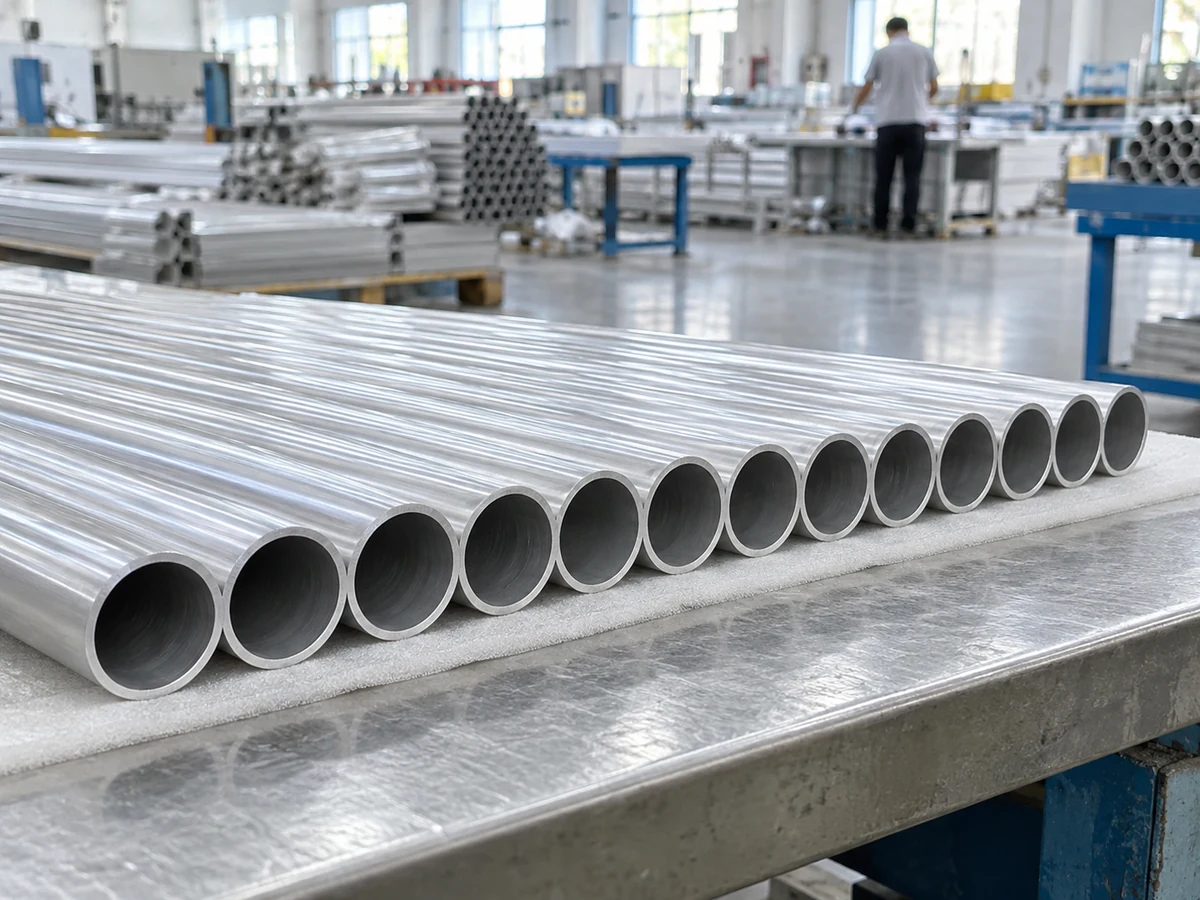
The same reach can require a different inner tube
Every dimension here is fictional. The overlap values are assumed inputs from the imagined approved designs, not recommended amounts. None of the lengths is a JiurunCut capacity, setting, measured result or machining recommendation.
Design A uses an outer tube body of 1000 mm and an inner body of 800 mm, with 200 mm of overlap at the specified extension. Its tube-body span is therefore 1000 + 800 − 200 = 1600 mm.
Design B keeps the 1000 mm outer tube and the same 1600 mm span, but its approved overlap is 300 mm. The corresponding inner tube is 900 mm: 1000 + 900 − 300 = 1600 mm.
The extra inner-tube length in B does not create extra reach in this example. It preserves B’s different overlap while reaching the same endpoint. A purchase line saying only 1600 mm telescopic assembly cannot tell the cutting supplier whether the intended inner component is 800 or 900 mm.
If A’s shorter inner tube were allocated to B, retaining B’s overlap would not give the specified span. Reducing the overlap to recover the span would instead change B’s approved relationship. This is a mismatch in the released requirements, not an instruction to extend the tube differently or a reason to alter the design.
Keep the approved pair identifiable through production
The fictional designs can share their stated outer-tube length, but not their inner-tube length. Do not merge the latter merely because the assemblies have the same extended-span description. The purchasing distinction is the component pair, not a new sorting or inventory system.
| Design being supplied | Released tube-body lengths and overlap basis | Consequence of treating unlike requirements as one |
|---|---|---|
| A — hypothetical two-tube design | Outer 1000 mm; inner 800 mm; overlap 200 mm at the stated 1600 mm span. | The assembly-span description must not replace the two component lengths in the cutting request. |
| B — hypothetical two-tube design | Outer 1000 mm; inner 900 mm; overlap 300 mm at the same 1600 mm span. | Using A’s inner component would not preserve both B’s specified span and overlap. |
| Actual assembly with collars, end fittings or further tube sections | Use its approved assembly and component drawings; no values are assigned here. | The simple tube-body model cannot be carried over without confirming the real reference points and relationships. |
A tube can match its own cutting instruction yet be assigned to the wrong assembly. Keep the released component identity and length linked to A or B so the assembly team receives the intended pair. This states a production need; it does not imply the saw identifies, labels or pairs the components automatically.

Testrite Aluminum’s standard telescopic tubing page asks about fully open length and the required end connection separately. These are assembly-level purchasing considerations in that supplier’s range, not interchangeable values for a tube cut list.
Both documents belong to the Testrite manufacturer group. They are not independent tests of this example or JiurunCut equipment. For a real mechanism, working reach, tube-body span, travel and closed envelope may have different reference points. Obtain the applicable definitions rather than extending the simplified arithmetic to fittings or additional stages.
Buy a cutting route for the released design
Where A and B genuinely require different inner lengths, purchase those distinct cutting outputs. A common finished inner component is an option only if both designs expressly approve it. A longer shared intermediate blank leaves another length-defining operation; it is not the same purchase as two ready-length components.
Alternatively, ask the mechanism supplier whether it can provide the required matched components. That would move the supply boundary, not prove a particular service is available or remove the need for the approved design. Neither route is inherently cheaper or more reliable.

A focused buyer message can read:
Our two designs share an extended-span description but use different approved overlaps. Please address the paired inner and outer component lengths, not the assembly span as a single cut value. Identify the actual tube input and output covered by the offer, and leave any missing component definition for our responsible design party to resolve.
Send the released lengths with the real material, sections and end requirements for assessment of the cutting configuration. Correct cut lengths do not validate locking, loading or assembled function. Those remain separate design and assembly matters, not conclusions to draw from the example or a machine photograph.
Send the approved tube pair and cutting requirement
Share the inner and outer part drawings, actual sections, approved cut lengths and intended production quantity with JiurunCut. Identify unresolved end-work or assembly definitions before treating an overall reach as a cutting instruction.
Discuss My Approved Tube Lengths
Ask what can be assessed for the actual saw proposal. JiurunCut’s specific cutting suitability and pairing functions remain unverified; this article does not establish telescopic-mechanism design, manufacture or certification services.