
Snow guard rail cutting is often the wrong first line on a machine RFQ. A roof snow-retention assembly is specified as a system: rail or crossmember, splices, clamps or brackets, clips, finish pieces and a layout approved for the roof. Some current systems are deliberately supplied for assembly without cutting on the roof. Before pricing a saw, establish whether any separately supplied aluminum member is actually authorized to be cut, by whom, and at what stage. This guide compares a product-owner supplied kit with an approved factory cut-blank route. The photos and equipment video are related illustrations, not a snow-guard project or qualification test.
Snow guard rail cutting starts with the named system
Ask for the system manufacturer, product family, generation, part numbers and current installation instructions. “Snow guard rail” is not a material specification. A rail in one family can be steel, while another family has aluminum and stainless components. The attachment and splice rules belong to the selected product. The roof designer and system supplier must determine the appropriate snow-retention layout for the panel, support and site conditions; a metal-saw supplier cannot infer structural performance from a rail section.
S-5!’s ColorGard 2.0 product information provides a concrete decision example. The manufacturer describes aluminum and stainless components, punched and unpunched crossmembers, internal splices and a design intended to eliminate preassembly and in-field cutting. Its punched and unpunched members install in 7 ft 8 in lengths according to that product page. Those details identify ColorGard 2.0, not a generic snow rail, a Jiurun machine specification or authorization to cut this product in a factory. Do not transfer an older product’s instructions to the current generation.
Another product family may use a different metal, mount and approved adjustment method. Canada Snow Guards’ product-specific instructions index illustrates why buyers should obtain the actual guide, cut sheet and roof-specific details rather than assuming a common rule for all snow bars. If the selected supplier’s current system requires no field cutting, keep the supply route intact unless the product owner gives written, product-specific approval for a proposed modification. A catalog picture or clean sample cut is not that approval.
Turn the roof layout into an assembly bill, then test whether cuts remain
The roof plan usually shows a run, not a saw list. Identify the roof panel profile, seam spacing, design load basis, eave and pedestrian exposure, approved clamp or bracket, number and location of rows, and any transition or termination. Have the system designer release the bill of materials and installation layout. On the member schedule, number each run and mark the standard rail sections, splices, clips, color strips, terminations and any specified gaps. Record revision and direction so site crews receive the same scheme that was priced.
For ColorGard 2.0, S-5! differentiates punched crossmembers with regularly spaced slots from unpunched crossmembers that accommodate other seam spacing, and it describes the splice as maintaining continuity and allowing thermal movement. A cut placed through a slot or a splice position could change the intended assembly. The buyer should ask the system supplier to resolve end conditions and the exact bill of materials. Never compute a universal deduction from the roof-run length or move a splice simply to improve saw yield. A standardized system may use its stock lengths and included splices without a cut operation at all.
Separate the complete snow-retention kit cost from the metal-cutting cost. The kit quote should include identified members and accessories, approved layout support, packing and installation documents. Only if the system owner permits a cut-blank route should the manufacturing quote include a saw operation. Then define exactly which member is delivered for cutting: unfinished extrusion, finished crossmember, steel bar, decorative strip or an unrelated support. Jiurun supplies industrial aluminum and nonferrous circular-saw equipment; a steel snow bar or an assembled proprietary roof kit is outside an assumed aluminum-profile saw scope.
Three procurement routes with different acceptance points
Route A: buy the complete specified kit. This is the natural baseline where the selected system provides prefabricated members, compatible splices and product-specific installation instructions. The buyer receives a labeled assembly package and a manufacturer-defined method. Ask whether a standard kit accommodates the drawn run and who resolves any nonstandard termination. Do not add a machine merely because the roof plan has an irregular dimension.
Route B: supplier-approved adjustment. Some systems may allow a limited site or shop adjustment under their own instructions. Obtain the exact product, permitted tool and cut location, required edge treatment, inspection and warranty position in writing. Assign a qualified installer or fabricator to that method. “Can be cut” is incomplete without defining the material, finish, permitted end condition and next assembly step.
Route C: a separate factory cut-blank process. Explore this only for a repeatable eligible aluminum input that the system owner explicitly permits to be saw-cut. The factory may supply lengths to a downstream roof-system assembler, not finished snow protection. Price support fixtures, first-off approval, inspection, scrap and protected transport. The system designer still approves the complete roof layout, attachment, structural performance and installation. Machine qualification is limited to the tested metal blank and documented configuration.
Compare all three routes at the same handoff boundary. A cheap per-cut price cannot be compared directly with a system kit that includes compatible splices and job-specific documentation. Count setup labor, approved offcut recovery, rejects, labeling, transport damage and responsibility for a failed fit. The least expensive route on paper may require the greatest amount of unpriced coordination.
Release a real aluminum cut-blank specification if Route C is permitted
A useful RFQ identifies alloy and temper if known, supplied section drawing, wall thickness, overall profile envelope, incoming length, finish, slots or holes, requested cut lengths and quantities by batch. Provide a physical sample and drawing revision. State which end is the datum, whether the end must be square or a specifically released shape, and how measurement changes after coating, deburring or assembly. Do not infer angle cuts from a sloped roof or from a generic rail photo; the product owner’s end geometry controls. For the exact variant, specify whether cut ends are visible, hidden under a connector, or adjacent to a clip.
For a genuine aluminum rail profile, the machine bidder needs its contact faces and unsupported length. Long stock needs stable infeed and outfeed support; the clamp must not crush a hollow section or mark a decorative face. Slots or a color-strip channel can interrupt what appears to be a flat gripping surface. Short end pieces need a safe stop, clamping and removal plan. Ask the bidder to document the blade, guarding, fixture, support method, chip collection and operator workflow used in a supervised sample trial. No catalog work envelope alone establishes suitability.

Do not assume that the machine in the related photo is the machine that will process a roof product. A trial must use the actual authorized rail or blank. For a proprietary finished crossmember, the supplier may prohibit any saw operation. Obtain that decision before asking a machine vendor for settings or cycle time.
Inspect the end as a mating part, not just a length
Agree the first-off criteria before cutting. Measure length from the named datum and verify the requested end direction and squareness or angle. Inspect burrs, deformation, finish damage, chips trapped in channels, remaining slot and hole geometry, and the actual connection to a manufacturer-approved splice or accessory. If the assembly needs a color strip, test that interface as well. Record sample identification, incoming condition, tested setup, measured results and disposition of rejects. Return any conflict between nominal length and connector fit to the drawing owner rather than silently changing the stop position.
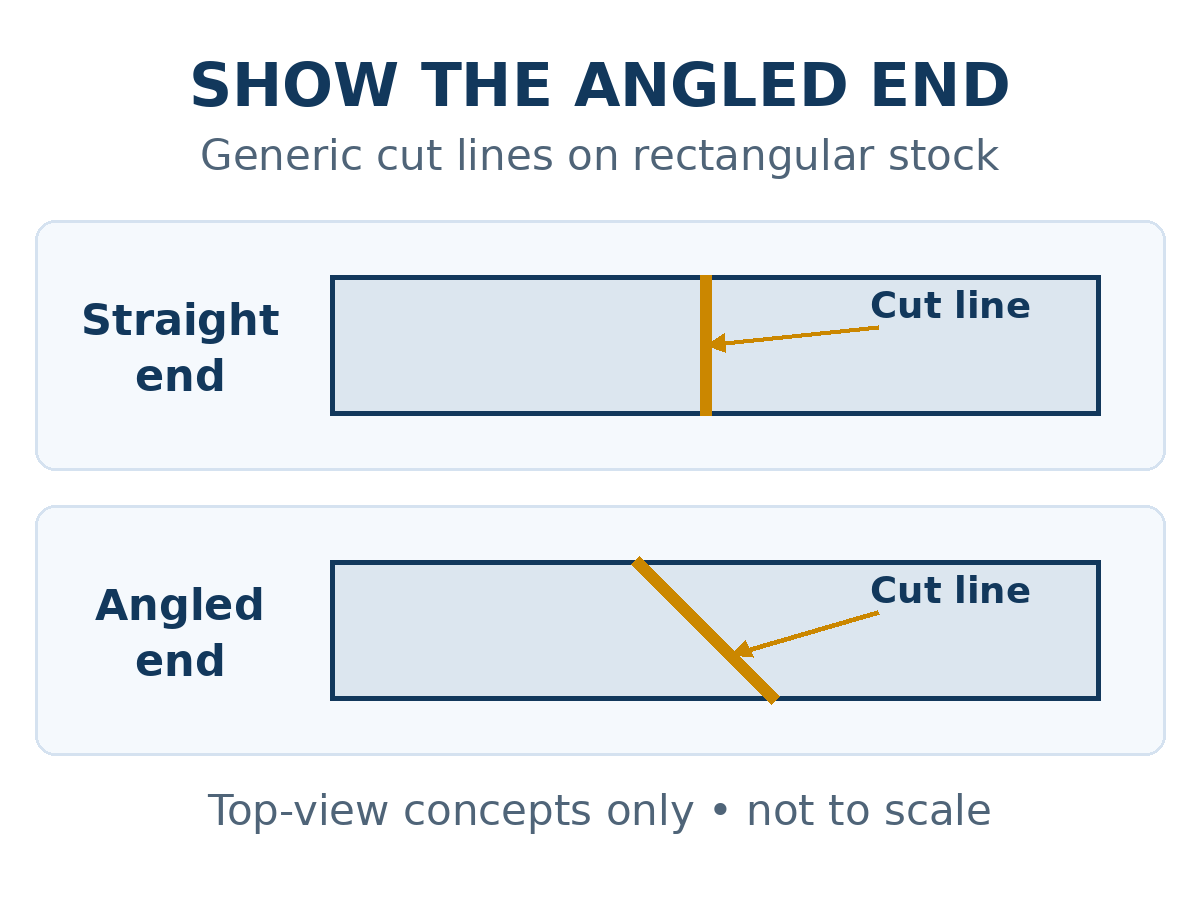
A square end and an angled end are separate drawing instructions, not interchangeable visual styles. The generic top-view diagram above illustrates that distinction; it is not a real snow-rail section, a released end detail or a recommendation to miter ColorGard 2.0. The approved roof system decides the end. A rail can pass a factory length check yet fail when its splice, clip or finish strip is fitted. That is why the inspection boundary must include the next component interface.

The conveyor profiles above show why “rail” is too broad for a quotation. Similar-looking long extrusions can have different section walls, channels and mating details. Send the actual rail section and product code; do not substitute this image as the workpiece. Once the first-off part is accepted, keep batch traceability to the same drawing and setup. If stock source or product revision changes, assess whether the first-off approval still applies.
Package and hand off the right kit to the roof team
Label accepted cut blanks by product, revision, roof run and length. Protect coated faces and cut ends from rubbing in transit, segregate rejected or unapproved pieces, and keep compatible splices, clips and brackets with the installation package. The roof installer should receive the manufacturer instructions and the released layout, not just a bundle of cut metal. Any site modification remains under the product owner’s method and the qualified installer’s control. Factory inspection of aluminum ends cannot verify snow load resistance, roof waterproofing or bracket attachment.
Ask bidders to state exclusions prominently: structural design, clamp selection, roof panel compatibility, installation, permits and warranties belong to the appropriate system and project parties. A saw proposal should identify precisely the tested blank and operation. A complete kit proposal should identify exactly which components and support are included. Keeping those scopes distinct protects the buyer from paying for a machine operation that a no-cut kit already removes.
Video: related aluminum-cutting equipment, not snow-rail evidence
The following Jiurun Machinery channel video shows an industrial aluminum cutting machine. It is a visual reference for discussing stock support and a supervised first-off, not a ColorGard 2.0 demonstration, snow-guard installation, approved cut method, customer order or structural test. The product owner must authorize a cut before any proposed roof member is trialed.
Send a decision-ready snow guard rail RFQ
Send the system name and generation, roof panel and approved layout, product-specific installation guide, bill of materials, rail section and finish, required termination details, quantities, route under consideration, and the written approval for any proposed cutting. If a factory aluminum blank is genuinely within scope, include samples and ask for a documented first-off and fixture plan. Otherwise, compare complete no-cut or supplier-prepared kits on their delivered assembly value.
For a permissible aluminum cutting stage, send Jiurun the authorized sample, released cut list and acceptance criteria for a machine assessment. If you have only a roof run dimension, begin with the snow-retention system supplier and roof designer. A saw quotation should follow their resolved product and layout decisions, not substitute for them.