
Ski carrier aluminum profile cutting is only one possible part of a complete winter-sports carrier order. A buyer may need cut aluminum arm blanks, a prepared carrier pair with grips and locks, or a finished kit that also includes roof-bar mounting hardware. These are different supply objects. Before asking for a saw trial or a price per cut, identify the product revision, each aluminum member, its mating parts, and the inspection that will release it.
Real products show why the boundary matters. Dometic describes an aluminum ski and snowboard carrier with a sliding base and T-slot roof-rack mounting. Škoda lists an anodized-aluminum carrier supplied as a two-piece set with T-groove fasteners and installation instructions. Neither product page is a manufacturing drawing for Jiurun or proof that its particular carrier bars are cut by the machine shown below. They demonstrate that the carrier body, vehicle load bar, and mounting kit must be named separately in an RFQ.
Separate the carrier bar from the roof crossbar
The roof crossbar belongs to the vehicle rack system. The ski carrier mounts to it; its upper and lower gripping members, sliding features, end covers, lock parts, rubber contact surfaces, and mounting feet can form a different bill of materials. A drawing for the crossbar T-slot must not be substituted for a drawing for a carrier arm. The same word “bar” may describe both in a supplier email. Label every sketch and photo with its assembly level, part number, revision, and position.
First decide whether the supplier is quoting raw cut blanks, prepared members, or a complete carrier pair. A raw blank quotation covers only approved stock, cut length, and cut-end condition. Drilling, machining, coating, rubber insertion, hinges, locks, fasteners, fit validation, and vehicle installation belong to named later operations unless the quotation expressly includes them. A finished retail carrier and a cut extrusion are not interchangeable purchasing units.
Release the actual section and member schedule
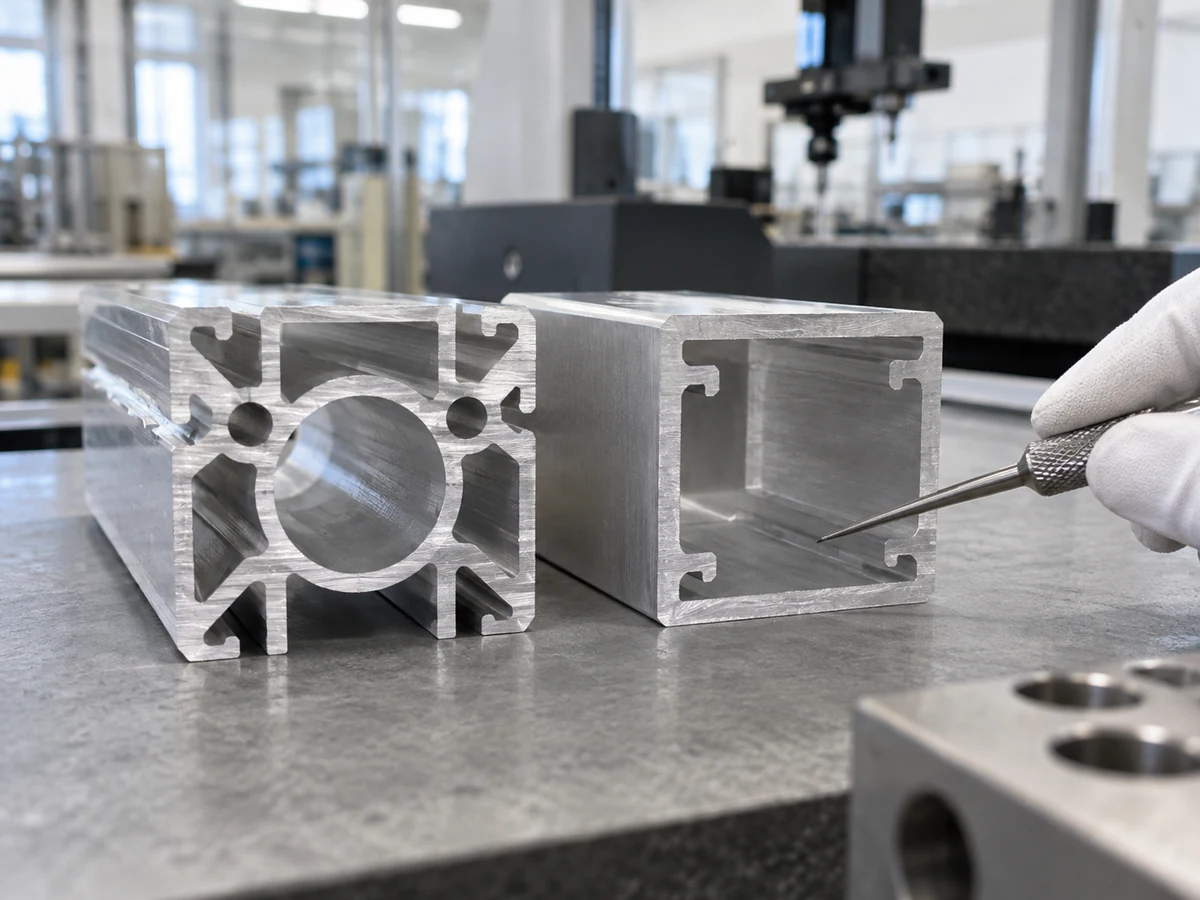
For each member that really is aluminum, supply an approved section drawing or representative sample. Identify material and finish from the product specification, open or closed cavities, visible face, grip channel, mounting feature, and any asymmetric orientation. If the carrier uses a different profile for its upper and lower halves, issue distinct line items. Include incoming stock length, finished cut length, quantities per carrier pair, batch quantity, and the revision that controls the order.
Define the datum before a tolerance. If one end receives a hinge, stop, or lock housing, show whether length is measured from that feature, the opposite cut face, or a fixture reference. Specify which ends remain visible and which are concealed by approved caps. State the required squareness or angle and inspection method from the assembly drawing. Do not copy a saw brochure accuracy into the acceptance drawing: feed repeatability, cut-length variation, and final carrier fit are separate measures.

Treat rubber, latch, and roof mounting as interfaces
A ski or snowboard carrier must interface with its own grip material and closure mechanism, and its mounting hardware must interface with the approved roof-bar system. A cut end that looks clean can still prevent an end cap from seating, interfere with a hinge or lock housing, or expose a cosmetic edge. Ask the product owner to mark keep-out and contact zones on the section drawing. The saw supplier can then propose support and clamp positions for the stock actually supplied.
Keep the roof-bar mounting test separate. A T-slot, clamp, or adapter shown in a consumer product description tells the buyer which interface to verify, but it does not establish the slot size or fastener for another model. Have the carrier maker confirm the approved load-bar family, mounting parts, installation instructions, and finished assembly checks. Vehicle compatibility, load rating, retention, and road-use approval remain with the carrier and vehicle-system owner; a saw-cut sample cannot certify them.
Plan the cut route around the finished surface
Ask whether aluminum stock arrives bare, anodized, painted, or otherwise finished. A finished visible face calls for agreed support pads, clamp contact, chip control, part separation, and packaging. If finishing follows cutting, specify who owns edge preparation and whether the final cut face must meet a coating requirement. The cutting process should be reviewed against real stock length and section geometry, especially when a thin wall, open slot, or internal feature could deform under clamping.
For a mixed run, show how the operator distinguishes upper from lower members and short from long carrier versions. Sequence changeovers by released part number, identify the first piece after each setup, and separate accepted material from trial pieces. A single overall “carrier bar” output count hides whether complete matched pairs can actually be assembled. Quote expected yield and labor only from an agreed trial and actual production assumptions, not from an illustrative video.
Use a first-article kit to close the quotation
For each distinct section and end condition, request a first-article cut set. Inspect the agreed length datum, both ends, burr and edge condition, visible finish, and whether protected surfaces were marked. Then the carrier manufacturer should assemble those pieces with the actual rubber, hinge, lock, end cover, and mounting hardware. Record fit, closure, sliding movement where applicable, and any interference. The cut-part supplier records its dimensions and process; the carrier owner decides whether the complete product passes its design checks.
Document any correction as a revision, not an informal instruction to “trim until it works.” If fit fails, distinguish an incorrect blank length from a wrong section, a later machining error, a finish build issue, or a mismatched mounting kit. Repeating the cut without that diagnosis can waste stock and still leave an unsafe or unusable assembly. Keep the approved sample, drawing, inspection plan, and packing instruction tied to one revision.
Compare offers at the same supply boundary
Compare a cut-blank offer with another cut-blank offer only after both include the same stock condition, sections, lengths, inspection, protection, and delivery unit. If one vendor quotes a prepared member with holes and installed grips while another quotes an unmachined extrusion, add the excluded operations and responsibilities before comparing price. A complete-carrier quote also includes product validation and hardware that a saw-cut-part quotation does not.
A useful purchase order states who supplies the extrusion, who owns offcuts and scrap, which party approves first articles, who inserts rubber or installs locks, how matched pairs are packed, and what happens if a part is rejected at assembly. Ask for an itemized carrier kit: upper and lower member IDs, handed or symmetric variants, approved mounting set, spare end covers, finish, and quantity per box. This turns a generic per-cut price into an executable supply agreement.
Ski carrier aluminum profile cutting RFQ checklist
- Product family, revision, carrier pair and roof-bar interface identified separately.
- Released section drawing or sample for every aluminum member, with material, finish and visible face.
- Incoming stock and finished lengths, datums, end conditions and quantities per pair.
- Clamp and support contact zones, open-slot protection, burr and appearance requirements.
- Named ownership of drilling, coating, rubber, hinges, locks, caps and mounting hardware.
- First-article dimensions and assembly fit with the actual mating parts.
- Matched-pair labels, packaging protection, acceptance records and revision control.
Related aluminum cutting equipment demonstration
This video from Jiurun Machinery’s own channel shows a long aluminum extrusion on the infeed of an automatic cutting machine. It is a related equipment view for discussing support and feeding. It does not show a ski-carrier part, the approved section, a vehicle fit check, or a verified rate or accuracy for this RFQ.
What to send Jiurun for a cutting review
Send the actual aluminum section drawing, stock and finished lengths, end-condition schedule, finish stage, expected batch quantities, and marked support faces. Add photos of the carrier assembly and roof-bar interface so the cutting task is not confused with the complete rack. Jiurun can review a cutting-equipment and workholding approach against the released input. The carrier manufacturer must still approve product fit, retention, load and vehicle compatibility. See our industrial aluminum profile cutting overview and send the drawings for a specific review.
Frequently asked questions
Is the roof crossbar the same part as the ski-carrier bar?
No. The crossbar supports accessories on the vehicle, while the carrier has its own gripping and mounting components. Use separate drawings and item numbers even when both contain aluminum.
Can a clean cut-end photo prove the carrier will close and lock?
No. It can inform cut-face inspection. Closure and retention need a representative assembly with the actual grip, hinge, lock, end cover and approved mounting parts.
Should every upper and lower member share one cut length?
Only if the released carrier drawing confirms it. Variants, handed parts and different carrier capacities can change the member schedule.