
Sailboat boom extrusion cutting begins with the approved aluminum section and the precise stage at which the buyer wants a saw-cut blank. A finished boom may also contain end fittings, sail-groove hardware, outhaul and reefing components, holes, fasteners and a finish. A saw quotation cannot treat the complete rig component as one length of generic aluminum stock.
This guide gives sailboat rig manufacturers, extrusion suppliers and contract fabricators seven checks for an RFQ. It helps define what a cutting trial can demonstrate and what the boom designer or assembler must approve later. No photograph or video below depicts an approved sailboat boom, customer order or tested boom-cutting configuration.
1. State the purchased stage before naming a length
Ask whether the purchase is for raw stock, a straight saw-cut extrusion blank, a blank with later drilling and machining, or a fully assembled boom. Record the handoff stage on the drawing and purchase order. A saw supplier can review a blank cut from approved stock; it cannot infer the size of that blank from a finished boom advertised to sailors.
As a manufacturer example, Seldén describes boom extrusions and a range of reefing and outhaul arrangements. Its example shows why the boom is a system with different configurations. It is not a specification for JiurunCut equipment or for another OEM’s boom.
2. Release the actual section, sail groove and datums
Send the controlled cross-section drawing and revision, extrusion supplier, alloy and temper, surface condition, stock length, and any straightness or twist limit that the designer specifies. Mark the sail groove, top and bottom, protected visible faces, and the datum that must face the feed or clamp. State whether the two ends are interchangeable. A section name alone is insufficient if the opening, internal webs, wall thickness or end interfaces have changed across revisions.
The Seldén boom-section reference illustrates that sail grooves and end constructions vary across boom sections. Use a product catalogue to identify questions; use the OEM’s released drawing to set the actual acceptance criteria. A rectangular industrial T-slot profile is not an interchangeable boom section.

3. Separate overall boom length from the saw blank
Define the measurement from a named end face and datum, then state the cut-blank length and tolerance for every variant. Identify any extra stock needed for later end preparation and any trim required to remove an extrusion start or end defect. Specify whether the saw face becomes a final accepted face or is intentionally left for a later operation. If an inboard or outboard fitting changes the finished overall length, record that separately.
For a mixed-length order, list incoming bar length, each blank length, quantity, allowed nesting pattern, kerf allowance and any minimum usable remnant. Do not let a low material-loss estimate silently change the approved blank dimension. If the route includes a second trim or end machining, show which party owns that step.
4. Review support, clamp and finish protection on a real sample
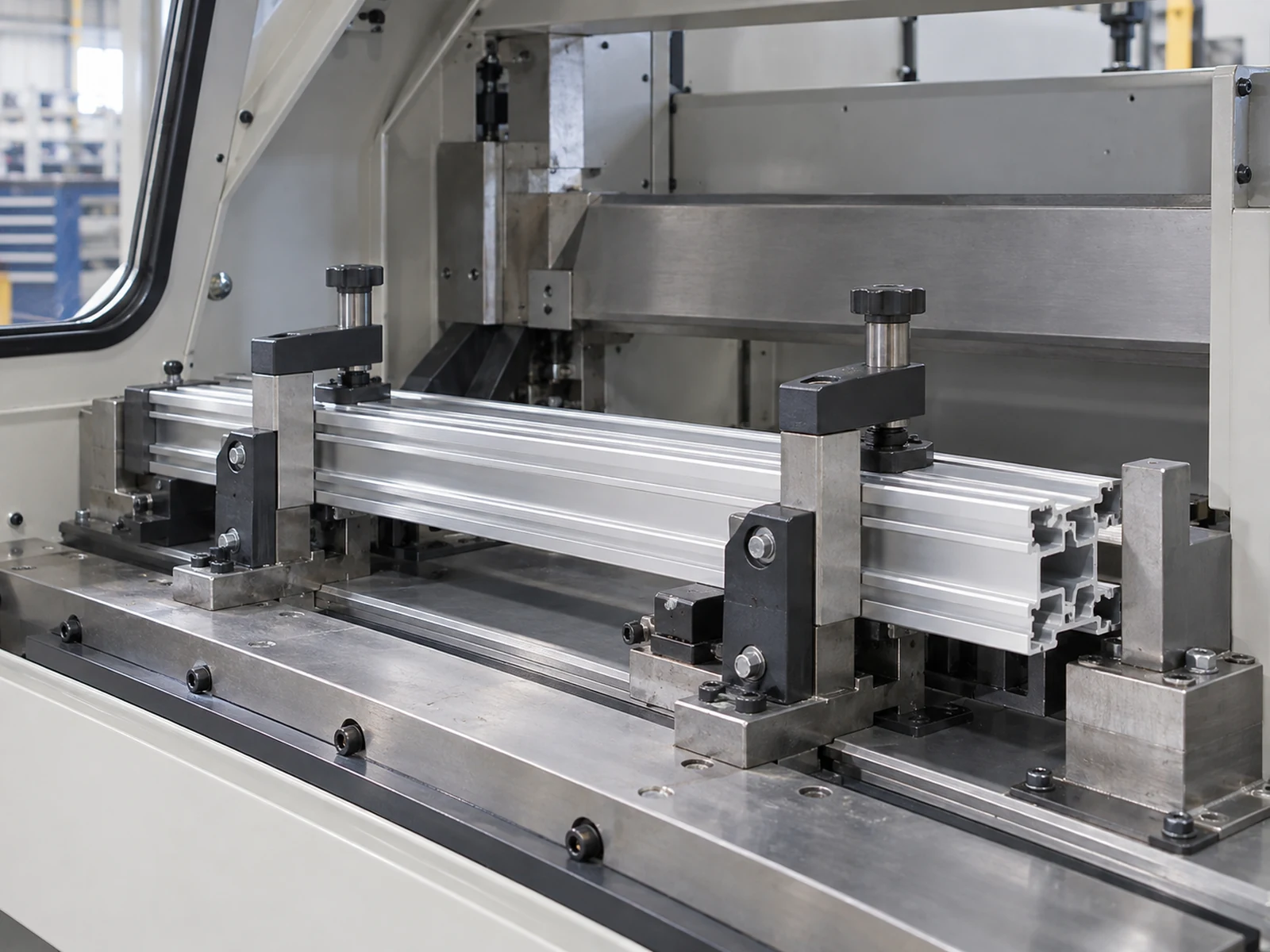
A deep or grooved boom extrusion may need different support from a common square tube. The proposed infeed, saw fixture and outfeed must prevent rotation while protecting the sail groove and visible finish. Review the actual section sample for clamp contact, unsupported span, extrusion bow, handling direction, and how the cut piece is removed. Ask the equipment supplier to confirm its guarded working range and fixture concept against the sample before specifying a machine model.
For sailboat boom extrusion cutting, a trial should record where the approved stock rests and where force is applied. If a clamp marks a finished face or distorts a thin wall, revise the support or the approved process before treating length repeatability as success. Do not transfer a result from a different profile, blade or clamp to the boom drawing.
5. Agree on cut-face and burr acceptance
Length alone does not make a useful boom blank. The buyer should define squareness or angle where needed, visible edge condition, burr limit at the sail groove and fitting interfaces, surface marks, and the measurement method. State whether deburring, cleaning and protective packing belong in the saw quotation. A sharp edge near a sail-contact surface may be unacceptable even when a length gauge passes.
Use first-off pieces and repeat samples from the approved material lot. Photograph both ends, note orientation and record any adjustment between samples. Inspection should compare the agreed blank stage with its drawing; it should not make claims about the later assembled boom’s strength or sailing behavior.
6. Keep fitting, rigging and structural approval with the responsible party
Mark which work follows cutting: fitting pockets or end machining, drilling, attachment points, coating, installing outhaul or reefing hardware, and assembly. A clean saw-cut blank does not establish gooseneck fit, vang or mainsheet attachment strength, corrosion resistance, fatigue life or safe rigging. Those decisions require the boom designer’s engineering and the assembler’s separate acceptance record.
If an OEM wants the saw cut to serve as a location reference for a later fitting, its drawing must say so. A fixture drawing, sample piece and responsible approver should travel with that requirement. Keep a revision record when section geometry or fitting design changes.
7. Quote the trial and production route on the same basis
A sailboat boom extrusion cutting quotation should name the actual input section, blank lengths, expected batch mix, feed and clamp method, inspection plan, protected surfaces, optional deburring, and material handling. Ask what is included in trial setup, tooling, operator actions, rejection handling and changeover. Compare proposals at the same handoff stage, not a bare saw-cycle claim against a fully inspected and packed blank.
The trial is a decision point: can the reviewed configuration cut the approved section into the specified blanks under the agreed checks? Record passes, adjustments and rejects without assigning an unverified accuracy or output number to the machine. If the buyer changes alloy, section, finish or tolerance, plan a fresh review.
What the Jiurun video shows
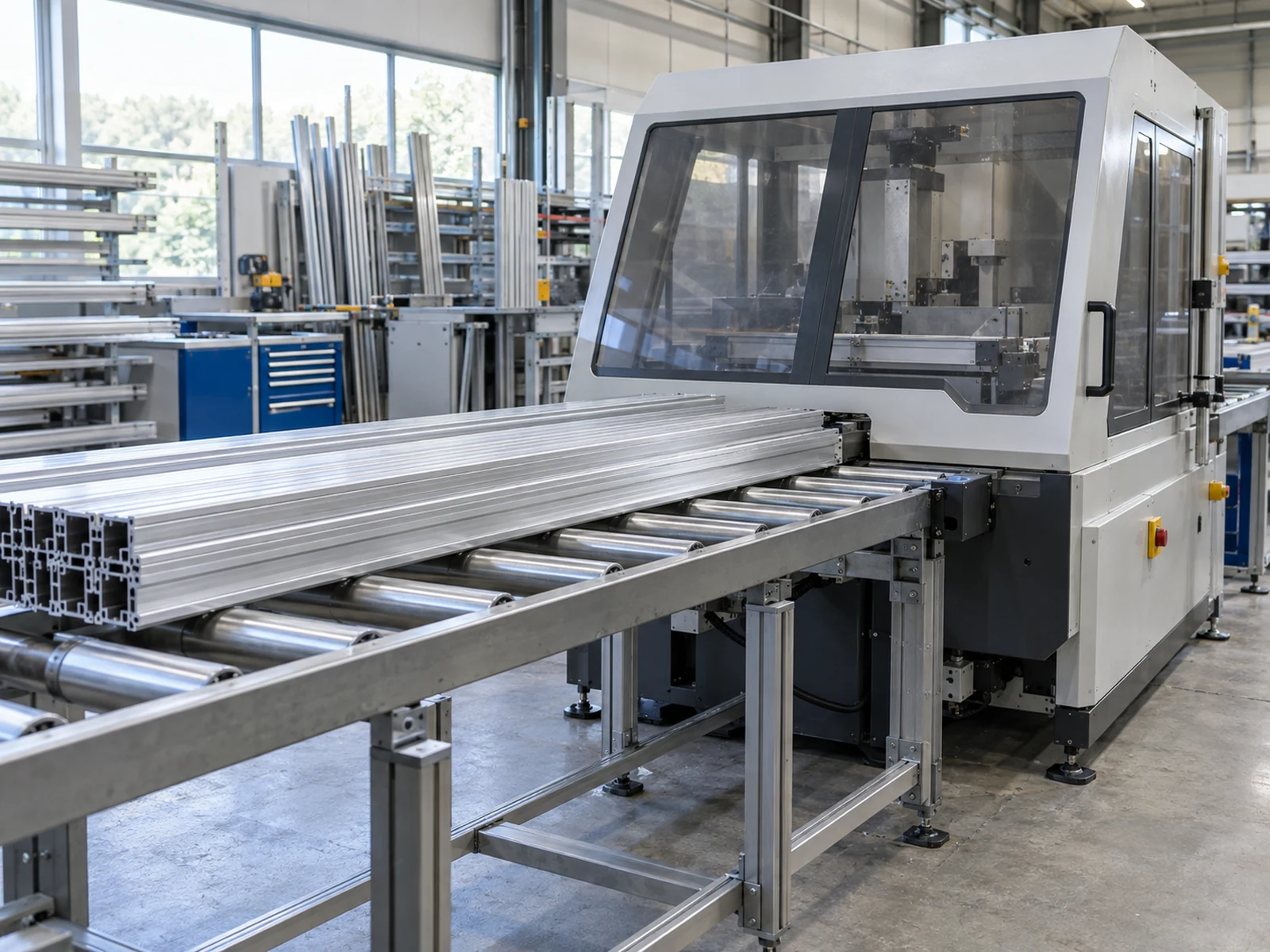
The Jiurun Machinery video below shows a long aluminum profile feeding toward a guarded automatic cutting machine. It is a general equipment and process view. It does not depict a sailboat boom extrusion, the fixture or machine configuration proposed for this RFQ, an OEM sample, or a verified performance result.
RFQ fields to send with a sailboat boom extrusion cutting inquiry
- Drawing and supply stage: Released section and blank drawings, revisions, and the exact saw handoff point.
- Material and incoming stock: Approved alloy, temper, supplier lot, surface condition, stock lengths and available samples.
- Orientation and interfaces: Sail-groove position, protected faces, datum, inboard/outboard end identity and later fitting allowance.
- Cut list and acceptance: Blank lengths, quantities, tolerance, end and burr criteria, measurement method and sample plan.
- Commercial boundary: Trial, tooling, handling, deburring and packing inclusions; excluded drilling, assembly and rigging approval.
Frequently asked questions
Can I quote from a finished boom length?
Use it to discuss the product, then request the released cut-blank dimension. End fittings and later operations can change the relationship between the two.
Does a clean sample cut approve the boom for sailing?
No. It supports acceptance of the specified saw blank only. The OEM must approve end fitting, assembly, structure and on-water suitability through its own process.
What if the section drawing is not ready?
Start a feasibility discussion with the actual extrusion sample and the intended handoff stage. Hold any definitive machine or cut-quality claim until the controlling drawing and acceptance method are agreed.
Next step: send JiurunCut the approved boom-section drawing and cut list, or identify what is still being designed. Include a real sample if available, the groove orientation, stock and blank lengths, surface condition, batch range and acceptance checklist. JiurunCut can then review a suitable saw-trial approach for those inputs.