
Round aluminum tube saw infeed is a purchasing problem that begins before the tube reaches the blade. A quotation may name a saw and a roller table, yet leave open how a bundle is presented, how one tube is separated, what keeps it from moving sideways, and who accepts the cut piece downstream. Those gaps affect the usable workflow even when the saw itself suits the nominal tube diameter.
This guide turns the complete material route into an RFQ and acceptance record. It addresses industrial circular-saw purchasing, not a claim that any pictured machine has a particular guard, support, load rating or safety performance. Ask the supplier to identify the actual ordered configuration, and have the site’s qualified personnel assess the handling arrangement against the real work and applicable requirements.

1. Start with the actual round-tube family
List each tube by outside diameter, wall, alloy or condition if relevant, starting length, maximum bundle quantity, cut-length range and end requirement. Keep the stock condition separate from the finished part: a quoted saw may accept one diameter while the incoming bundle, surface protection and replenishment method vary by job. Photograph the normal delivered pack and note whether tubes arrive nested, strapped, sleeved or loose. Do not use a single nominal diameter as a substitute for the whole handling problem.
For each family, record which party supplies the tube, where it waits, and the first controlled point at which an individual tube is presented to the infeed. A supplier can then state whether its quotation includes a storage rack, transfer aid, singulation device, roller support or only the saw. The buyer should also identify any existing equipment that must remain in service.
2. Separate storage, transfer and feeding
A warehouse rack, a staging position and an infeed roller bed perform different jobs. Draw the route from the delivery pack to the cut station, marking each pickup, set-down, turn and change in height. Record the longest stock that must be moved, the available approach direction and the people or equipment involved. A diagram of the proposed floor space is more useful than a statement that loading is “manual” or “automatic.”
For round stock, ask how each stage limits unintended rolling or spreading while material is stored, transferred and presented. Do not infer restraint from a photograph of tubes resting on rollers. The local safety review should assess the actual rack and handling method, including access for replenishment and the place where a tube can be stopped or recovered. The U.S. OSHA Materials Handling guidance discusses blocking and racking cylindrical stock; apply the rules and engineering assessment relevant to the installation site.
If a proposed aid is described as “automatic loading,” ask the supplier to identify exactly which transitions it performs. Does it receive a whole bundle, separate one tube, align it to a support, or only move a tube already placed at the feed line? Each answer changes what work remains with the operator.
3. Review the human handling task, not just the machine footprint
A round aluminum tube saw infeed can appear compact on a layout while requiring repeated reaches around a rack or across a roller table. Walk through a normal replenishment cycle with the proposed stock length and pack format. Note the points where a worker lifts, pushes, pulls, carries or turns the tube; whether an awkward reach or twist is necessary; and whether the same action repeats throughout a shift. Record the observation as a site task, not as a universal safe lifting weight.
NIOSH’s risk-factor guidance identifies force, repetition and posture as relevant to work-related musculoskeletal risks, and recommends observing the task and consulting workers. Its ergonomics program guidance points to matching work methods and equipment to the task. These U.S. resources help frame questions; they do not certify this saw, prescribe a site-specific lifting limit or replace local professional assessment.
Request a layout that shows the operator position, stock pickup point, transfer aid and replenishment path. If the planned method still depends on repeated manual transfers, ask what alternative support or assist can be evaluated. The buyer should specify which party provides that aid and who integrates it with the saw.
4. Define the support and rolling-control interface
At the infeed, the tube must move toward a repeatable reference without relying on a statement such as “standard rollers supplied.” Ask for a drawing of the support span, the feed-direction reference, side guidance or other approved restraint, and the transition into the saw. Check the smallest and largest tube in the actual mix. A support that looks suitable for one large tube may leave a different contact and guidance problem for smaller stock; a sketch or sample assessment is needed before accepting the configuration.
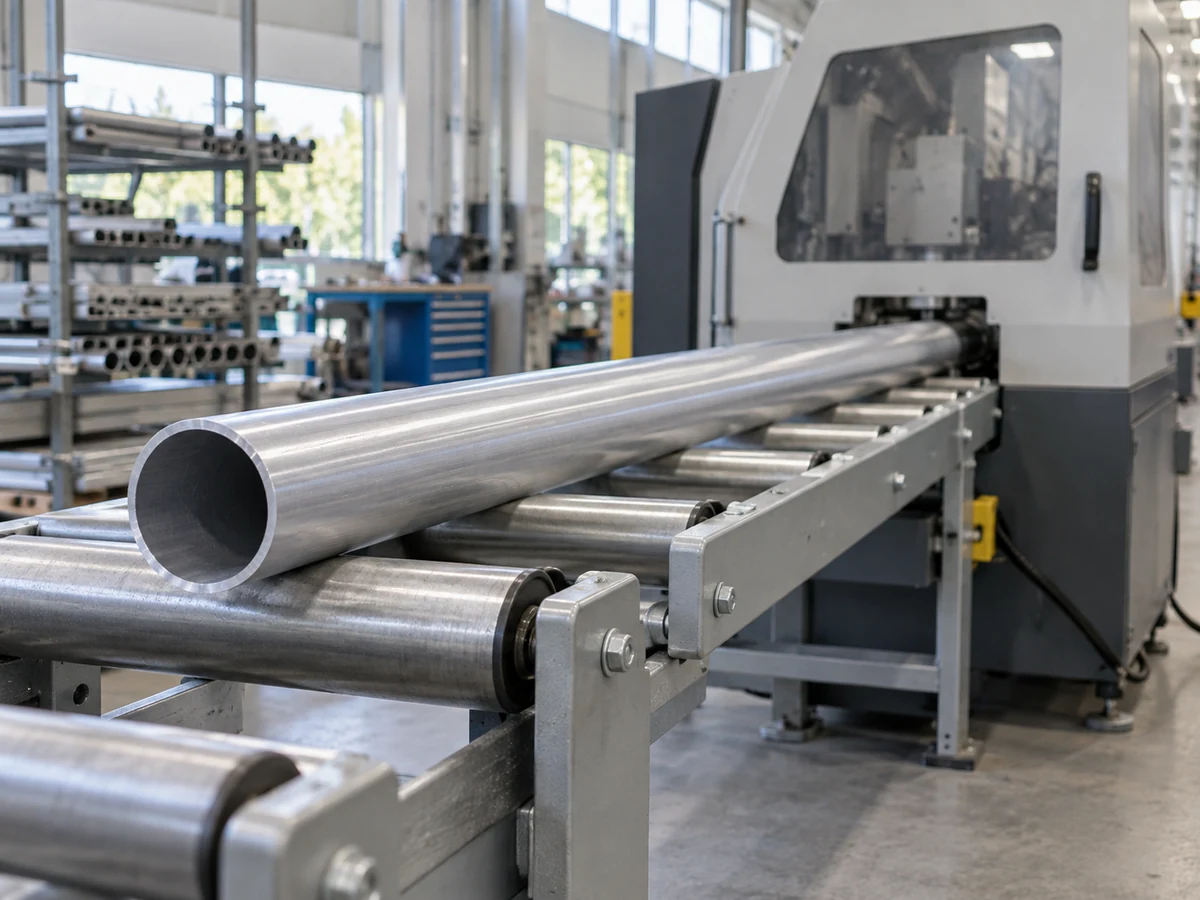
Ask the supplier to distinguish freely turning support rollers from driven feeding, and to explain where the tube is located before any feed motion begins. Request the limits of the quoted scope in writing: upstream table length, guides, stops, sensors, controls, transfer aid and guarding should each be marked included, optional or by others. Avoid turning a feed-position claim into a finished-part accuracy claim.
5. Confirm the cut-end and outfeed handover
The support plan must continue through the cut, not stop at the saw entrance. Record the shortest accepted piece, the longest accepted piece, whether a short offcut is produced, and where each exits. Ask how a round cut piece is retained or received at the outfeed and who removes it. Separate the intended product, remnant and scrap routes, especially when different lengths share one shift. The detailed requirement depends on the ordered configuration and the site’s safe operating method.
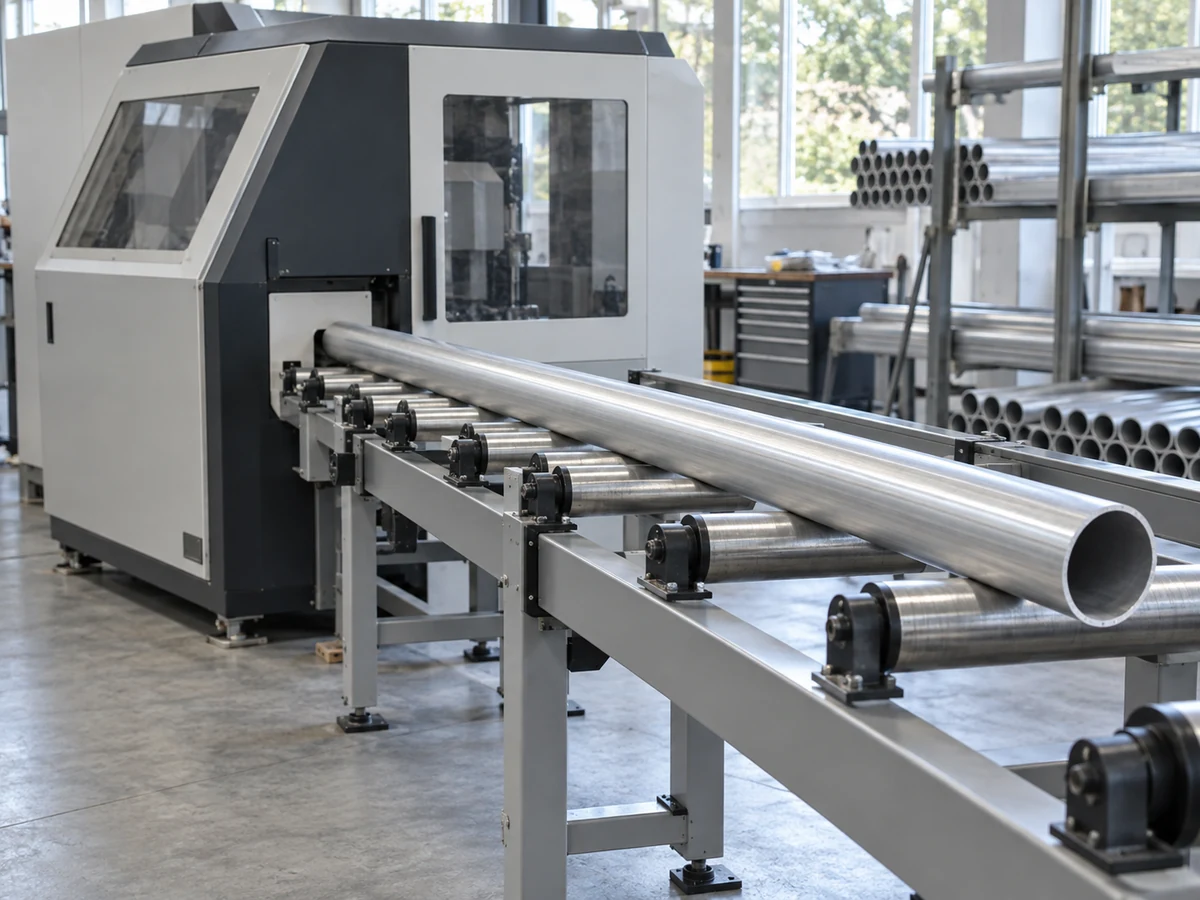
Link this review to the site’s separate shortest-piece outfeed question. A buyer should request evidence for the actual shortest piece rather than accepting a table length measured only for full-size stock.
6. Make the quotation and acceptance test observable
Attach a one-page tube-family record and a marked layout to the RFQ. Ask the supplier to return a scope matrix with a named owner for each interface: warehouse rack, stock transfer, staging, singulation, infeed support, feed motion, saw, outfeed support, finished-part pickup and remnant handling. This exposes omissions before a price comparison. Two quotations cannot be compared fairly when one includes a transfer device and another begins at a tube already positioned on the rollers.
For acceptance, agree on representative tubes from the actual range and a witnessed route from staged stock to accepted output. Define what will be demonstrated at the supplier site and what must be rechecked after installation. The record should identify the stock, the ordered devices, the operator role, the observed transitions and any unresolved action. Do not treat a short video, catalogue image or a trial on unrelated material as proof of the entire handling route.
Where a task involves lifting or awkward manual movement, the buyer’s site safety and ergonomics personnel should decide the assessment method and acceptance criteria. A machine quote can document equipment scope, but it cannot by itself establish that a site’s complete handling job is safe.
7. Copy these questions into the RFQ
- Which tube diameters, walls, lengths and pack formats were used to size the quoted infeed?
- Where does supplier responsibility begin: bundle, staged tube, or tube already placed at the feed line?
- What holds round stock at storage, transfer, presentation and outfeed, and which party supplies each device?
- Which infeed supports, guides, drives and controls are included in the exact quotation?
- What manual lifts, reaches, turns and repeated transfers remain after the quoted equipment is installed?
- How are the shortest cut piece, remnant and scrap received and removed?
- Which material families and handover steps will be witnessed at factory and site acceptance?
The practical decision is not simply whether a saw can cut a round tube. It is whether the supplier’s scope and the buyer’s site plan together cover every transfer and support point. For a configuration review, send Jiurun the tube-family list, starting lengths, pack photos, site layout and the proposed handover boundary through the contact page. We can discuss the saw and quoted accessories against that record; site-specific handling and safety approval remains with the appropriate local team.
Related equipment footage
The Jiurun video below shows general guarded saw and feed equipment footage. It is not a round-tube handling demonstration and does not establish the material, machine model, quoted accessories, customer, trial cut or performance discussed above.