
The saw has made a dimensionally acceptable aluminum cut, but the part is still on a conveyor. Who picks it up, keeps its job identity, places it in the right receiver and deals with the next profile size? A robotic aluminum saw cell should be purchased against that complete handoff. A fast saw demonstration by itself does not show that the proposed handling route can deliver the accepted mix of parts.
This guide is for a factory comparing operator collection, a dedicated transfer arrangement and robotic handling around an approved aluminum cutting job. It is a purchasing framework, not a claim that a particular Jiurun machine includes a robot. The exact saw configuration, robot, tooling, controls and integration responsibilities must be confirmed in a written quotation and on the buyer’s real stock.
Start at the receiver, then work back to the saw
Name the output that the next operation will accept. It might be an individual cut blank at a marked inspection point, a separated kit in a tote, or a stack of parts with a job label. The receiver, orientation, count, identity and allowable contact marks are different for each. If the purchase order says only “automatic unloading,” the buyer cannot tell whether the quoted system ends at a discharge roller or at the approved container.
Draw one material path from incoming stock to that accepted output. Mark the supplier or operator responsible at every transition: stock presentation; feed and cut; cut-piece exposure; pickup; any inspection or marking; placement; container change; and removal of full containers. Include where offcuts, rejected pieces and unconsumed stock go. A robot may solve pickup while an operator still stages bars and exchanges bins. That can be a valid route, but its retained work belongs in the cost and staffing comparison.
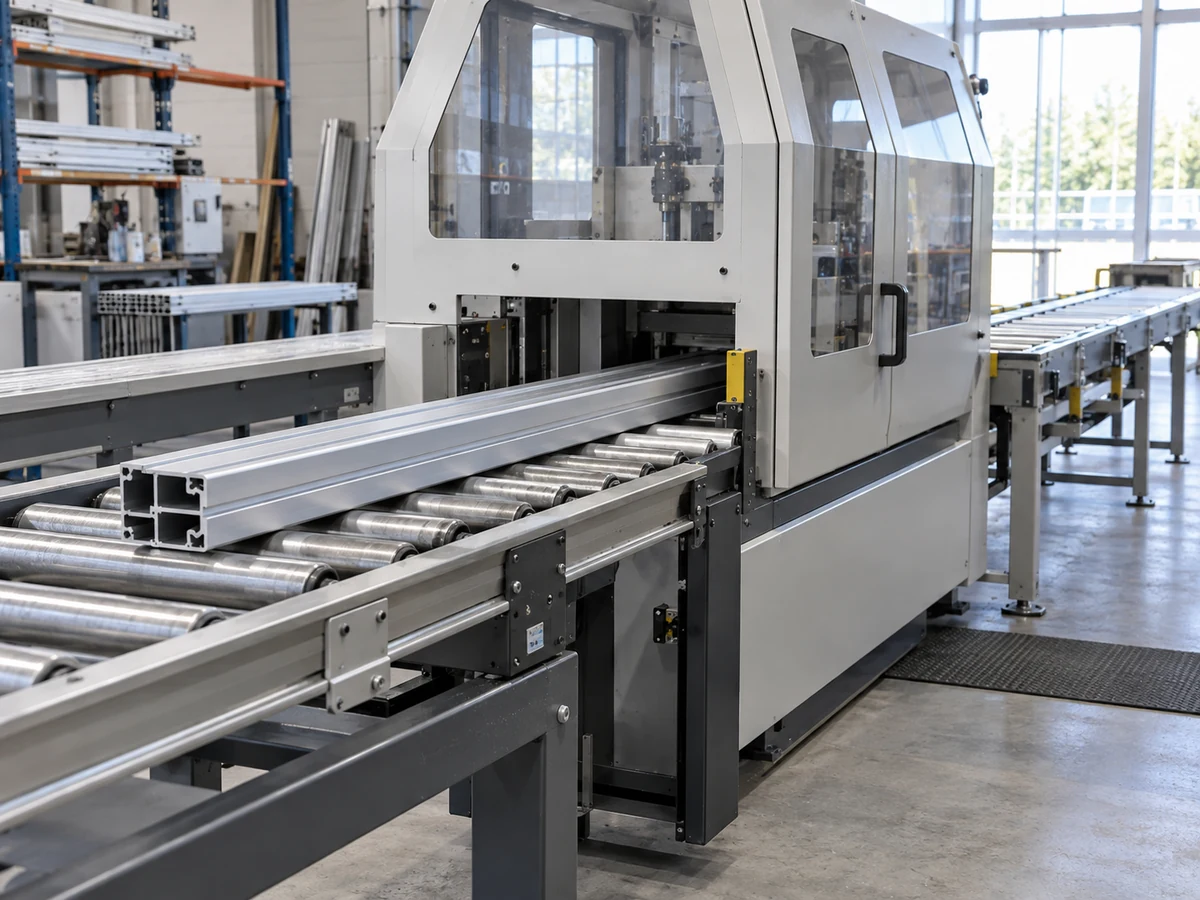
Robotic aluminum saw cell or simpler transfer: compare three routes
Operator-supported saw: A person performs the agreed loading, collection, identification and exception work. Quote the saw, safe access, staffing pattern, handling equipment and inspection time needed to reach the defined receiver. Do not compare its bare machine price with the delivered output of a more complete cell.
Saw plus dedicated transfer: A fixed conveyor, chute or other transfer can suit a narrower part and receiver mix. Verify whether each released section can actually clear the saw, stay separate and arrive in a usable orientation. A fixed transfer is not automatically a sorting or accepted-part system. Record the human work at the far end and the changeover needed for different sections.
Saw plus robotic handling: The robot, gripper, sensing, controls and receiver arrangement can be quoted as a connected application. Published KASTO robotic sawing examples show that pickup, gripper changes and container placement can be part of such a system. They are examples of another manufacturer’s solutions, not evidence that Jiurun offers those functions or that a particular aluminum profile is already qualified. Ask the proposed suppliers to define exactly which of those services are in their scope.
For all three routes, use the same released job list, output stage, shift assumptions and acceptance rules. Count actual people who still replenish stock, inspect first pieces, clear exceptions and take away completed containers. A quoted cycle time without those services is not a whole-route comparison.

Make a supported-job catalogue before choosing the gripper
“Handles aluminum profiles” is too broad for a handling quotation. List each approved stock family and cut blank by drawing revision, section shape, envelope, mass, finished length range, surface condition and planned receiving container. Identify which faces may be contacted and which end or side must face the next process. If nested, hollow or thin-wall pieces are in the mix, include samples that expose their actual handling challenge. Do not infer suitability from an attractive machine video.
Separate the job that was witnessed from jobs that were only discussed. For each family, ask whether the proposed gripper can pick the cut piece after the saw cycle, retain it during transfer, and place it without violating the receiver’s mark and orientation criteria. FANUC’s machine-tending questions distinguish part geometry, gripping method, payload, reach and control communication. Those are useful RFQ prompts; the values and tool choice still require the integrator’s assessment of this application.
Write an explicit status beside every family: included and demonstrated, included but awaiting a representative trial, or outside the quoted scope. A gripper for one rectangular extrusion cannot be assumed to cover a round tube, a short trim and a protected finished face. Require a changeover description where tooling, nests, programs or receiver positions differ. State who supplies the physical samples and who signs off each added family.
Price changeover, replenishment and exception handling
A robot can wait while the saw is ready if the next empty bin is absent, if a gripper change takes longer than assumed, or if the bar supply stops. The RFQ should describe the normal and exceptional sequence: first-off inspection, stock replenishment, full-container removal, recipe selection, jam or mispick response, rejected-piece segregation and restart authorization. Ask which events stop only the handling stage and which require the complete cell to wait. These are questions for the suppliers and the buyer’s process owner, not instructions for bypassing guards or recovery controls.
Include all auxiliary equipment in each quote: stock racks, support and transfer rollers, grippers and fingers, sensing, bins or pallets, labels, machine-to-robot signals, commissioning, training and service documentation. Record excluded work just as clearly. A separately quoted robot and saw may still need an integrator to resolve signal timing, protected access and physical placement. The buyer should appoint an accountable owner for the connected result before adding the individual prices.
Do not use the same fixed part rate for every product in a mixed catalogue. A short, easy-to-grip sample may hide the time needed for a longer part, a marked surface, a smaller batch or a container exchange. Compare a representative order sequence, including planned changeovers and replenishment, over a stated elapsed period. Report accepted pieces at the agreed receiver, not just saw cycles or robot motions.

Witness the integrated handoff, not just a clean cut
Agree on two evidence layers. First, inspect the saw-made blank against its released drawing, material identity and cut-stage criteria. Second, observe that the same accepted piece reaches the correct receiver in the specified orientation and identity state. Keep those records linked so a good cut is not counted as a delivered part when pickup or placement fails. If the buyer needs later deburring, machining or packaging, assign that work separately unless the actual quote includes it.
A representative trial should include the most difficult approved presentation and pickup cases, not merely the easiest profile. Ask the supplier to show the handoff during a normal run and through agreed interruptions such as a full receiver, a missing part or a change to the next approved job. Record the observed output, the retained operator actions and any untested families. Integrated safeguarding and risk assessment must be handled by qualified parties for the actual cell; a generic video or saw quote is not that assessment.
Then compare the three routes at the same accepted-output stage. Include equipment and integration, floor space, retained labor, changeover, sample qualification, maintenance access, spares, reject handling and the cost of downstream work. State assumptions that have not yet been verified rather than turning them into performance promises.
Use this RFQ pack to make the answer specific
- Released stock and cut-blank drawings, revisions, real samples and the expected family and batch mix.
- Cut-stage acceptance criteria, protected contact faces, piece orientation and receiving-container rules.
- A diagram of incoming stock, saw, pickup position, possible downstream operations and final receiver.
- The activities to be automated and those the factory will still staff, including replenishment, inspection and exceptions.
- The trial cases, witness criteria, accountable integrator and evidence required at handover.
Send the cutting portion to JiurunCut with the real profile and receiving requirements. Ask which automatic saw, if any, can be assessed for the cut, and request a written interface and responsibility plan before treating a robotic aluminum saw cell as a purchasable complete application.
The following video on Jiurun’s own channel shows related automatic feeding and cutting equipment. It does not show robotic pickup, the three-route comparison, the exact quoted configuration, a customer installation or accepted cell output.