
Pool cover reel tube cutting starts with the approved reel system, not the pool width. A quoted 18-foot or 20-foot cover span describes an assembled operating range. It does not tell a saw shop the length of each aluminum tube section, the engagement needed between telescoping members, or which end must accept a hub, plug or drive fitting. An OEM or authorized fabricator should first decide whether the purchase is for a complete manufacturer-approved tube set, separate cut blanks, or an assembled reel.
That distinction matters because a solar-cover reel tube is only one part of a system. The tube family, telescoping connection, end hardware and support arrangement must work together. This article is a purchasing and cut-list checklist; it does not specify a universal overlap, tube size or saw setting.
First define what is being bought
Ask for the reel maker’s model and current assembly documentation before preparing a tube cutting quote. Some suppliers sell the tube set separately from the reel end kit. For example, FeherGuard’s in-ground reel range lists telescoping tube sets separately from several end kits and identifies compatibility by tube and reel family. CPI Pool Products’ above-ground reel listing states that the tube is not included with that product. These are examples of why the line item must name the delivered scope; their details should not be copied into another manufacturer’s drawing.
Use three distinct descriptions in the RFQ:
- Approved complete tube set: the specified manufacturer’s matched tube sections and associated joining parts, supplied to its instructions. Quote by exact model and set identifier.
- Saw-cut tube blanks: cut lengths made from an OEM-approved tube profile, ready for the next named operation. Quote the individual section drawing and cut list.
- Complete reel assembly: tube set plus the agreed hubs, supports, fasteners and assembly work. A cut-blank quote is not an assembly quote.
If the project uses a proprietary retail reel system, first ask its manufacturer whether field cutting or substitution is permitted. A general saw shop should not infer a safe modification from a nominal pool width or from a photograph of a similar reel.
Why pool width is not a tube cut length
Pool width, cover width and assembled reel span describe different things. The reel may sit outside the pool edge; the cover may attach at selected positions; and telescoping members may overlap inside an outer tube. End components can also consume length or require a particular insertion depth. An approved drawing must establish those relationships for the exact system.
Do not subtract a guessed overlap from a catalogue span. FeherGuard’s tube-set listing separates tube-set options by diameter, finish and compatible reel family. That catalogue organization is useful for product selection, but a published set range is not a section-by-section manufacturing cut list. Ask for the manufacturer-approved bill of materials and drawing revision when the order is for individual blanks.
For every inner and outer section, record the section identifier, quantity, stock form, finished blank length, end condition and orientation. Flag any rib, seam, slot or locking feature that must align after cutting. Identify whether holes, slots, coating, deburring, plugs or assembly are included or are downstream operations. This lets the buyer compare quotations at the same delivery stage.
Pool cover reel tube cutting: build the approved cut list
A useful cut list has more information than a single overall length. Supply the approved drawing revision and a line for each distinct tube member. Include the following fields:
- System identity: reel model, tube-set family and permitted profile or material specification from the system owner.
- Member identity: inner or outer tube, section size, wall, finish and any directional feature shown on the drawing.
- Blank requirement: quantity, cut length, length tolerance, squareness or end-face requirement, and datum used for inspection.
- Connection allowance: required telescoping engagement and adjustment range, only as stated by the approved design.
- End interfaces: hub, plug, drive, bearing or locking-part fit; distinguish saw-cut ends from later machining.
- Traceability and packing: mark each member and keep matched sections together so the installer can identify the correct assembly order.
Where the drawing does not identify the acceptable joint clearance, edge condition or fit-check method, return that question to the reel designer before making production blanks. A cut face may meet a length tolerance yet still interfere with an insert or leave a burr that scratches the adjoining telescoping member.
Trial the actual approved tubes before committing the batch
Round and thin-wall tube can roll, ovalize or mark under poorly supported handling. For a purchasing trial, provide samples from the approved tube lot and identify the actual saw, blade, clamp and feed arrangement to be evaluated. Support the stock through infeed and outfeed, prevent rotation without crushing the wall, and check the cut-end condition against the drawing. Inspect the end that will enter another member or receive a plug, rather than judging only the outside appearance.
Record trial evidence as a comparison against agreed acceptance criteria: section ID and finish, stock condition, clamping contact, measured length and end face, burr location, roundness or local deformation if specified, and a physical fit check with the correct mating components. Where a hub or plug fit is critical, use the approved gauge or genuine mating hardware. One acceptable cut does not prove every finish, wall or batch will behave identically.
How to compare quotations fairly
Put each supplier’s offer against the same approved delivered state. A low unit price for plain saw-cut blanks cannot be compared directly with a manufacturer-approved tube set that includes locking features, end plugs or finish. Separate material, cutting, deburring, further machining, hardware, assembly, packing and inspection lines. Confirm who owns the design and who accepts the final telescoping fit.
For small or uncertain volumes, a complete approved tube set may be the simpler purchase. For an OEM with controlled drawings, repeated demand and authorized stock, cutting separate sections can make sense after the trial and acceptance method are agreed. In either case, the reel’s load capacity, cover behavior, installation position and safety obligations belong to the approved system design and installation instructions; a saw-cut sample does not establish them.
Send a quote-ready RFQ
Send the reel model and tube-set identifier; approved drawing and revision; member-by-member blank list; material and finish specification; quantity and batch plan; end-face, burr and fit criteria; supplied mating parts or gauges; downstream operations; packing and marking instructions; and the exact delivery stage. State whether the request is to cut OEM-approved stock or to procure the maker’s complete set. If a detail is unknown, label it as a design question rather than estimating it from pool width.
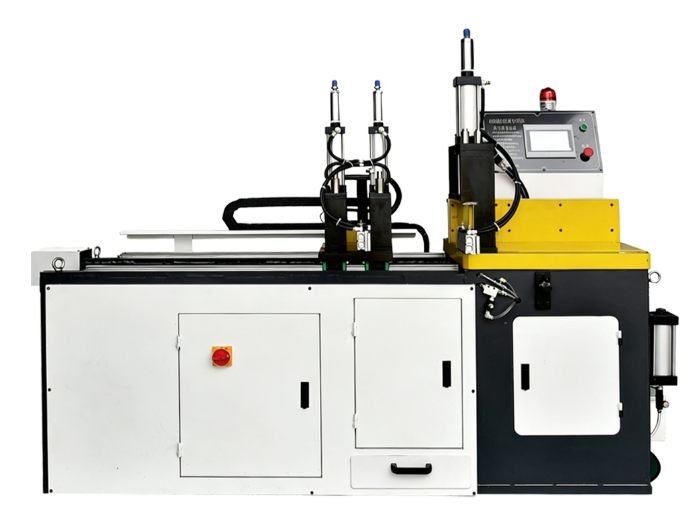
Jiurun supplies industrial cutting equipment for aluminum and other nonferrous profiles. Its aluminum profile cutting machine range can be evaluated against an approved sample and acceptance plan; the right configuration requires an application review. Contact Jiurun with the tube drawings, sample availability and required cut stage to discuss a responsible trial scope.
Related equipment video
The following video from Jiurun Machinery shows a related saw operating. It is an equipment illustration only. It does not show the pool-reel tube, the approved reel system, a customer trial, or measured results for this application.
Frequently asked questions
Can the pool width be used as the saw length?
No. It is an application dimension, not a member cut list. Obtain the approved reel-system drawing and identify every telescoping section and end interface.
Can any round aluminum tube replace a reel tube?
Do not assume so. Confirm section geometry, finish, joint features and hardware compatibility with the system owner. A visually similar tube may not fit the specified connection.
What should the first cutting trial prove?
It should show whether the proposed setup cuts the approved sample to the drawing’s end and fit requirements, using the agreed inspection method. It should not be described as proof of the finished reel’s load rating or field performance.