
Cut blank → nested pair → display span: these are three different dimensions in a telescoping pipe-and-drape crossbar. The inner and outer tubes each need a released cut-part drawing; the assembled range also depends on overlap and stop position. For pipe and drape aluminum tube cutting, identify the exact member and its end condition on the saw order before translating any catalog width into a quote.
Separate blank, pair and span dimensions
Georgia Expo identifies uprights and horizontal drape supports as different parts of a pipe-and-drape system; its support range includes fixed and telescoping versions. A listed width describes how the display is used. It does not specify the length of either unassembled tube. The shop needs a released drawing for the exact fixed member, outer tube or sliding inner tube being purchased.
Put three measurements on that drawing in their own locations: the distance between saw-cut faces, the overall finished member after hardware or other operations, and the collapsed or extended dimension of the assembled pair. The last of these depends on overlap and the stop or locking features. It cannot be converted into two cut lengths by dividing a catalog width. For a replacement, identify the system maker and revision before copying a dimension from an existing part; for an OEM design, the approved drawing is the source of record.
The hardware is another reason to avoid a universal blank length. Georgia Expo shows hook ends and button stops on its supports. Rose Brand describes a ball cap and collar lock on a different upright system. These are examples of distinct interfaces, not dimensions or components to interchange.
Read the sliding pair by what fails
The support reaches full width, but the stop is misplaced
Check the outer and inner part numbers and the positions of the stop features against the approved assembly. Rose Brand publishes separate collapsed and stop lengths for its adjustable supports, illustrating why maximum span alone is incomplete. A wrong stop position can come from the blank datum, a later hole or button operation, or an incorrect pairing. The system owner must judge the required overlap and travel; extending a tube to its advertised width does not prove the engagement is acceptable.
The inner tube binds at the mouth
Look first for a local problem: an inward burr, a deformed rim, a clamp mark or a finish buildup. Then compare the actual inner and outer sections with the approved stock specifications. One outside-diameter reading does not establish clearance along the whole sliding path. Record where the pair binds and whether the interference follows the tube or stays at the outer mouth. That observation helps separate a cutting or handling issue from a section mismatch.
The tube slides, but the hook or cap will not seat
Confirm the datum end, the cut-to-feature distance and the exact hardware revision. An acceptable saw end does not mean the later fitting has been installed in the right position. Keep the cutting inspection distinct from approval of the finished display and its safe use.
Trial the inner and outer tubes together
Before a batch, cut an inner and an outer sample from the specified stock, plus a fixed member if the order includes one. Support the round section near the blade and locate it against a defined stop. Thin walls can move or become marked under a hard clamp, so the setup should be judged on the actual section and finish. Blade, support spacing and clamp force need a trial on that stock; a photograph cannot establish them.

Measure each sample from its stated datum and examine squareness or the specified angle, edge condition, visible surface damage and bore shape. Then fit the pair to the approved mating part and check travel and stop engagement. If it binds, note the location before deburring or changing the fixture; otherwise the cause may disappear without being identified. Keep the accepted sample and drawing revision with the batch. This is a component check, not proof of the complete structure’s load rating.
The end treatment is a separate drawing decision
Many members use a square cut, but a cap, sleeve or other design can require a different end. State the angle, orientation, datum and who performs the edge finishing. Do not assume a miter because a saw can make one. A burr at a sliding end can matter more than an attractive outer face, while a sharp edge can interfere with fitting or handling. Define the permitted condition on the actual drawing instead of asking vaguely for a “clean cut.”

For another kind of nesting problem, our telescopic-handle tube guide explains why a sliding pair and its later button features must be specified together. Its application and dimensions are separate from pipe and drape.
Watch the equipment motion, then test the real pair
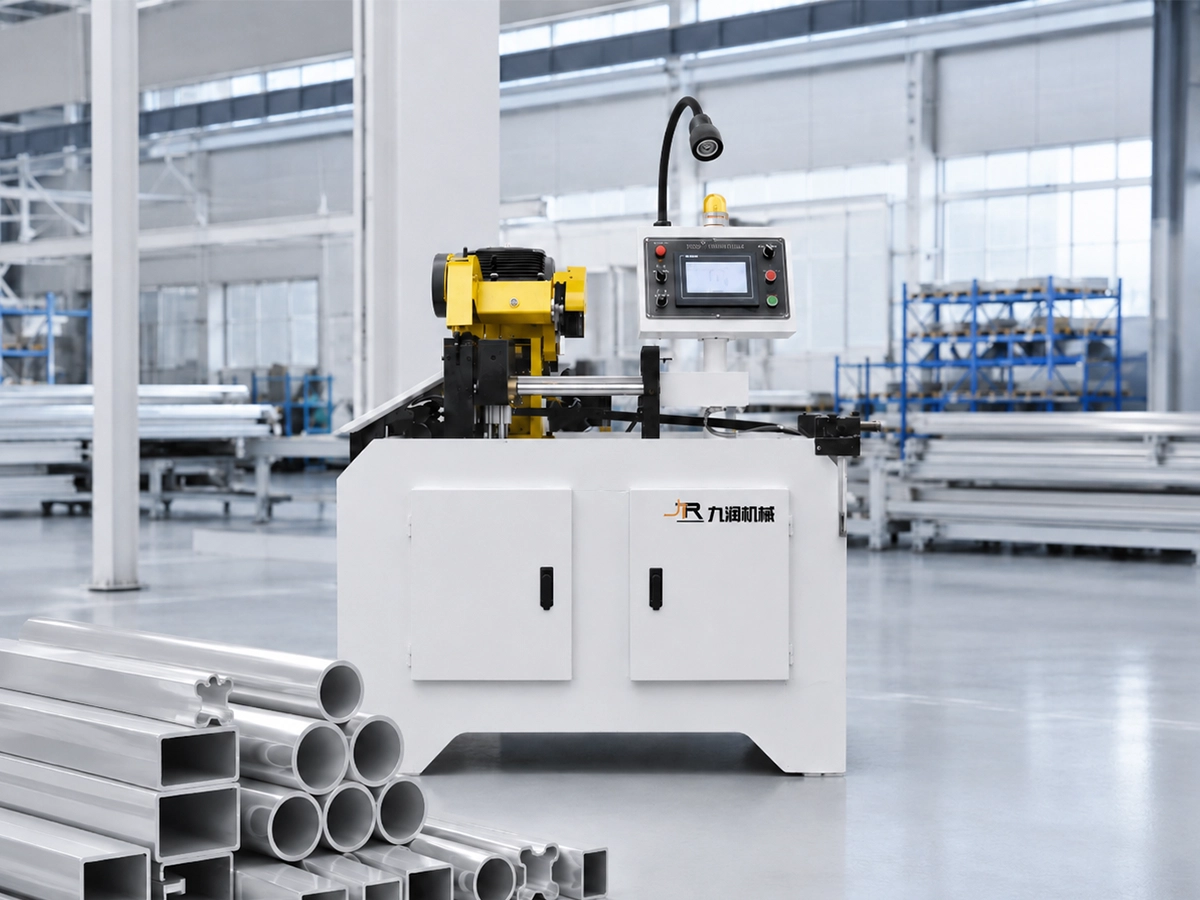
The Jiurun Machinery clip below shows aluminum-cutting equipment motion. It is useful for discussing feeding and saw access, but it does not show these pipe-and-drape members, their material or an approved cutting configuration. A buyer should evaluate the actual inner and outer samples against the released drawings rather than treat a general machine demonstration as a fit test.
Send the paired drawings, not just a booth width
A productive cutting inquiry identifies the fixed, inner and outer blanks separately, with their drawing revisions, approved alloy and section, cut-face datums, end treatment and the later stop or fitting locations. Include the mating sample or a defined fit method so the first trial can answer the specific concern: travel, binding or hardware seating. Contact Jiurun Machinery with that part set to discuss the saw-cutting step. The system owner remains responsible for approving compatibility and safe installation.