
Pedalboard aluminum rails are a useful sourcing question only after the board architecture is clear. A welded rail frame, a drilled modular surface and a finished retail board ask for different manufacturing steps. A crosscut saw can prepare repeatable straight members for a frame, but it cannot supply the holes, slots, coating, welding or assembly by itself. This guide helps an OEM buyer decide what belongs in a cut-length request for quotation (RFQ) and what should stay with the downstream fabricator.
The distinction is visible in current product descriptions. Pedaltrain’s Terra 42 describes an aluminum frame and rail arrangement. Temple Audio’s Templeboards describe powder-coated aluminum and CNC-machined construction. Those are finished-product examples, not specifications for Jiurun equipment or evidence that either brand uses a particular cutting process. Ask your own design team which architecture your drawing actually defines.
1. Confirm that the purchased item is a rail blank
Before quoting pedalboard aluminum rails, mark the boundary of supply. Does your supplier ship straight cut extrusion only, or a drilled and finished subassembly? A rail blank has a profile section, cut length, end condition and quantity. A complete board adds joining, mounting and finish requirements. If the design starts from a perforated sheet, a rail-cutting proposal may be the wrong route entirely.
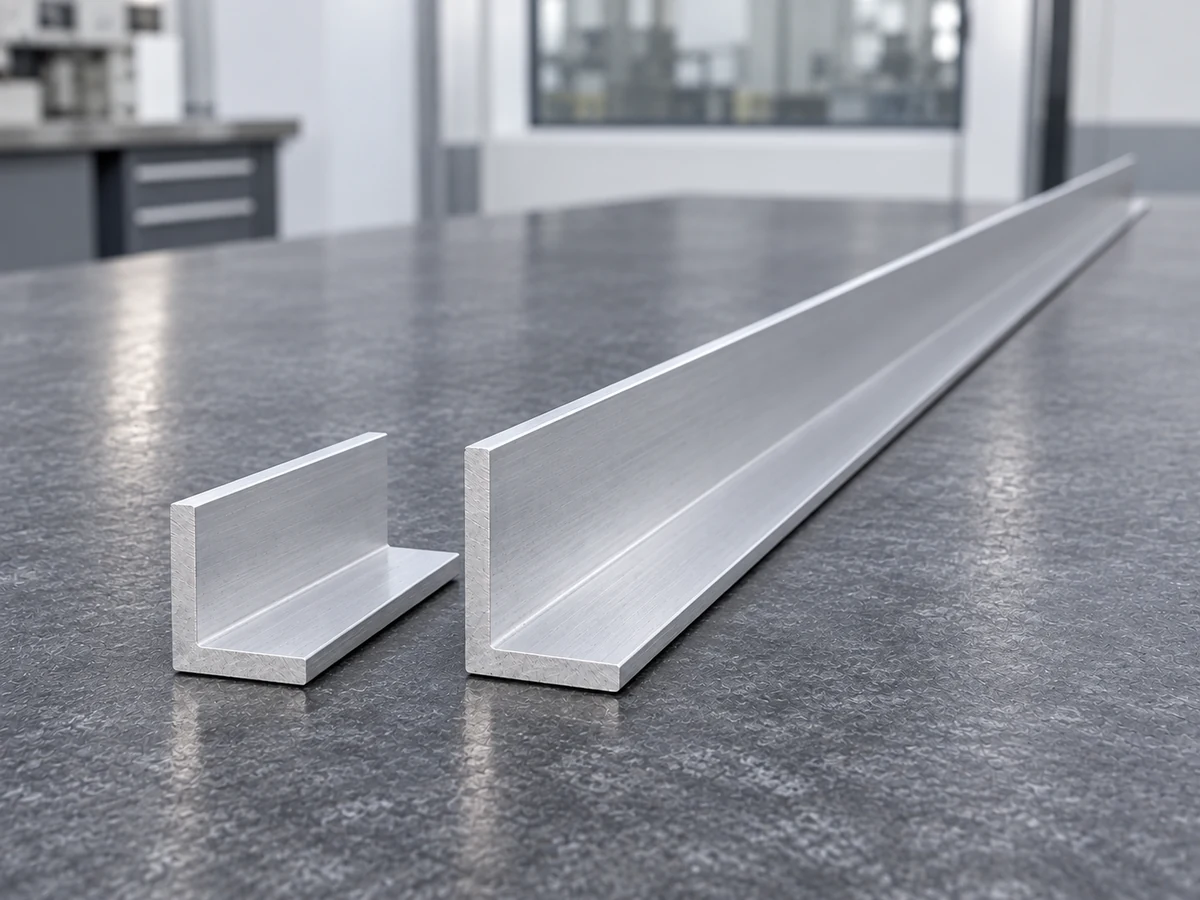
Put a photograph or section drawing beside the part number. The generic angle stock pictured below illustrates how a simple straight member and a short cut piece differ; it is not a Pedaltrain or Temple part, a pedalboard design, or proof of a required section.
2. Separate finished-board dimensions from cut length
Retail board width and depth do not define a saw stop. Rail ends may sit between side members, overlap them, meet at a miter or terminate before an end cap. The usable blank length depends on that joint and on the next operation’s trim allowance. Do not copy a product-page dimension into a cutting program.
For each rail number, state the drawing revision, datum-to-datum finished length, saw-cut allowance, end angle, tolerance and whether the value applies before or after coating. If a first-article assembly determines the real length, label the opening lot as a trial rather than treating an unverified number as production data.
3. Define the actual section and surface condition
“Aluminum rail” is too broad for workholding. An open angle, a channel, a hollow extrusion and a custom ribbed member contact the saw fence differently. Send the section drawing with outside envelope, wall locations, visible faces and allowable clamp-contact surfaces. Also identify the alloy and temper specified by your engineering team; a marketing description such as “aircraft-grade aluminum” is not an alloy designation for purchasing.
State whether the stock arrives bare, anodized or powder-coated. A prefinished visible face needs protection during loading and clamping; a part coated later needs a clearly defined dimensional stage for inspection. Do not infer the finish order from photographs of a retail board.
4. Resolve the datum, support and clamping plan
A long, narrow rail may twist or tip when its functional face does not lie flat on the saw bed. The RFQ should identify the primary locating face, the end from which length is measured and the face on which clamp marks are acceptable. For a hollow or thin-wall custom section, ask for a support concept and a small trial lot before claiming a cycle time or tolerance.
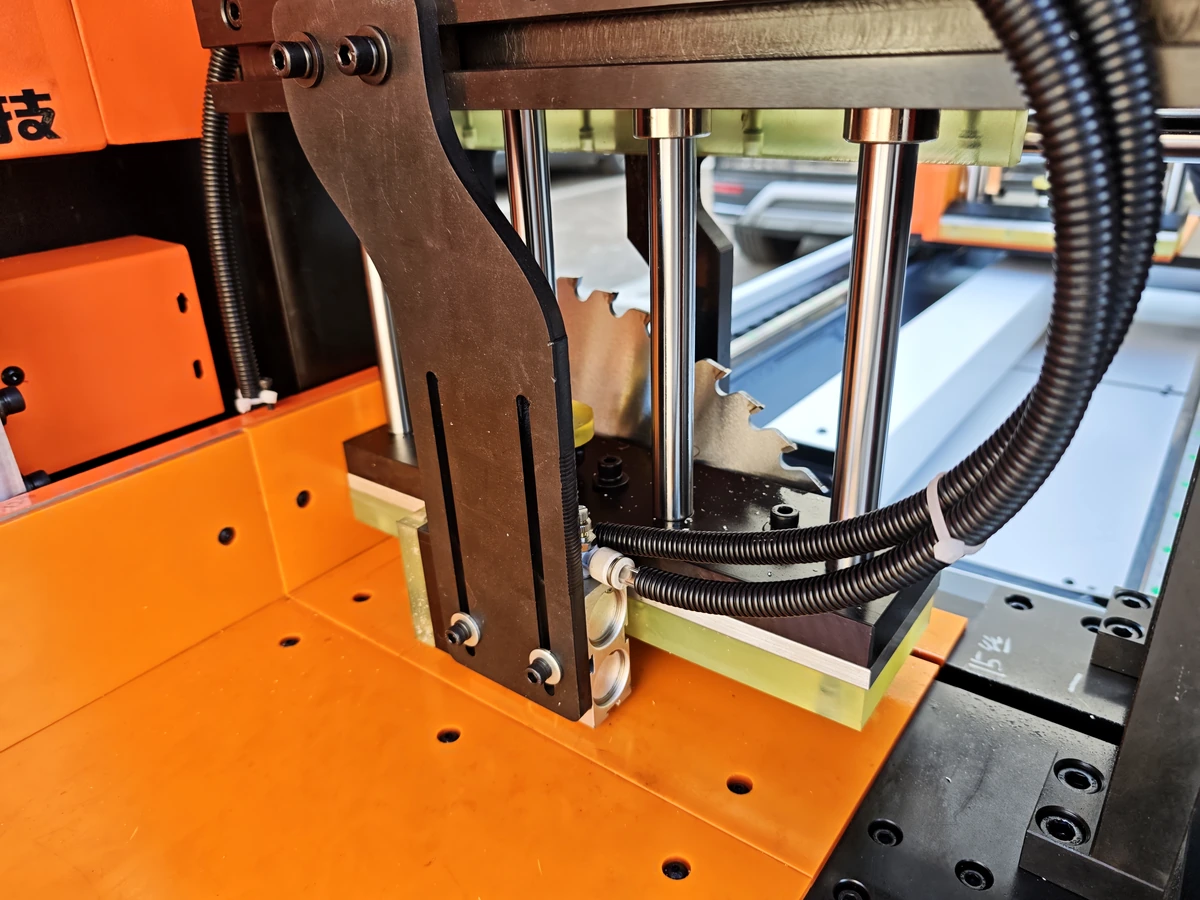
The next image shows a circular blade and guide/clamp area inside a different aluminum cutting machine. It illustrates a workholding discussion only. It does not show a pedalboard part, an approved fixture, the machine used for the pictured angle, or validated cut performance.
5. Keep secondary features on a separate routing line
Pedal attachment, cable passage and frame assembly can require drilling, milling, slots, fastening or welding. A crosscut operation only establishes member ends. List each feature on its own routing line, with the station that creates it and the inspection point that follows. This prevents a cut-length quote from being mistaken for a finished-board quote.
Also decide how parts move between stations. Are rails bundled by length, handedness and coating color? Are ends protected before transport? A mixed bin of visually similar members can create an assembly error even if each cut length is within its own drawing tolerance.
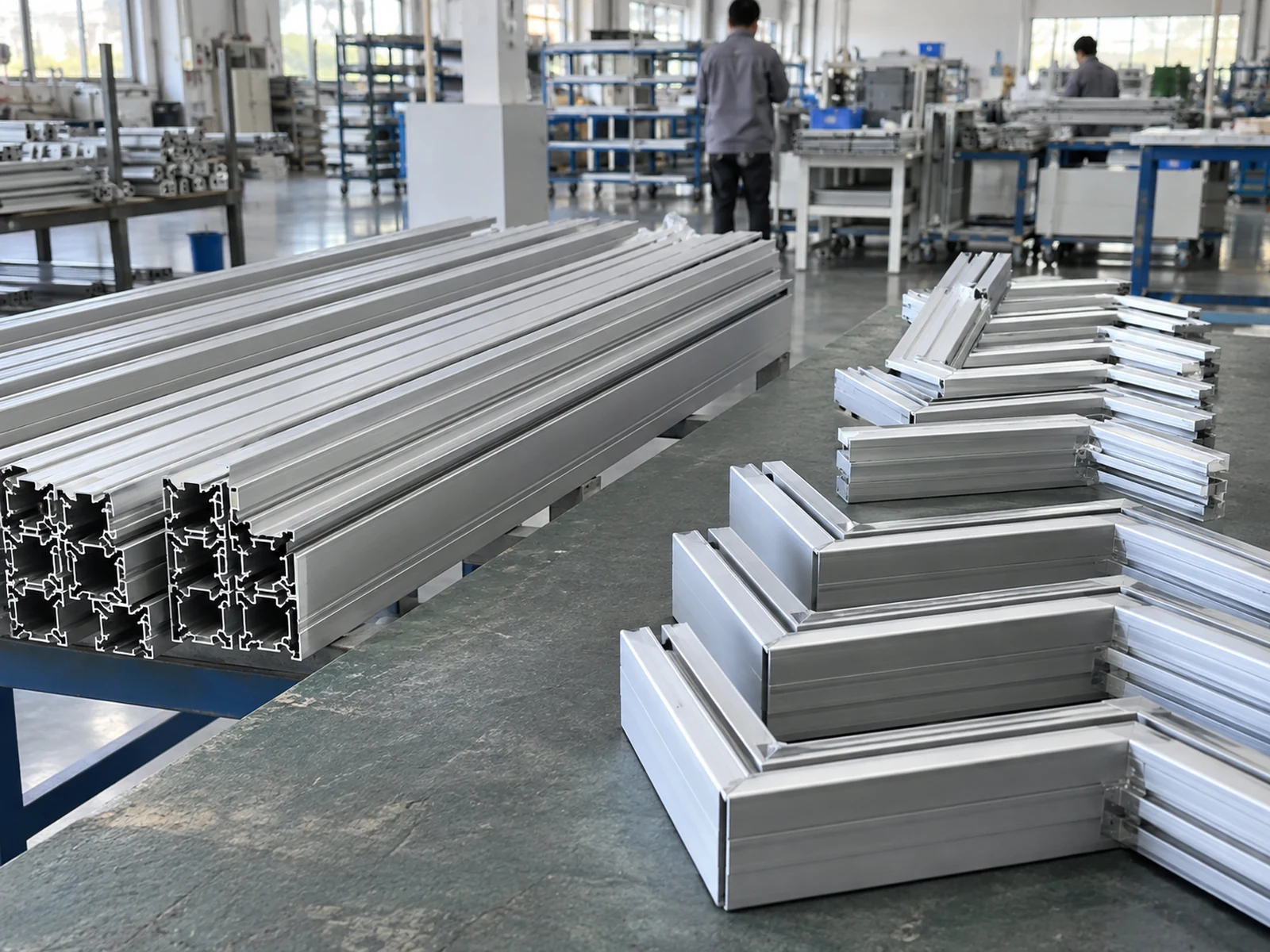
The following workshop photograph shows long profiles at left and prepared mitered frame parts at right. It is a related illustration of batch separation, not pedalboard material, a customer order or evidence that these pieces came from the machine above.
6. Approve the first article at the assembly interface
A sample should be judged by more than a caliper reading across one end. Inspect the specified length datum, angle, burr condition, visible-face damage and part identity. Then assemble representative left and right members with the actual side pieces or end caps. Check fit at the joint and access for the planned fasteners. Record the accepted drawing revision and any fixture or program adjustment before releasing a larger batch.
Ask the vendor to report the trial results against your limits. A photograph of a saw or a generic cutting video cannot establish that your alloy, section, finish and joint have passed an acceptance test.
What to put in the pedalboard rail RFQ
- Board architecture and the exact item being purchased: cut rail, processed rail, subassembly or finished board.
- Section drawing, alloy/temper, incoming finish, visible faces and permitted clamp contact.
- Per-part cut length, datum, angle, tolerance, trim allowance, quantity and drawing revision.
- Separate operations for holes, slots, coating, joining and final inspection.
- Trial quantity, sample acceptance method, packing identity and protection requirements.
Equipment context: The following JiurunMachinery video shows a general aluminum saw example. It is not a pedalboard rail run, not the machine shown in the close-up above, and not proof of the article’s proposed setup or result.
If your drawing calls for straight rail blanks, send JiurunCut the section drawing, cut list and sample acceptance criteria for an application review. Keep the finished-board features in the same packet so the cutoff scope is clear.