
Kitchen wall rail cutting starts with an approved section and clear quote boundary. A modular kitchen wall rail can carry hooks, shelves and other removable accessories, but a purchase order for “cut aluminum rail” leaves several different jobs hidden in one line. The buyer may need bare rail blanks, rails prepared for a mounting kit, or a ready-to-install system with brackets, end caps and lighting parts. These are different deliverables. Define the approved profile and the handoff before asking an aluminum saw supplier to quote the cut.
This guide is for OEM buyers and fabricators specifying aluminum cut members for a wall storage system. It is not an installation instruction or a load rating. The system designer owns wall fixing, accessory fit, electrical details and the finished assembly.
Kitchen wall rail cutting starts with the system architecture
Real wall systems show why a single “rail” label is too broad. Lee Valley’s wall rail collection distinguishes a ready-to-mount kit from rails cut to length and lists separate end caps, hooks, shelves and a lower lighting channel with a diffuser. Zobal’s modular wall system uses several construction profiles, a working central rail, panels and optional LED components. These are examples of system architecture, not Jiurun projects or evidence that one saw setup suits either proprietary profile.
Ask the system owner for the released section drawing and bill of materials. Identify which member is to be cut, its alloy and temper if specified, finish state, cut length datum and ordered quantity. A U-shaped channel, a rail with an undercut hook interface, and an LED-ready central profile cannot be interchanged just because all three are aluminum. The accessory engagement geometry and the available support surfaces govern the trial.

Choose the quote boundary before choosing the saw
Use three explicit purchasing routes. A cut-blank order covers approved stock cut to a defined length and end condition. A mount-ready member order may additionally require holes, slots, corner preparation or labeled positions, but those operations must be separately scoped and sourced. A complete system order includes accessories and assembly responsibility that a saw-cutting quote alone does not establish. Write the route in the RFQ header and repeat it in the acceptance checklist.
For example, a 3 m stock rail might be divided into several shorter wall runs. The cut list must say whether the measured length is the exposed aluminum body, the finished run including end caps, or the distance between joining parts. If the finish is already applied, protection during handling and permitted end touch-up need approval. Do not silently subtract a cap allowance or assume a generic clearance. Have the system owner supply the actual mating parts and an accepted first-off assembly.
Release the profile and distinguish both ends
On a wall rail, one end may receive an end cap while the other meets a connector or a corner. Those ends can have different appearance and fit requirements. Mark each drawing with an end designation, cut orientation, visible face, allowable burr and any post-cut finishing ownership. If a diffuser or sliding hook enters through an open end, its passage must remain clear after cutting and deburring. A caliper length alone cannot prove that an accessory still seats and travels as designed.
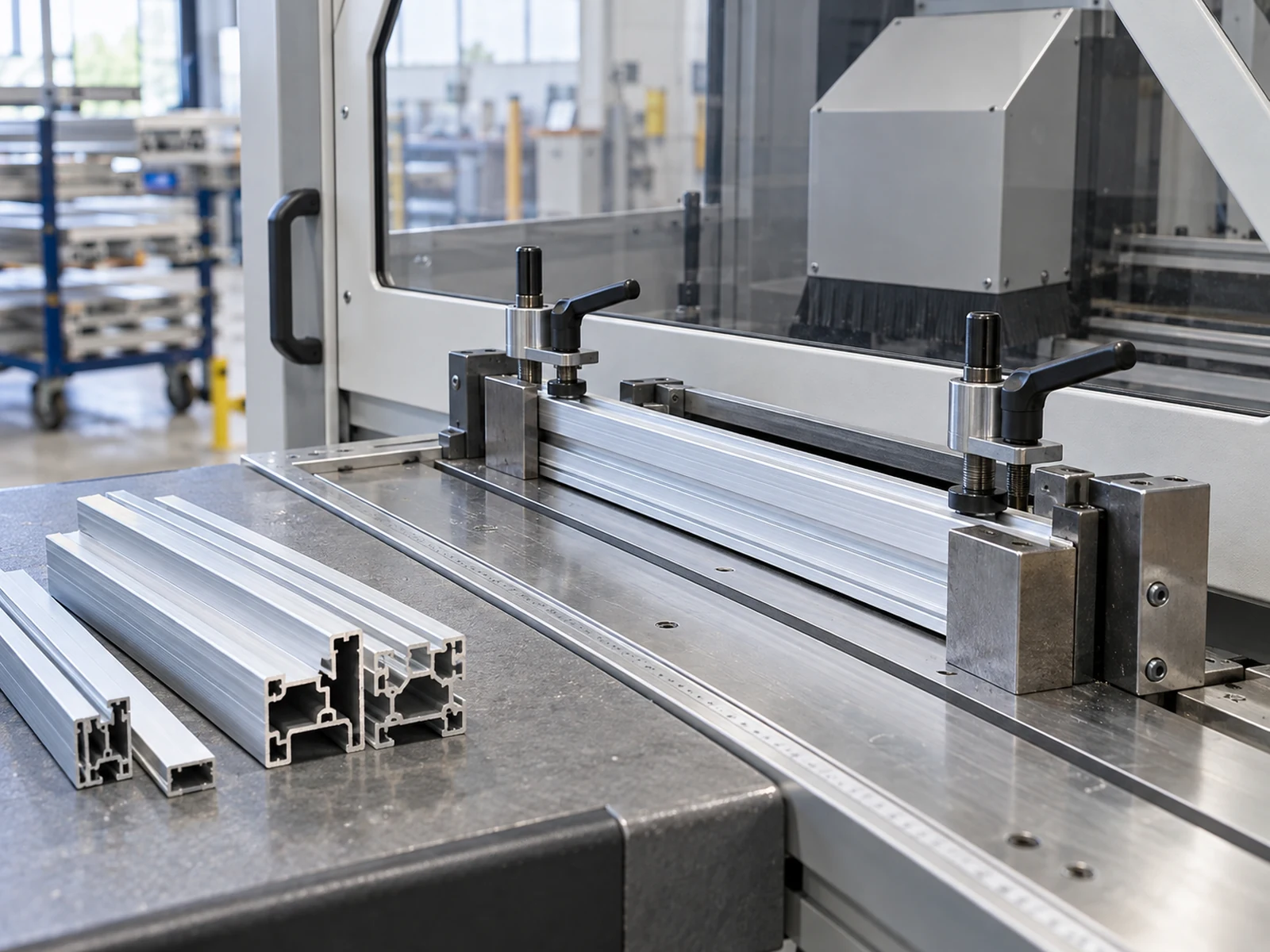
Give the saw supplier one approved extrusion sample and drawings for every section variant. Thin lips, asymmetric hooks, internal cavities and decorative outer surfaces affect how a member can be supported and clamped. Ask for a stopped setup review and a controlled first-off cut on the released stock. Evaluate the specific cut face and fit against the approved mating components. A stock photograph or generic cutting video is not a substitute for that trial.
Keep mounting, lighting and accessories in separate lines
A rail with a lower LED channel may require a diffuser length, strip clearance, wire exit and end-cap detail. These belong to the lighting and system design package unless specifically included in the cut member drawing. If the rail carries movable hooks or shelves, the system owner must define the engagement test and approved loads. If it meets tile or another wall finish, the installer must define the wall interface. The aluminum cut can be checked against the drawing; it cannot establish wall-anchor capacity or electrical suitability.
List every supplied item separately: rail blank, connector, end cap, hook, shelf bracket, diffuser, LED parts, fastener and label. Note which parts are furnished as fit-check gauges and which are part of the delivery. This prevents a quote for a simple cut member from being mistaken for a complete functional wall system.
Run a first-off check that reflects the buying decision
- Identity: match the stock label, profile drawing revision and finish state to the order.
- Length: measure from the approved datum and record the chosen inspection method.
- End condition: check burrs, deformation and cosmetic surfaces at both designated ends.
- Fit: try the actual cap, connector and representative accessory supplied by the system owner; record any interference.
- Handoff: label accepted pieces by run or kit and state who performs secondary machining, finish repair and assembly.
Photograph the approved first-off piece with its revision and record the acceptance decision. Repeat the checks after a section, finish or mating-part change. If the owner has not supplied the geometry or fit parts, quote the blank boundary only and state the missing inputs. Do not turn a preliminary sample into a production guarantee.

What to send with the RFQ
For kitchen wall rail cutting, send the approved section and revision, stock form and finish, a line-by-line cut list, end designations, required volume, packing units and the exact acceptance method. Add mating caps and connectors for a first-off fit check if that is in scope. Describe any lighting channel, bracket or accessory as an interface to preserve, not as a saw supplier’s performance claim. Ask the supplier to identify which checks are included in the quoted operation and which need another process or the system integrator.
The short equipment clip below shows a related Jiurun aluminum cutting machine view. It does not show this kitchen rail, a released profile, a customer order, a fit test or an accepted performance result.
Next step: if you are comparing saw capacity or a cut-member handoff for an approved wall rail, send Jiurun the released profile drawing and first-off acceptance plan. We can discuss a suitable cutting-equipment evaluation around the actual stock and scope; the system owner remains responsible for assembly, mounting and end-use approval.