
An aluminum saw for industrial workbench manufacturing belongs in a make-or-buy decision, not in a generic equipment list. A workbench supplier may buy a complete station, receive a prepared frame kit, or cut approved aluminum frame members in-house before adding the work surface and accessories. Those routes leave very different work, inspection and integration responsibilities at the factory. The right comparison starts with a released workstation family and a common accepted delivery point.
This guide helps a workbench manufacturer define what it actually retains, build a representative cutting trial and request comparable quotations. It does not specify an ergonomic layout, ESD protection, electrical installation, load capacity or compliance result. Those requirements belong to the approved station design and its responsible reviewers.
Compare the three supply routes at the same handover stage
Choose one released station configuration and state what the receiving team will accept: loose frame members, a labeled frame kit or a complete workstation. Keep that acceptance stage fixed in every quotation. A low price for raw profiles cannot be compared directly with a delivered bench that already includes joining, a work surface, adjustment hardware, accessories and final inspection.
| Route | What arrives | Factory work that remains |
|---|---|---|
| Buy a complete workstation | An identified station at the agreed acceptance state | Incoming checks, placement and any integration retained by contract |
| Buy a prepared frame kit | Identified members and specified connectors | Kit verification, joining, top and accessory installation, and final checks |
| Cut approved profiles in-house | Approved profile stock in its documented condition | Cutting, part identification, downstream preparation, kit assembly and station completion |
Ask each bidder to price the same order mix and delivery period through that shared acceptance point. Add the operations, consumables, inventory and rejects still owned by your factory. The result is a route comparison per accepted workstation, rather than a misleading price per cut or per meter of extrusion.
Freeze the station architecture before sizing the saw
Industrial workstations can combine aluminum profile frames with a work surface, feet or casters, height-adjustment elements, shelves, lighting, tool holders, power distribution and material supply equipment. Bosch Rexroth’s manual production systems overview treats workstations, material supply and linking as distinct parts of a configurable system. This is an example of why a buyer should identify the actual approved station architecture; it does not define JiurunCut equipment or prove that every pictured component should be manufactured in-house.
For each released station family, list the frame members you will really cut. Separate them from bought tops, lifting units, connectors, electrical items, accessories and complete subassemblies. Record the profile series and drawing revision, cross-section, alloy and temper if specified, incoming finish, stock length, visible-surface requirements, and the downstream receiver. Do not infer saw capacity from the outside bench dimensions. The largest stock section, fixture envelope, member length and end condition may drive different constraints.
Keep the approved design authority clear. A saw supplier can discuss profile cutting against supplied drawings and samples. The station designer or integrator must confirm load paths, stability, adjustment, grounding or ESD requirements, wiring and the finished workstation’s acceptance method. Cutting a profile is one operation within that larger release.
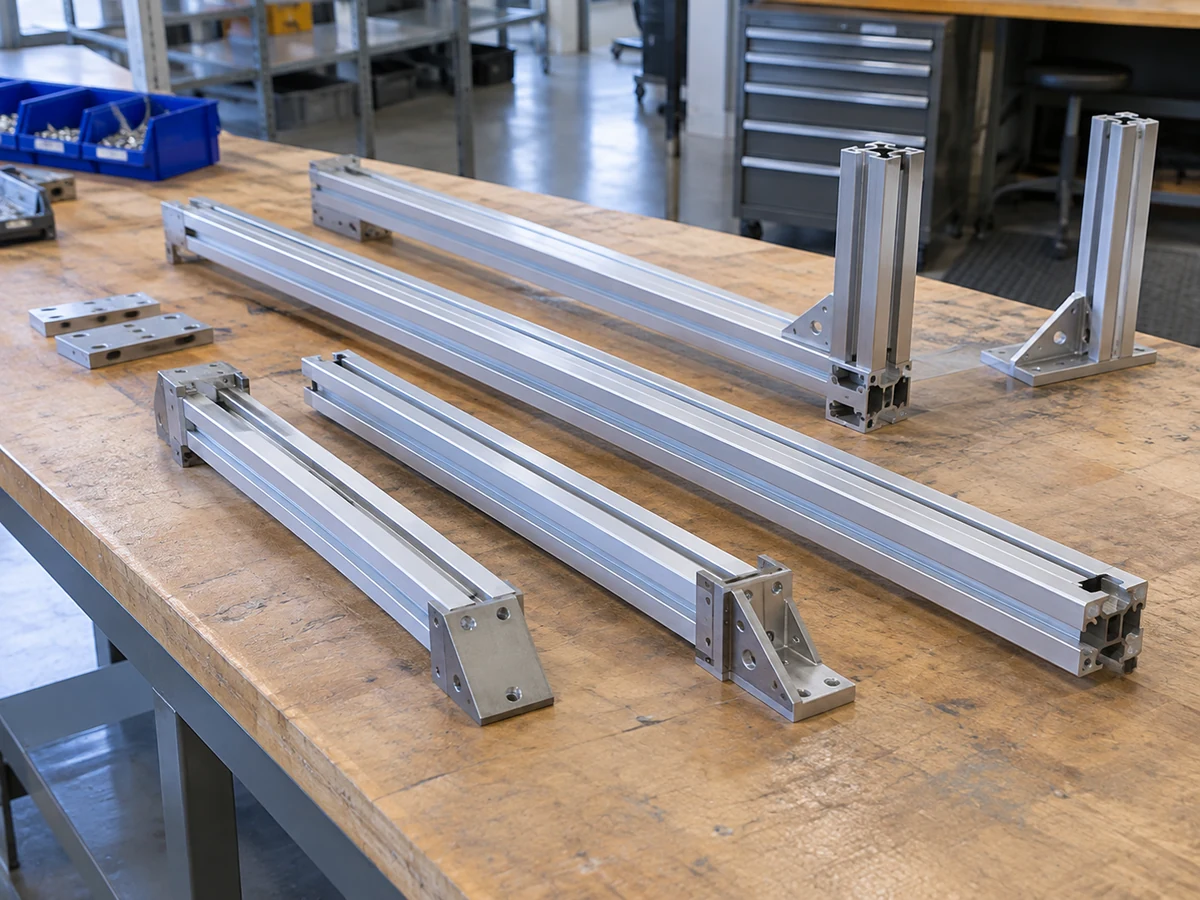
Turn a workstation drawing into a controlled member schedule
A procurement-ready schedule connects each cut to a released station. Give every member a part ID, station or kit ID, revision, quantity, approved stock identity, length reference, end orientation, visible-face instruction and handover destination. Specify the drawing or master sample that controls each end. If a connector requires later drilling, tapping, notching or joining, name the responsible operation rather than silently treating the saw as a complete fabrication cell.
Describe incoming material as it will arrive: bare, coated, protected, pre-fitted or another approved condition. Surface protection and clamping should be evaluated on that real condition. A cut that is dimensionally acceptable but damages a visible face may fail the station’s receiving criteria. Conversely, an attractive loose sample is not a complete kit if members are mislabeled, mixed across revisions or missing at assembly.
Ask the receiving team to define what it checks at the handover point: member identity, cut-end condition, orientation, kit completeness and any later interface check. Keep profile feeding repeatability separate from finished-part accuracy; neither a brochure value nor a single easy sample establishes acceptance across a mixed station portfolio.

Trial an aluminum saw for industrial workbench manufacturing on the actual mix
Send the saw supplier released drawings and representative stock, not merely a photograph of a finished bench. Include the largest and smallest eligible profiles, the longest and shortest retained members, visible-finish conditions, relevant end orientations, realistic batch sizes and changes between station families. Where a station uses a prepared bought frame for some variants, keep that variant outside the proposed cutting workload unless the sourcing decision actually changes.
Agree the evidence before the trial. State what will be measured immediately after the cut, what the downstream joining team will check, how visible surfaces are judged and who signs off a complete kit. Record setup, batch sequence, identification, rejected parts, offcuts and operator handling. Run at least one complete released member set through the handover check. A supplier video of another material or model can illustrate equipment, but it cannot substitute for your own sample record.
If the decision turns on a specialized end feature, ask whether the quoted configuration actually includes the required process. A circular saw quote should not be assumed to include machining, connector installation, height-adjustment assembly or finished-station testing. The JiurunCut industrial profile cutting overview can help frame a machine discussion, while the final scope still depends on supplied stock and drawings.
Compare the complete cost and responsibility of each route
For retained cutting, include stock purchase, usable yield, setup, blade and consumables, labor, inspection, surface protection, identification, downstream joining, work-surface installation, rejected members, inventory and equipment ownership. For a prepared kit, include incoming verification, shortages, assembly and change control. For a complete station, include the accepted configuration, delivery, incoming checks and integration that remain with the manufacturer.
Use the same released station mix, order quantities and delivery period for all three routes. Test the result against revision frequency and actual capacity at the constrained operation. A saw may serve several products, so allocate its time and changeover burden to the approved workload rather than assigning all costs or benefits to one optimistic station forecast. The least expensive route per profile is not necessarily the least expensive route per accepted workbench.
Write responsibility into the comparison. Who owns a missing connector, a wrong profile revision, a damaged work surface or a kit that cannot be joined? Who accepts station stability and any specified ESD or electrical features? The saw trial answers only the cut-related questions. The finished station remains subject to its own design, assembly and verification process.
Send a decision-ready RFQ
- The released station family, drawings, revisions and order quantities.
- The exact frame members retained for cutting and the approved incoming stock condition.
- Member IDs, lengths, end references, orientation, surface requirements and kit grouping.
- Bought tops, connectors, lifting units, accessories and electrical items, with clear supply boundaries.
- The accepted output: loose members, identified kits or completed stations.
- The representative trial mix, measurement plan and downstream acceptance method.
- Batch sizes, changeovers, delivery assumptions and the cost items each bidder includes.
Ask the supplier to state the offered configuration, its exclusions and what must be proven on your actual profiles. Request a sample record before relying on any throughput, quality or savings claim. The manufacturer should compare that evidence with the bought-kit and complete-station bids at the same handover point.
See a general circular-saw equipment example
The following Jiurun Machinery video shows general JR-455Q circular-saw equipment and handling. It is included only to illustrate machinery context for a retained profile-cutting discussion. It does not show this article’s workbench materials, a buyer’s station design or configuration, a customer order, a workbench frame trial, or verified performance for any proposed RFQ.
Frequently asked buyer questions
Can the saw be selected from a finished workbench photograph?
No. The retained member drawings, incoming profile sections, end conditions and production mix define the cutting workload. A photograph cannot establish the stock size, fixture needs or acceptance references.
Does a good cut qualify the finished workstation?
No. It supports only the agreed member-level checks. Frame joining, top installation, adjustment, stability and any electrical or ESD requirements need separate responsibility and verification.
Should the factory cut every aluminum member it sells?
Only if that member belongs to an approved retained route. Bought kits and complete stations may be preferable for some families. Compare the routes using the same accepted output and realistic order mix.
Next step: send your released frame drawings, stock samples, station quantities and required cut evidence through JiurunCut’s application review. We can discuss a cutting-machine quotation against that defined workload, while your station team retains responsibility for the complete workstation specification.