
Entrance mat aluminum frame cutting is a small part of a larger entrance-flooring decision. A buyer can order saw-cut angle members, a labeled frame kit, or a complete mat system. Those are different deliverables with different owners for the corner fit, substrate interface, drainage, finish and final installation. A saw quote should start with the member that your team actually intends to make or receive—not with the outside dimensions of a finished mat.
This guide is for fabricators and procurement teams evaluating a repeatable cutting route for approved aluminum frame profiles. It explains how to release the cut list, arrange a representative trial and compare offers at the same accepted stage. The illustrative photos and equipment video below show related profile and saw operations; they do not document a specific entrance-mat project or prove a machine configuration.
Entrance mat aluminum frame cutting starts with the supply boundary
An entrance mat assembly may combine aluminum rails, hinges, tread inserts and a perimeter frame. The frame itself may be recessed, surface mounted or omitted, depending on the system. Construction Specialties lists distinct level-base, tapered-angle, threshold and surface-frame options for its Pedimat line. That product information establishes why “mat frame” alone is not a complete saw specification; it does not establish that Jiurun supplies those proprietary components. See the manufacturer’s frame-option overview.
On the RFQ, identify one of three endpoints:
- Loose saw-cut members: release the extrusion, drawing and cut schedule.
- A labeled perimeter kit: add corner hardware, part pairing and assembly responsibility.
- An installed entrance mat: include tread, recess, site measurements and installation under the system owner.
Keep those costs separate or the lowest quoted cutting price may shift unpriced work to the buyer.
Release the actual profile and frame interface
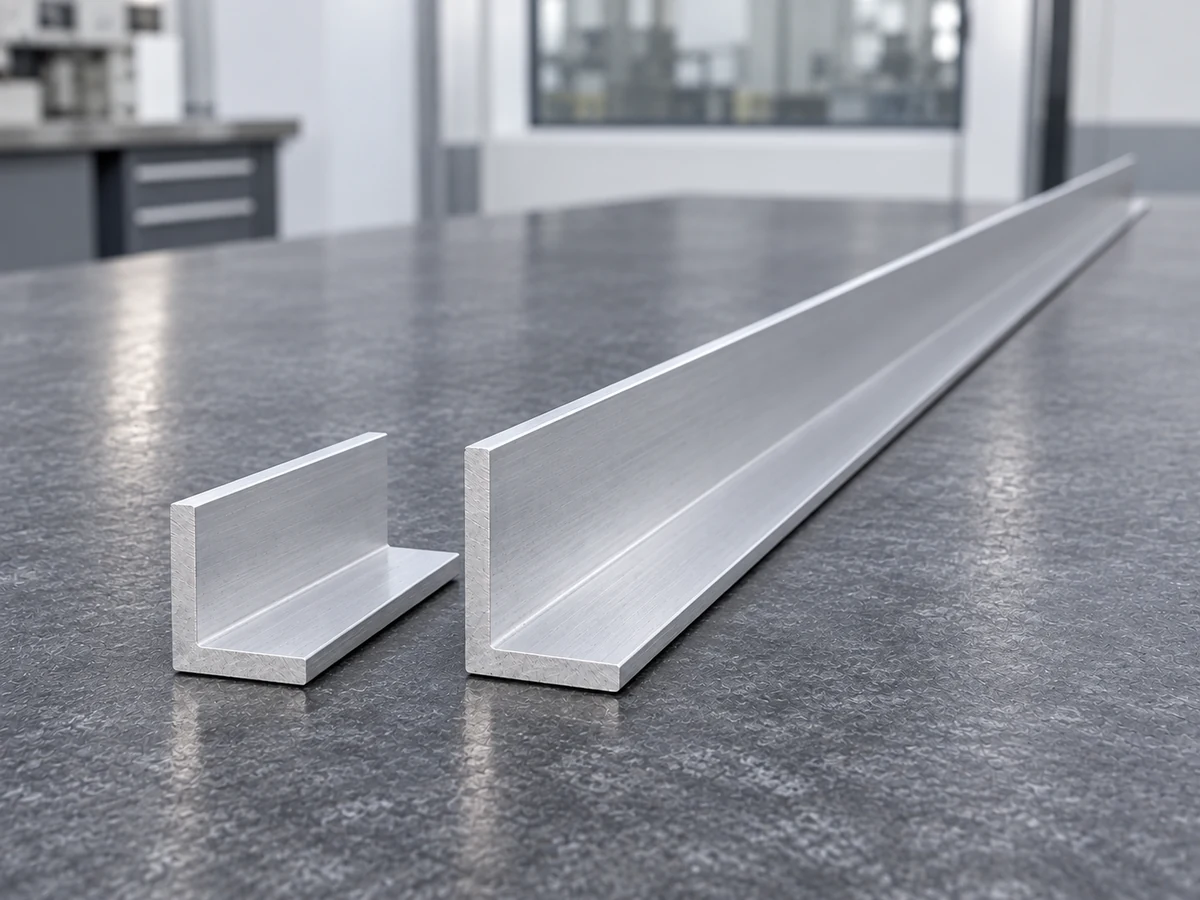
Record the frame system or approved drawing revision, alloy and temper if specified, cross-section, stock supply condition and finish. Attach a section drawing that distinguishes the vertical leg, horizontal bearing surface, visible edge and any lip or recess. A nominal outside size cannot tell the saw operator which edge controls the cut length. If the entrance-mat vendor owns the frame design, obtain its approved section and installation details before adapting a generic angle extrusion.
The installation interface matters beyond the saw. An emco installation-frame guide describes a frame that must sit flush with the substrate and adjoining floor and be fully supported. That is system-specific guidance, not a universal installation dimension. For an RFQ, ask the system owner to state the recess depth, floor transition, corner treatment and allowable site adjustment. The cutting team should make parts to that approved reference; it should not invent a floor-detail tolerance.
Make length and corner geometry unambiguous
Write a cut list for each member, with a profile ID, revision, finished length definition, end A and end B, quantity, finish lot and destination kit. Distinguish a 90-degree end from a miter. For a mitered perimeter, specify whether length is measured along the outside visible edge, inside bearing edge or another drawing datum. Mark left-hand and right-hand parts. Four sides with the same outside dimension can require different saw settings when the section is asymmetric or a threshold piece is present.
Include the corner-joining method even when joining is outside the saw supplier’s scope. A mechanical connector, welded corner or fitted insert can change the permitted cut-end condition and inspection datum. The article on gallery rail joint and length control illustrates the general procurement lesson: a cut end should be accepted against the downstream joint, not by a bare length number alone. Entrance-flooring dimensions and hardware must still come from its own approved system.
Plan a representative saw trial
Trial the real approved profile, preferably including the longest and shortest released members, both required end geometries and the surface finish that will be shipped. Document incoming stock condition first. A damaged finish, bowed stock or inconsistent section should not be blamed automatically on the cutting cycle. If raw and finished stock use different routes, trial each route that will actually be purchased.
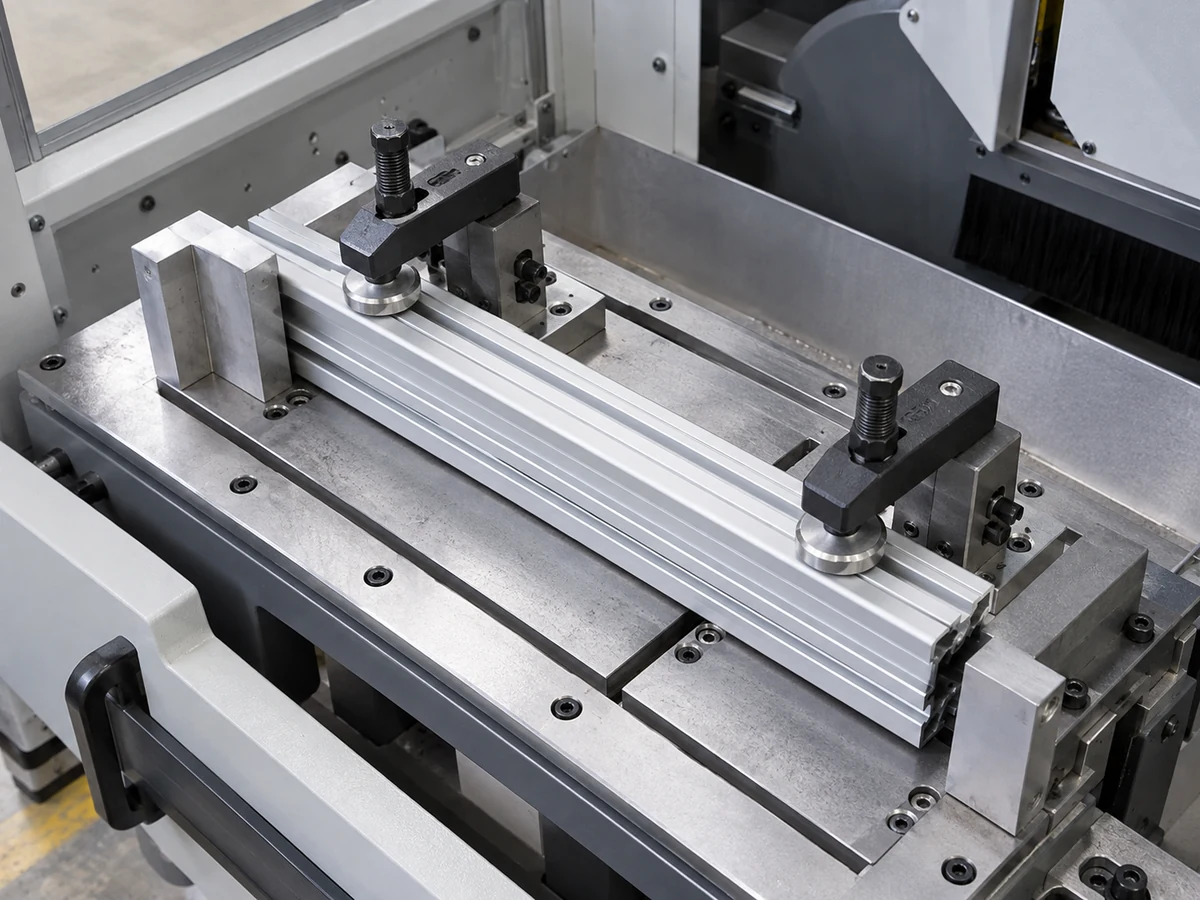
Before cutting, agree how the stock will be supported and located without marking the visible frame edge. Select a contact surface and clamp position that avoid a fragile lip or a decorative face. Record the blade and fixture setup used for the trial, but do not infer that the pictured setup below is suitable for this particular profile. A first-off check should measure the agreed length datum, end angle, corner fit and visible edge condition. Keep the accepted first-off part and the setup record together.
Inspect the corner as a system part
A length that passes a caliper check may still leave a visible corner gap. Ask the system owner for the accepted corner assembly, including connector or join allowance and the required appearance of the visible edge. Trial two representative corners with the actual mating section. Check the corner on the approved frame datum and record whether a burr, coating buildup or incorrect handedness caused any interference. Do not polish away a mismatch before documenting it; the correction may belong to the cut program, incoming profile or connector.
Keep functional acceptance separate from cosmetic acceptance. The entrance-mat owner must decide whether a cut edge will be concealed, exposed, finished later or covered by a joint. When a coated or anodized profile is cut, ask whether the fresh end requires post-cut treatment and who performs it. The saw quotation should state the condition in which cut members leave the machine, not quietly promise a finished perimeter.
Compare equipment quotes at the same stage
For each proposed saw, request a written trial on the released frame section, the required cut angles, the longest stock length, the smallest member, and both raw and finished surfaces where relevant. Ask what infeed and outfeed support, stop or feed datum, clamp contact, blade, chip handling and operator steps are included. Identify any accessories or change parts that the quoted configuration excludes. A catalog photo or a video of another aluminum profile demonstrates equipment type, but it cannot certify your mat-frame result.
A fair comparison has one denominator: accepted frame members per released kit. Record setup time, first-off approval, rejected pieces, changeover effort and the finished condition at the receiver. Estimate how many cut members your own production retains; do not size a saw from all completed mat sales if most frames are bought as kits. A lower unit-cut price can lose its advantage when separate deburring, labeling, rework or freight is added. Ask the supplier to price those stages explicitly.

Video: a general aluminum saw example
The following video comes from Jiurun’s own channel and shows a related aluminum cutting machine operation. It is a general equipment example, not a mat-frame cut, a customer installation or proof of the lengths, corners, finish or performance discussed here.
Specify receiving and handover
Pack and label the approved cut members by frame system, profile, drawing revision, finish lot, length/hand, quantity and kit destination. Protect visible faces from rubbing in transit and keep mating corners identifiable. At receipt, sample the accepted datum and corner fit, compare the label to the cut list, and quarantine a discrepant lot before mixing it with the next finish batch. The downstream assembler should know whether any deburring, end treatment or connector fitting remains.
For a useful RFQ, send the released section drawing, approved frame layout, member schedule, incoming stock description, cut-end and visible-finish acceptance criteria, expected batch pattern and a representative sample. Then request a witnessed first-off procedure, scope of included tooling and support, and a quote for the exact accepted stage. Contact Jiurun with those details if your team is assessing a saw-cut member process; the final entrance-mat system and site installation remain with the responsible system supplier.