
Energy storage cabinet rail supply is a make-or-buy decision, not simply a request for a saw quotation. A cabinet builder may purchase a completed, approved frame; order a labeled set of prepared aluminum members; or retain long extrusion stock and cut the released members in-house. These routes transfer different work, inspection and responsibility. Choose the route against the actual cabinet family and its controlling drawings before comparing machine prices.
This guide is for manufacturers and system integrators planning the metal-member supply stage of a stationary energy storage cabinet. It does not authorize a change to an installed energy storage system. The cabinet or system authority must approve the design, interfaces and any applicable safety assessment. A cutting-machine supplier can discuss the cut job; it cannot certify the battery system from a picture or a sample cut.
Decide which unit you are actually buying
Start with the accepted output of the purchase order. A complete frame shifts cutting, joining and much of the frame-fit work to the frame supplier. A prepared kit shifts extrusion and most cutting outside but leaves identification, assembly and acceptance with the cabinet builder. Long stock keeps the cutting operation inside the plant. A mixed route may be sensible when standard cabinets repeat but unusual project variants do not.
| Supply route | What arrives | What the buyer still controls | Best question to ask |
|---|---|---|---|
| Completed approved frame or module | An assembled frame to a released system definition | Incoming identity, interface fit and the supplier’s approved scope | Who owns a nonconforming joint or missing interface? |
| Prepared member kit | Cut, identified rails and columns for one cabinet variant | Kit completeness, assembly sequence and final frame acceptance | Is every revision and handedness represented in the kit? |
| Retained long stock with in-house cutting | Approved extrusion lengths and separate bought components | Cut program, segregation, end condition, traceability and fit trial | Does the recurring job volume justify the entire cell and its controls? |
A quotation for a saw should only follow the third route, or a clearly defined portion of the mixed route. Do not compare a machine price with a completed-frame price without adding tooling, operator time, inspection, scrap, storage and the remaining assembly work to the in-house case.
Energy storage cabinet rail supply starts with a released cabinet family
For each cabinet variant, obtain the released assembly and member drawings from the party responsible for the system. The purchase package should identify the cabinet or PACK family, rail and column part numbers, revision, cross-section, alloy and temper where specified, finish state, handedness, quantity per cabinet and the stage at which holes, slots, threads or end treatments are made. A generic profile description is not enough when two rails look similar but have different interfaces.
Separate dimensions of the extrusion itself from dimensions created by cutting and subsequent fabrication. The Aluminum Association describes dedicated drafting conventions for extruded-product drawings and explains that different profile dimensions have different tolerance concepts. That is a reason to ask for the controlling drawing and agreed inspection method, not to substitute a generic tolerance table for an approved cabinet requirement. Aluminum Association: drafting standards for extruded products and extrusion tolerance guidance provide background.
Record every process that occurs after a length is cut. A saw does not add a mounting hole, machine a slot, apply a coating, install a gasket, set electrical clearances or validate a loaded structure. If the next plant receives only cut blanks, call them blanks. If it needs ready-to-assemble members, include the responsible downstream operations and the acceptance point in the RFQ.
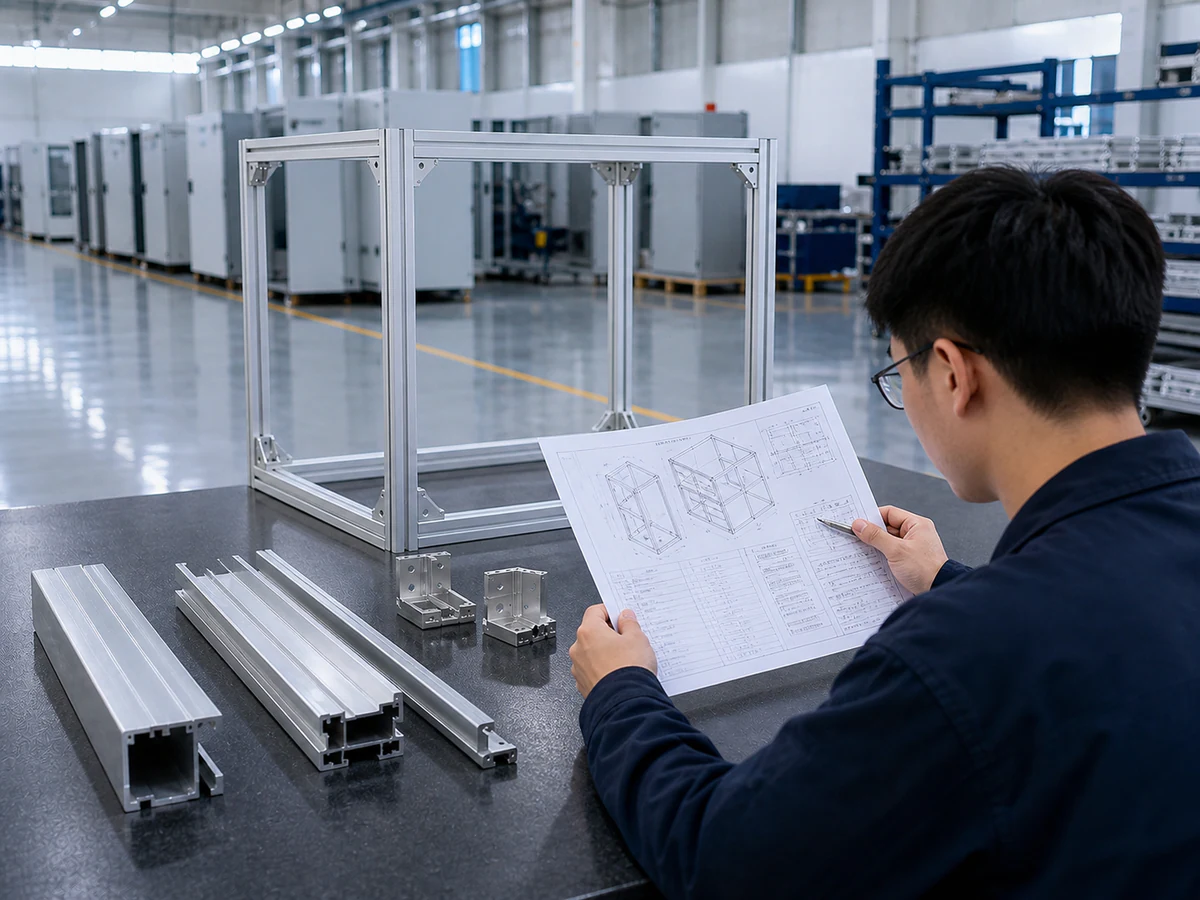
Map the interfaces that make a rail usable
A rail is useful only in its intended frame. Make an interface register for the corner connectors, neighboring columns, enclosure panels, doors, mounting brackets, bought battery modules and cable or ventilation arrangements that the system designer has specified. The register should state which interfaces the cut member can affect and who has authority to accept them. Some features may be outside the saw supplier’s scope entirely; make that boundary visible before the purchase order.
For a prepared kit, check that each physical item carries the correct variant and revision identity. For long stock, keep similar-looking profiles separated and connect the released cut list to the saw program. A wrong profile cut to a correct length is still a wrong part. Decide how offcuts, damaged visible surfaces and unidentifiable pieces will be quarantined rather than silently returned to a kit.
Compare complete cost at the same acceptance point
Build a comparison for one accepted cabinet family and one defined production period. The completed-frame route includes bought assembly price, logistics and incoming checks. The prepared-kit route adds in-house joining, fit review and missing-part risk. The in-house route adds stock purchasing, saw and handling equipment, floor space, programming, fixtures, blade and maintenance consumables, operators, inspection, rework and material loss. The question is which route delivers the approved member or frame at the required release stage with predictable revision control.
Do not use an advertised feed-repeatability figure as the finished rail’s dimensional acceptance. The final part depends on the actual stock, support, clamp, blade, program, cut condition, measurement method and any later operations. Ask vendors to separate machine feeding claims from the acceptance evidence for the finished member.
Run a representative trial before committing to an in-house cell
If cutting remains in-house, trial the actual profile families and cut schedule that drive the investment. Include the longest and shortest approved members, different cross-sections, the relevant end forms, recurring kit quantities and changeovers between variants. Agree in advance what is measured, by whom, with which drawing revision, and whether results concern only sawn blanks or ready-to-assemble members. Retain identified samples and the measurement record.
Then perform an assembly-fit review under the cabinet builder’s approved procedure. A member can meet a length check yet still fail a corner, panel or bracket interface. Conversely, a demonstration on unrelated stock cannot establish that a specific cabinet kit is acceptable. Keep the machine trial, member inspection and system-level acceptance as separate sign-offs.
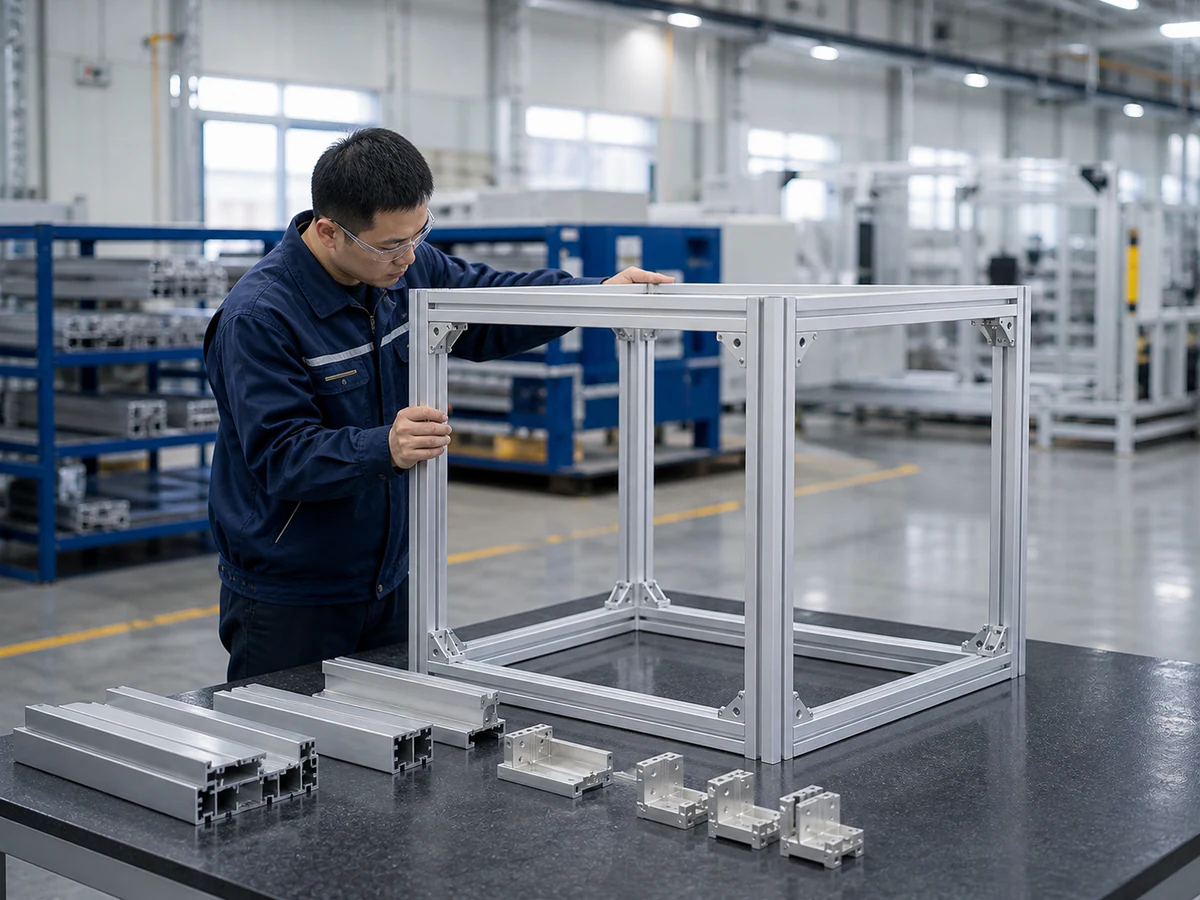
Put these items in the RFQ
- The released cabinet family and the party authorized to approve a member or frame change.
- The supply route to be quoted: complete approved frame, prepared kit, retained long stock, or a named mixture.
- A revision-controlled part and cut list with quantities, cross-sections, finishes and downstream operations.
- The actual input-stock form, length range and how similar profiles will be identified and segregated.
- Required saw output, measurement points, surface-protection handling and kit-label format.
- Trial samples, assembly-fit review owner, acceptance evidence and disposition of nonconforming parts.
- Commercial assumptions: variant mix, batch frequency, bought components, change control and after-delivery responsibility.
Request separate prices for the routes that are genuinely feasible. A vendor who cannot quote a complete frame may still quote a cutting cell; a frame supplier may not own battery-system integration. The RFQ should make these responsibilities explicit rather than folding them into one vague price.
Keep system approval separate from the cutting decision
Stationary energy storage equipment is assessed as a system, not inferred from the appearance of an aluminum rail. UL Solutions’ ESS installation FAQ describes system-level fire and large-scale testing requirements that can apply in specified contexts. The applicable market, installation, listing and system authority determine what is required for the particular product. This article does not prescribe a code route or imply that any depicted frame has been evaluated under UL 9540 or UL 9540A.
That boundary matters to procurement. The saw purchase can be assessed by its ability to process a released member portfolio and deliver traceable blanks. It cannot by itself approve the cabinet design, an installed-system alteration, fire behavior, electrical integration or performance. When a proposed cut would change the released system, return it to the responsible engineering and compliance authority before ordering.
Equipment example and next step
The Jiurun video below is a general example of an enclosed aluminum angle-saw and its handling area. It does not show the cabinet rails pictured above and does not prove a material, model configuration, customer job, trial cut, dimensional result or energy storage system performance.
Watch the Jiurun angle-saw equipment example.
If your released cabinet member list calls for retained cutting, send Jiurun the approved profile range, cut list, input-stock form and trial-acceptance plan through the contact page. Ask for a machine and handling proposal against that defined job, while keeping cabinet and system approval with the responsible authority.
Frequently asked questions
Can a saw quotation replace a cabinet-frame quotation?
No. A saw quotation covers the defined cutting scope. A complete-frame quotation includes other fabrication and assembly work. Compare both at the same accepted output stage.
Can one cut sample approve all cabinet variants?
Only if the responsible buyer has defined a representative family and the sample covers its controlled differences. Otherwise, record the untested variants and perform the additional trial or review that the buyer requires.
Does the machine video prove this cabinet rail can be cut?
No. It is general equipment footage from Jiurun’s own channel. The released rail geometry, material, setup and acceptance must be checked on the actual job.