
A repeat order for aluminum display racks can fail even when every new member matches the length printed on the old cut list. The profile may have a different slot or bore, the connector may have changed, a shelf may use a revised pitch, or a new finish lot may look different beside an installed rack.
The buyer’s question is therefore not simply, “Can this saw cut the length?” It is, “Will the new parts interchange with the approved rack at the receiving and assembly point?” This guide sets a practical release boundary for display rack repeat orders before anyone commits stock or cuts another batch.
Decide whether this is a repeat, a substitution, or a new revision
Start with one approved physical rack and its current drawing package. An exact repeat uses the same approved profile, connector, hole preparation, visible finish, orientation and assembly relationship. A proposed substitute may perform the same job but must be tested against the old rack and its accessories. A changed shelf position, load requirement, panel interface or overall envelope is a design revision, even if many cut lengths remain unchanged.
Label these three routes separately in the purchase order. Otherwise an unapproved substitute can arrive under the apparently harmless description “same as last time.”
Record the rack family, drawing and revision, profile supplier or approved equivalent, extrusion section identifier, alloy and temper if specified, finish specification, connector part number, end preparation, cut length and quantity by position.
Also record which old stock or field-installed units the new order must mate with. Do not let a generic outer size such as “40 mm frame” stand in for the actual section and connector system. The profile maker item explains that its modular lines differ in groove and bore geometry and that connections are often anchored in the groove; that is useful background for why a nominally similar extrusion needs interface checking, not a claim that these images or Jiurun equipment use item components. See item’s profile-system explanation.
Display rack repeat orders: freeze the interfaces that make parts interchangeable
For display rack repeat orders, a controlled release pack needs more than a cut list. Identify the face that is visible in the store, the face that carries the shelf or panel, the slot that receives the fastener, the end that meets a post, and the datum used for length.
Specify whether the drawing length is the extrusion’s overall length, a shoulder-to-shoulder span, or an assembled clearance. Mark handed or mirrored parts explicitly. If a connector sits inside a slot or central bore, verify its part number and access direction before approving a new profile source. A section change that moves a groove may make an otherwise accurate cut unusable.
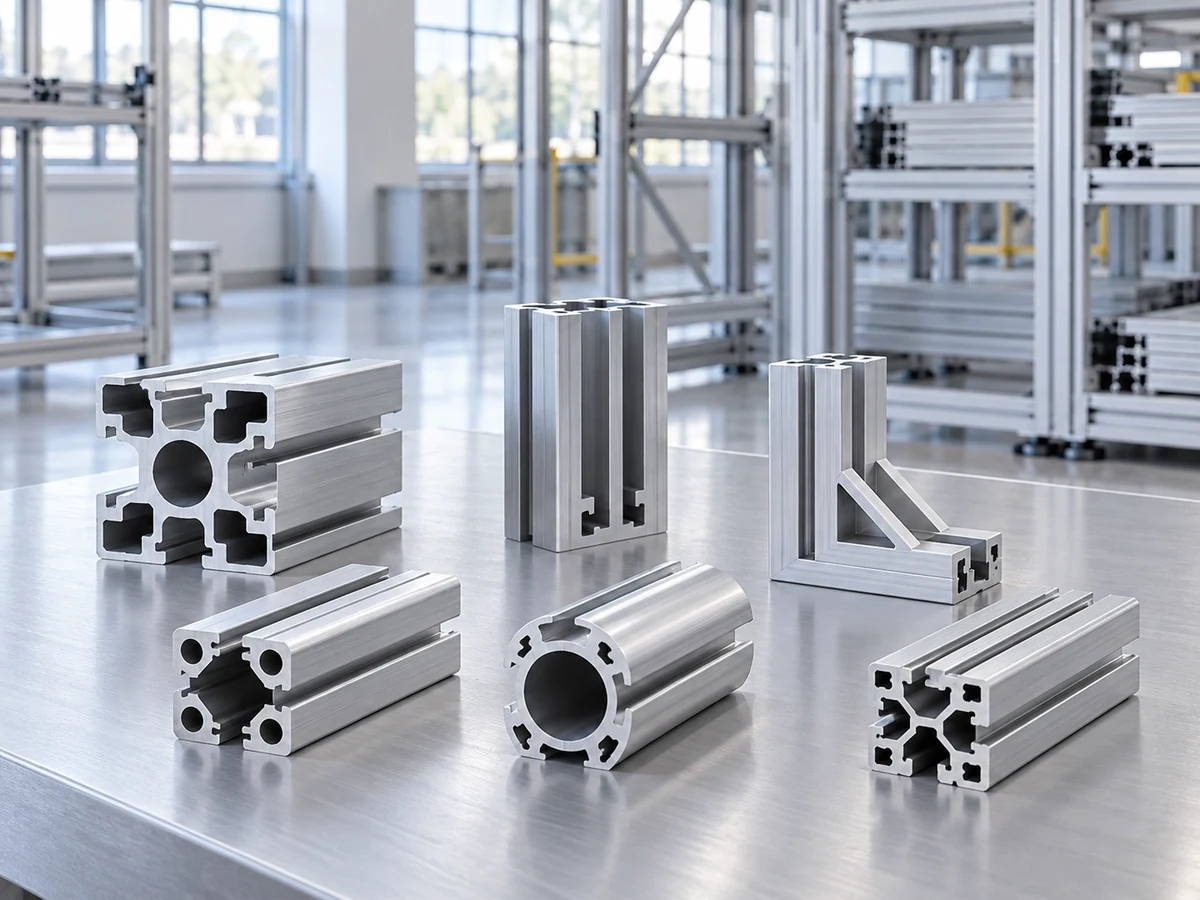
Control visible finish separately from structural fit. A new rack that is mechanically interchangeable can still be rejected if its anodized or coated members visibly differ beside installed units. Agree on the comparison light, viewing distance and retained reference sample with the customer; do not invent a universal color tolerance.
If old units have worn or faded, decide in writing whether the target is the original approved finish or the current installed appearance. Keep those decisions with the revision record rather than asking the saw operator to resolve them at dispatch.
Choose the purchased unit before requesting a saw quotation
There are three useful purchase boundaries. Loose cut members include the specified sections cut to the agreed datum; the buyer handles any drilling, tapping, connector supply, kitting and rack assembly. A prepared frame kit adds the named end work, identifiers and counted connectors, ready for a controlled assembly check. An assembled rack also includes the approved joint build and agreed pack or transport protection.
Compare quotes only at the same boundary and acceptance point. A low price for loose cuts is not comparable with a price for a complete, checked rack. Our separate flat-pack versus assembled delivery guide covers the shipping decision.
Ask the supplier to show line items for extrusion stock, saw cutting, any machining after cutting, connector supply, trial assembly, finish protection, labeling, packing and rejected-part handling. State who owns leftover stock and approved master samples. If the installed family uses more than one section, submit the actual mix rather than a convenient single profile.
ASTM B221/B221M covers specified aluminum-alloy extruded profiles and other extruded forms; citing its scope helps identify a material-specification conversation, but a material standard alone does not approve a finished display-rack joint or a particular cut tolerance. ASTM’s B221 listing is the source for that limited point.
Run a cross-fit trial before releasing the batch
Build the trial around the hardest interchangeability question, not the easiest cut. Select the shortest and longest member in the order, at least one connector-bearing joint, any mirrored pair, and a shelf or panel position that depends on the revised drawing. Include one retained old member or an approved master rack. First verify incoming stock identity and section against the approved sample.
Next cut and measure from the agreed datum with the actual support and clamping arrangement. Then assemble a new member with the old connector and, where relevant, an old member with the new connector. This cross-fit sequence can reveal an interface change that a length gauge alone would miss.

Use the customer’s actual acceptance limits and measurement method. Record the stock lot, machine and blade setup, drawing revision, part position, measured feature, fit result, responsible approver and disposition of any failed sample. If the trial fails, sort the cause before recutting: wrong stock, wrong datum, swapped hand, end preparation, connector mismatch or an actual saw-process issue lead to different corrective actions. Our display-rack saw-trial article discusses shelf pitch and assembly-fit checks in greater detail.
Decide when cutting in-house is justified
An in-house aluminum saw is useful when the organization retains enough repeatable member cutting to control the released profile mix, accepted-part flow and changeovers. It does not replace design approval, connector sourcing or downstream preparation.
Compare three routes for the same accepted output: buying complete approved racks, outsourcing prepared kits, and cutting approved stock in-house. For each route include stock handling, setup and trial time, rejected parts, connector and finish responsibilities, packaging, urgent reorder response, and the person who signs off a revision. A saw can improve control of a real retained cutting bottleneck; it cannot make an undefined rack family interchangeable.
If requesting a machine quotation, send representative extrusion sections and lengths, the widest and smallest profiles, the shortest accepted part, actual cut angles, expected mix per shift, site envelope, and a sample of the approval method. Ask what the quoted configuration includes for feeding, clamping, blade, outfeed and guarding. Do not transfer a model’s published feed-positioning number into a promise about final assembled-rack accuracy. The member-kit cutting guide helps define what belongs at the saw and what belongs downstream.
A release sheet for the next repeat order
- Approved rack family, drawing revision and one retained master sample or controlled photographs.
- Exact profile section IDs, approved alternatives, alloy/temper where specified, and visible finish reference.
- Connector IDs, fastener access, end work and any panel or shelf interface.
- Cut list by position, quantity, hand, datum and acceptance method.
- Purchased unit: loose cuts, prepared kit or assembled rack; name the owner of every excluded operation.
- Representative cross-fit trial plan, approver and failed-sample disposition.
- Lot and revision labels, pack protection and receiving check.
For display rack repeat orders, release the batch only when trial evidence supports the exact purchase boundary. Keep the approved first article and revision record for the next store rollout; a later “repeat” can then be checked against a real baseline rather than a vague description.
Equipment video: a general cutting example
The video below is from Jiurun Machinery’s own YouTube channel and shows general aluminum-saw equipment. It is an equipment-view example only. It does not demonstrate this display-rack section, the connector system, a customer order, a trial cut, the quoted configuration or achieved performance. Use the documented cross-fit and measurement plan above to judge a specific project.
Play the Jiurun equipment example
Send a quote package that can be checked
If you are planning repeat display-rack member cutting, send Jiurun the approved extrusion section drawings, sample sections, cut list, connector and end-work boundary, expected order mix and acceptance method. Ask for a configuration and representative trial plan against those inputs. We can discuss the saw-cutting scope; assembly design and rack load approval remain with the responsible rack designer and buyer. Contact Jiurun with your RFQ package.