
Curved curtain track cutting starts with a measurement problem. A bay window can have a clear opening width, a wall projection and a finished curtain path—and those are three different measurements. A buyer who sends only the opening width to a saw supplier has not yet specified the straight aluminum blank needed for a curved rail. The finished track may include returns, offsets, a splice and hardware zones. Its actual length depends on the released bend path and on where the track maker measures that path.
Practical decision: release the track system and bend drawing first, then agree which dimensions belong to the saw blank, the bent rail and the assembled curtain system. Do not turn the window’s straight-line span into a cut length by adding a guessed allowance.
The straight-line span is not the rail path
Consider a track following two sides of a bay. A tape measure between its end locations gives a chord or projection, not the distance traveled along the rail. Even a dimension marked “overall width” may refer to the outside of a fitted track, the wall opening or a mounting envelope. None of those labels alone defines the length to cut from straight stock.
The drawing should identify the specified rail profile, the measurement reference (for example, the designated rail edge or centerline), bend directions and positions, end coordinates, and any straight lengths before and after each curve. Ask the track or bending supplier to mark the reference on the drawing. Forest’s DS bending instructions, for example, distinguish bend and measurement references for that particular system. This is a useful reminder to agree a reference; it is not a universal formula for every curtain rail.
Also state whether the quoted item is a single continuous rail, two rails joined on site, or a rail with shaped returns. A joint can change the required individual blank lengths even when the installed envelope is identical.
Choose the rail system before deciding the bend sequence
“Curtain track” does not name one interchangeable extrusion. A manual glider track, a corded arrangement and a motorized rail can have different profiles, carriers, drive hardware, end stops and bending rules. Forest’s KS manual track and CS manual track are separate systems; Forest also documents a motorized track system. Their published details should be read for the selected system, not mixed into a generic “curtain track” tolerance.
Confirm that the specified profile can be bent in the requested direction and radius with its intended carriers and hardware. The rail mouth and wall orientation matter because a profile can be physically bent yet leave the carrier path unsuitable. Forest’s bending instructions for several named systems show why tool orientation and the distance from the bending reference to the rail end need explicit treatment.
Which comes first: sawing or bending?
There is no safe default answer from the window dimensions alone. In one approved workflow, straight stock is sawed into a controlled blank and then bent. In another, the bender needs additional straight material for handling or later end trimming. Specify the sequence with the actual track and bending supplier, including who owns any approved trim allowance and what happens if a bent end moves outside the required envelope.
For curved curtain track cutting, give the saw supplier the extrusion drawing and sample, incoming stock length and condition, required blank length and datum, end-face requirement, finish protection, and quantity. A repeatable straight blank is a useful acceptance point. It does not prove that the bent assembly will fit the bay or that carriers will pass through a curve.

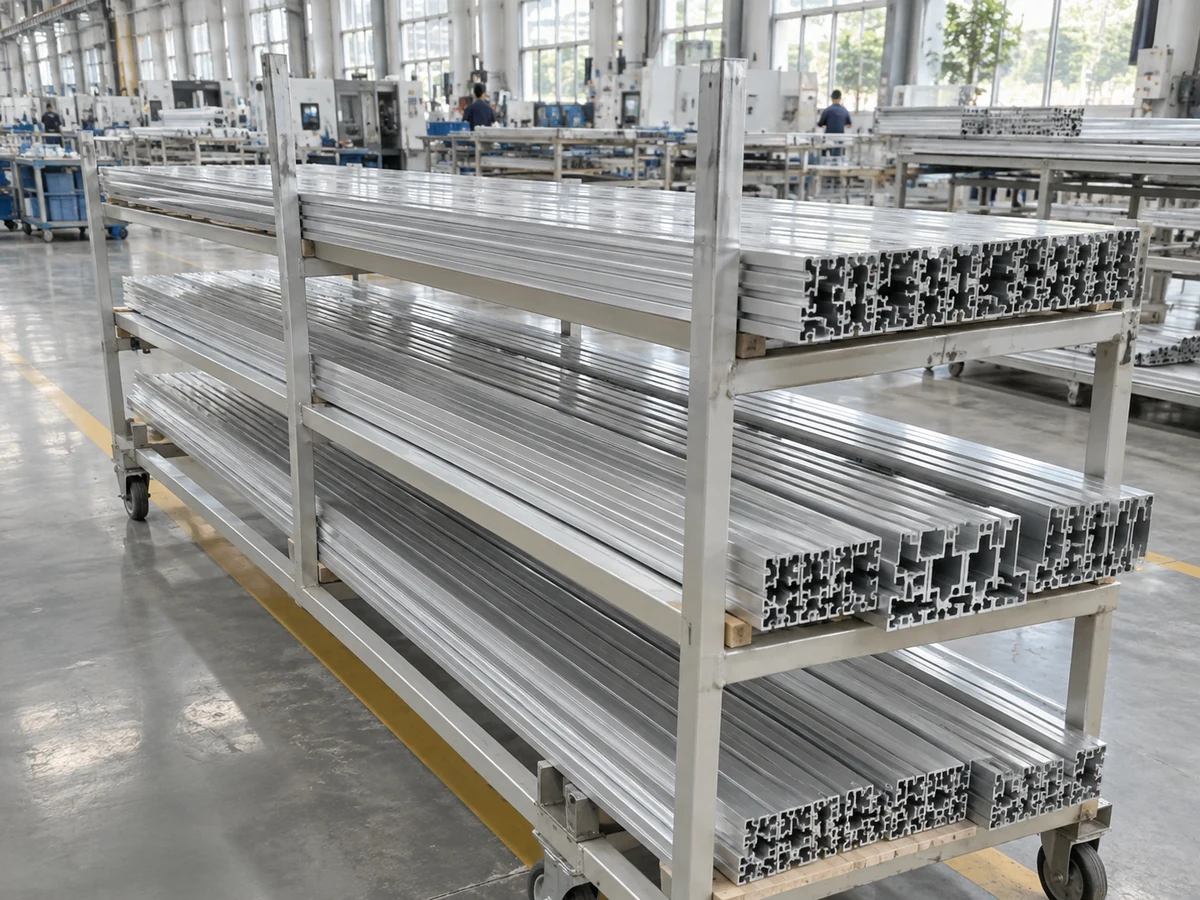
Long, slim stock also needs a defined handling path. Infeed support, offload space and separation of unfinished and accepted blanks can affect whether a saw trial is representative. The photo below illustrates long-profile staging only; the visible heavy sections are not curtain rails.
Separate four acceptance points
- Drawing release: the track maker accepts the rail system, section, curve geometry, reference dimensions, mounting plan and hardware positions.
- Cut blank: the saw supplier and buyer agree the straight blank length, datum, end condition and identification. Check these on sample blanks before production.
- Bent rail: the bender checks the specified path, end positions, orientation and finish after forming. A good blank can still fail this stage.
- Assembled system: the installer or system supplier checks the fitted envelope, brackets, end stops and actual carrier movement, with the intended curtain load where the system specification requires it.
This separation makes a failure actionable. A blank that is too short calls for a cut-plan or measurement review. A blank that meets its drawing but ends in the wrong installed position calls for a bend-reference or layout review. A rail with correct geometry but sticking carriers calls for a system and forming review. Recutting stock without locating the failed stage can waste otherwise acceptable profiles.
What the saw demonstration can—and cannot—show
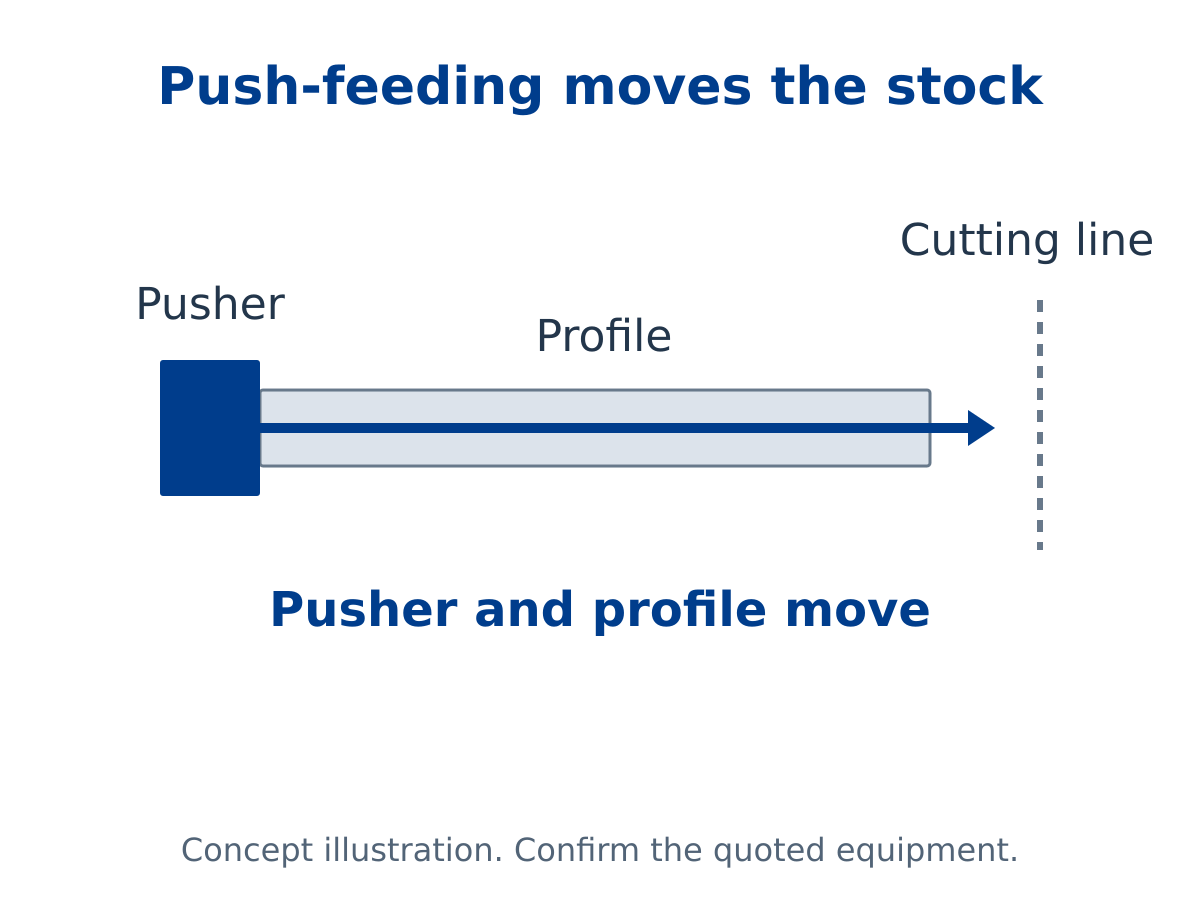
The Jiurun video below shows an automatic aluminum profile feeding and cutting machine. It gives a visual reference for straight-stock feeding. It is not a curved-track bend demonstration, a test of the rail systems named above, or evidence that a particular profile and machine combination meets your drawing.
Send a drawing package that can be quoted
For curved curtain track cutting, a useful proposal starts with the released drawing. Send the released profile section or a sample, the system maker’s bend layout, the marked measurement reference, required straight blank and finished-rail dimensions, expected cut quantity, surface finish, and the acceptance owner for bending and carrier travel. If the developed path or trim sequence is still undecided, ask the track maker to resolve it before requesting a production cut length. Jiurun can then review the straight-stock cutting and handling portion against the actual extrusion and acceptance method. Send the drawing package to Jiurun.