
Boat seat pedestal post cutting begins with a purchasing boundary: are you buying a complete approved seating system, a finished replacement post, or a straight aluminum blank that an OEM will finish and validate? Those are different deliverables. A saw quote for the third route should be based on the released post drawing and real incoming stock, not on a nominal seat height or a catalog diameter alone.
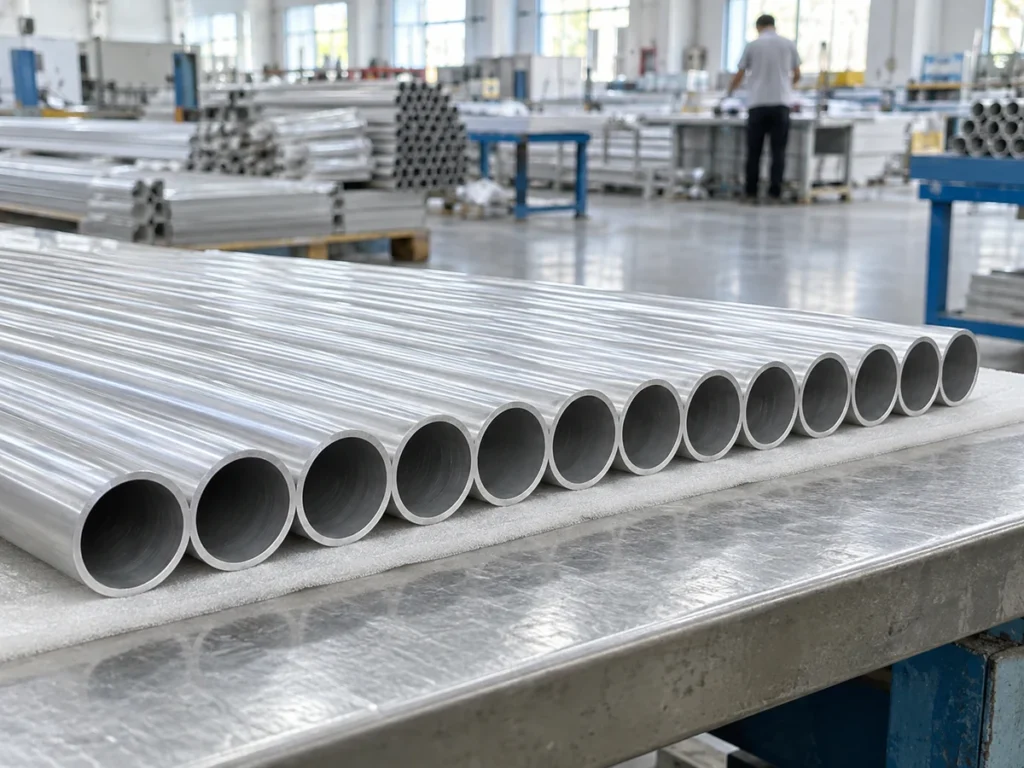
As a product example, Springfield Marine lists an anodized aluminum pedestal post while identifying the seat mount and base as separate components. That listing illustrates why a cut tube is only one part of the seating system. It does not identify a Jiurun customer, prove cross-brand compatibility, or qualify any saw for that post. The featured photograph likewise shows related round aluminum tube samples, not a marine pedestal order.
Decide what the supplier must deliver
Before asking for a cutting machine or subcontracted cut parts, define the accepted unit. If the boat builder buys a complete pedestal package, the package supplier owns its internal fit and system evidence. If the builder buys a finished replacement post, its approved supplier must state the exact mating family and finished end condition. If the builder releases a straight post blank, the drawing owner must identify which later operations and approvals remain with the OEM.
| Purchase route | What is received | What a saw trial can establish |
|---|---|---|
| Complete seating system | Approved post, base, mount and required hardware under one system responsibility | Usually no in-house post-cutting decision; compare complete supply and receiving controls |
| Finished post from an approved source | Post with specified ends and finish for a named mating system | Only useful if the supplier changes its manufacturing route and the system owner accepts the change |
| OEM-controlled cut blank | Identified straight stock cut to a released blank length | Cut length, end condition, marking and handling on the actual stock; final seating-system fit remains a separate approval |
Do not substitute one route for another just because the visible part is a tube. A post can have an apparently simple straight cut while its insertion, lock, cap, slide or base interface depends on an approved family and downstream work.
Release a post drawing, not a nominal size
The RFQ needs a revision-controlled post or blank drawing. State the permitted stock form and whether the part is an extrusion, another tube product, or an already finished component. Include the specified alloy and temper if the OEM has released them; do not infer either from a stock photograph. Define outside diameter, inside diameter or wall, straightness basis, surface condition, length datum, end squareness and any cut-end feature that the receiving team will actually inspect. Put the limits in the drawing or an approved inspection plan rather than assuming a generic saw tolerance.
For a short post, a small length difference may matter to the assembled seat position, but nominal seat height is not the blank length. The base, engagement depth, mount, slide and any cap or insert can all affect the final height. Ask the system owner to release the post length from its assembly stack. Then identify whether the saw is asked to produce a rough blank for later work or the final length at the cut station.
Also state the end condition honestly. A saw can make a straight cut, but it does not automatically supply drilled holes, a locking feature, a fitted insert, an anodized cut face or a validated seat interface. Name who owns each later operation, how the post is identified between stations and where the accepted-unit handoff occurs.
Plan the finish route before clamping stock
Some buyers release unfinished tube for cutting and finish later; others receive prefinished stock and require the cut station to protect that surface. Record which route applies, the protected faces, acceptable handling marks, cut-edge treatment and packaging requirement. Do not promise corrosion resistance or coating continuity from a photograph or a saw demonstration. The finish owner should specify what happens to exposed ends and how the finished post is inspected.
When quoting prefinished stock, include a representative sample with the same surface state. A trial on uncoated scrap can miss scuffing, imprinting and separation problems that appear on the purchased material. Ask the machine supplier to show how it will support the tube, manage contact at the infeed and outfeed, and keep accepted parts distinct from test pieces. Guarding and safe operation must remain part of the approved machine evaluation.

Make the saw trial answer a purchase question
Give the prospective saw supplier the actual approved stock or a clearly identified equivalent sample, the drawing revision and the intended accepted unit. Include the shortest and longest released blank lengths, relevant finish states and any length family that changes the support or handling method. If multiple tubes might be cut together, ask for a separate, explicit evaluation: a single-tube result is not evidence that a multi-tube arrangement is approved or economical.
Inspect first-off pieces against the agreed drawing and record the measurement method. Check end squareness and visible edge condition where required, length from the released datum, surface damage, identity marks and segregation of rejected pieces. Let the OEM or system owner decide whether a sample proceeds to the mating base and seat mount for a controlled assembly check. A dry fit can reveal an interface problem, but it does not replace whole-system approval, strength testing or vessel installation validation.
The supplier should demonstrate the entire repeatable route: load, support, clamp, cut, unload, inspect, identify and protect. Ask for a changeover between relevant post lengths and record good accepted pieces rather than counting raw strokes. The buyer can then compare the result with an outsourced finished-post route or a complete pedestal package. For broader machine selection context, see our single versus multi-pipe trial guide; that guide is a buying framework, not approval for this marine component.
Related equipment video: the Jiurun Machinery aluminum profile saw video shows general machine feed and cutting. It is related equipment footage. It does not demonstrate this round pedestal post, the specified material or finish, an approved machine setup, a customer trial or seating performance. The playable video is embedded below.
Release batches by identity and accepted ends
For production, tie each accepted lot to the released post drawing, incoming stock identification, finish route, cut length and inspection record. If there are several post heights or base families, do not let similar-looking tubes share an unmarked bin. A simple bundle label or controlled container can prevent an expensive assembly mix-up. The batch record should show which end is the reference if the two ends receive different downstream work.
Compare total accepted cost, not only cycle time. Count stock yield, setup and changeover, inspection, edge work, finish protection, rejects and the labor needed to deliver the unit the buyer actually wants. If the OEM already buys a qualified finished post, adding an internal saw may transfer more quality and system responsibility than the headline cut time suggests. If the OEM owns a high-volume blank route, a controlled trial can make the machine decision measurable.
Boat seat pedestal post cutting RFQ checklist
- Identify the complete pedestal family and who approves system fit and safety.
- State the accepted unit: complete package, finished post or cut blank.
- Attach the released post drawing, revision, stock form and material/finish specification.
- Give the real stock section, length mix, incoming condition and sample quantity.
- Define length datum, end condition, inspection method and acceptance limits.
- Assign end preparation, insert or lock features, finish and exposed-end treatment.
- Request a first-off and repeat-run demonstration on representative stock.
- Specify lot identity, protected packing, reject segregation and handoff records.
- Ask for the complete quoted machine scope, support/handling arrangement and changeover assumptions.
Common buyer questions
Can a nominal 2-3/8-inch post fit any pedestal base?
No conclusion follows from nominal diameter alone. Mating geometry, lock features and manufacturer family must come from the approved system documentation. Treat the Springfield listing as an example of separate components, not an interchangeability claim.
Can a saw trial certify a marine seat?
No. A saw trial can document the cut blank and its handling under stated conditions. The boat builder or seating-system owner retains assembly, installation and applicable system approval decisions.
What should I send Jiurun for a useful quote?
Send the released blank drawing, real sample stock, finish state, length mix, target accepted output and downstream handoff. Jiurun can then discuss an appropriate cutting trial and machine scope without guessing from a seat photograph. Our marine fabrication buying guide explains how to separate saw work from the complete vessel component route.
Ready to compare a cut-blank route? Contact Jiurun with the approved post drawing and representative stock details. We can review the cutting scope; the seating-system owner remains responsible for component compatibility and final approval.