
Automated aluminum bar storage is a production-system purchase, not simply a way to stack more stock beside a saw. The buyer has to decide whether the store should release material to several destinations, feed one cutting station directly, or support both routes under controlled rules. The useful comparison is the accepted work leaving the whole route: the right bar, in the right condition, at the right destination and time. A faster retrieval cycle alone cannot prove that orders will be cut and released faster.
This guide compares three architectures for an aluminum operation. It does not claim that a particular Jiurun saw contains an automated warehouse, automatic bar separation or a tested storage interface. Confirm the saw, loading options, storage equipment and integration scope in each supplier’s written offer. The photographs below illustrate visible stock and infeed conditions; they do not prove an installed automatic store or its performance.
Define the storage job before choosing a connection
Start with a family sheet for the bars that actually enter the proposed store. Record their physical sections, lengths, bundle and carrier condition, surface-protection requirements, material identification, available floor space and any mixed-length remnants. Mark which stock may go to the saw, which goes to another process, and which must remain in reserve. The distinction matters because a store dedicated to one saw can be efficient for a stable route but inconvenient if the same material must also feed fabrication, machining or external dispatch.
Then describe the order. Is the release request for a full bundle, one identified bar, a particular alloy and temper, or a cut list? Who confirms that the selected stock matches the order and who records the remaining length? Do not assume that a cassette delivered to an infeed is already a single, correctly oriented bar ready for the saw. Retrieval, bar separation, transport, support and saw feeding are different functions that may be quoted by different suppliers.
Three architectures for automated aluminum bar storage
Independent store serving several workstations
An independent bar store can present material at a defined handover point for the saw, another machine or manual picking. This is valuable when work orders change, different processes share stock, or the buyer expects a future route that has not been designed yet. Its flexibility depends on a real release procedure: the selected carrier and bar must be identified, safely transferred and received by the destination. Manual transfer may be acceptable, but its people, travel time, protection and verification steps belong in the capacity calculation.
Ask the storage supplier to state the retrieval position, carrier capacity, permitted material formats, identification method, access for maintenance and the conditions under which an operator may intervene. Ask the saw supplier what reaches its own loading boundary. A drawing showing two machines near each other is not a handover specification.
Store directly coupled to a saw
A coupled route can move selected stock from the storage system toward a defined cutting station with fewer discretionary handoffs. That can be useful for repeatable families and a high share of orders that follow the same path. The connection also makes the stages interdependent. If a carrier is unavailable, a bar cannot be separated, a transfer is blocked, or the saw stops, the whole route may wait unless the design includes a controlled buffer and recovery procedure.
Integrated storage-and-saw systems exist in the wider market. For example, KASTO describes a storage, material-feed, sawing and removal centre. That third-party example shows a possible system boundary; it is not evidence that any Jiurun model has the same architecture or output. Obtain a quotation for the exact material family, saw and transfer functions being offered rather than copying a capability from another manufacturer.
Hybrid store with a reserved saw route
A hybrid design keeps a defined path to the saw while preserving a separate retrieval point for other users. It may offer a useful compromise if one cutting line consumes most stock but occasional jobs need independent access. It requires scheduling rules: which order has priority, how a carrier is reserved, how a store request is cancelled, and whether a partially used bar can return without losing its identity. A nominal second outlet is not a flexible system if operators must stop the first route and reconstruct stock records whenever it is used.

Separate retrieval, singling and saw feeding
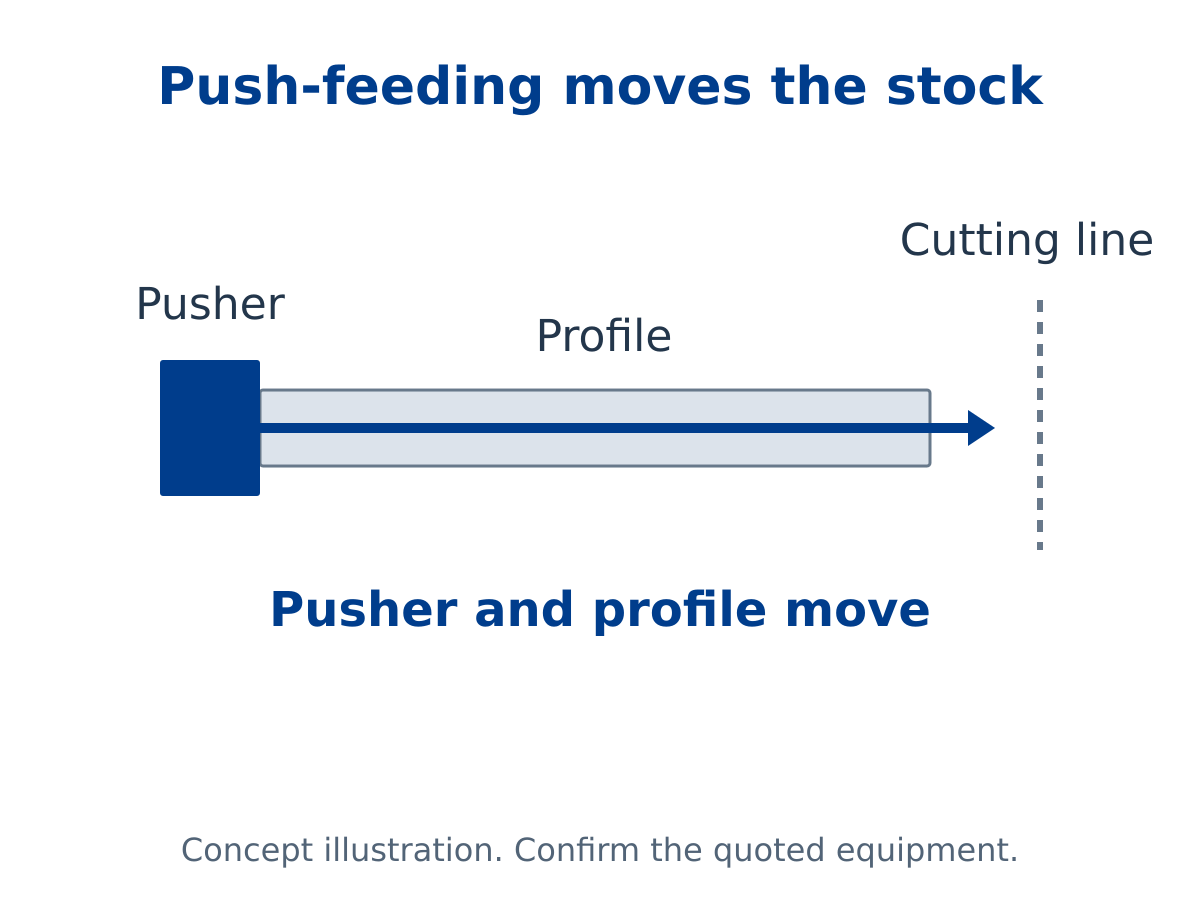
The most consequential interface is often hidden by the word “loading.” A store may retrieve a carrier; a separator may select one bar; a conveyor may transport it; a loader may support and orient it; the saw’s feed system may then advance stock to the cutting position. These are successive jobs, not synonyms. For each boundary, list the bar’s location, orientation, quantity, identity and responsible equipment. State whether an operator can safely clear a misfeed without losing the order record.
A simple process map should show the permitted stock shape and length at every stage, the maximum queue, any surface-contact risk and the fate of a bar rejected at the saw. Request a specific answer for short remnants and partly used bundles. Some systems can return material under defined conditions; others may require a separate manual route. Neither result should be assumed from a general picture of a roller conveyor.
Model demand with the same accepted output for every option
Compare the independent, coupled and hybrid routes over the same production period and the same family mix. The output unit should be an identified, accepted cut order at the agreed receiving point. Estimate the time for selecting stock, moving it, separating a bar, loading, cutting, checking the parts, handling the remainder and releasing the order. Add changeovers, blocked retrievals and maintenance windows. A store retrieval rate and a saw cutting rate are both useful inputs, but neither is a finished-order rate.
Test the hard cases rather than only a long run of one profile. A realistic sequence may include a high-demand family, a short job that interrupts it, a bar that needs protection, a different destination, a partially used remainder and a held part. Record which requests can run in parallel and which compete for the same carrier, lift, aisle or operator. This is where a second retrieval point or a controlled buffer may have more value than a faster single-cycle mechanism.
The saw bottleneck buying guide explains why a faster individual station does not automatically increase accepted output. For a storage purchase, the same principle applies across the material path. Use a comparable scenario and state every assumption before asking suppliers to predict throughput.
Keep stock identity intact through cuts and returns
Automated aluminum bar storage becomes a traceability problem as soon as stock is split. Decide where the order, material specification, lot or bundle identifier, bar length and remainder are recorded. State when ownership passes from the store to the saw and from the saw to the receiving operation. If a cut is rejected, the system must keep the rejected piece and the remaining bar distinct from accepted output. A screen showing an inventory quantity is not enough to prove that a physical remnant can be located later.
Specify the return rule before buying the handling equipment. Will a residual bar go back into a carrier, into a separately identified rack, or directly to another job? What minimum condition must it meet, who checks its new length, and what happens if the label is damaged? Different answers can make a fully coupled connection less attractive than an independent retrieval point, especially when mixed orders generate frequent remainders.
Define safety and integration ownership in the RFQ
A complete offer should identify who designs the interfaces among storage motion, bar separation, conveyors, the saw, guarding, emergency stops, access gates, extraction and control software. Ask how each module reaches a safe state when its neighbour stops, and how production resumes without sending an unidentified bar forward. Do not treat a supplier’s standard equipment image as proof that the particular connection, controller or guard is included.
Also distinguish equipment supply from site work. The buyer may need foundations, floor-load confirmation, electrical supply, protected travel routes, maintenance access, operator training and acceptance support. State which party provides each drawing and which party signs off commissioning. If several suppliers are involved, name the one responsible for demonstrating the whole stock-to-cut sequence. Our multi-supplier integration guide gives a separate way to examine responsibility, while this article focuses on choosing the storage architecture itself.
Make the acceptance test follow real orders
Before approving a system, agree a witnessed test using representative stock and a normal mix of orders. Include retrieval from several storage positions, the longest and most awkward eligible bar, a change of material family, one order for another destination, a cut sequence with remainders, a controlled stop, and recovery from an intentionally held or misidentified item. Measure accepted output and record every manual intervention. Keep any supplier demonstration separate from results on the buyer’s own stock and accepted conditions.
Ask for a quote table with three columns: store-only equipment and handover, store-to-saw connection, and optional hybrid capability. In each column list load carriers, retrieval points, bar separation, transport, saw loading, control interfaces, guarding, installation and test responsibility. Compare complete quoted scope and the labour that remains. If the buyer only needs predictable stock presentation for a saw, do not buy an assumed fully automated warehouse. If several destinations depend on one inventory, do not lock the design to one saw without testing how every other order will be served.
RFQ checklist for the buying decision
- List actual aluminum bar families, sections, lengths, carriers, surface conditions and destinations.
- Define the accepted output and the same mixed-order test period for every architecture.
- Mark each physical interface: retrieval, singling, transfer, support, feed, cutting and return.
- Identify the data owner for stock, order, lot, saw program, accepted parts and remnants.
- Request interruption, manual bypass, safe recovery and maintenance-access procedures.
- Price installation, guarding, controls, training and complete-route acceptance with named responsibility.
Choose automated aluminum bar storage by the work it must release, not by the warehouse mechanism in isolation. A dedicated link can suit a stable saw route; an independent store can serve a varied workshop; a hybrid can work when its priorities and exceptions are engineered. The final choice belongs to the actual stock family, order mix, receiving rules and documented quotation.
Equipment video: general saw example
The following clip is from Jiurun Machinery’s YouTube channel and shows general aluminum saw equipment. It is an illustration of a possible saw station only. It does not show this article’s automated bar warehouse, storage-to-saw connection, a specified material, a quoted model configuration, a customer, a sample cut or verified performance.
To compare a saw station with your proposed storage route, send Jiurun your actual aluminum profiles, cut lengths, order mix and required handover condition. Request the exact saw model and options in the quotation, then obtain a separate complete storage-and-integration proposal from the responsible suppliers where needed.