
Aluminum slatwall insert cutting starts with a panel-system decision, not a saw speed claim. A metal strip can be a loose cut part, an insert supplied with a board, or one element of a finished display. Those are different deliverables. If the buyer gives a supplier only a nominal panel width, the supplier cannot know which groove, end position, finish or receiving test belongs to the cut strip.
This guide helps a retail-fixture manufacturer or OEM prepare a cut-part RFQ for an approved aluminum insert profile. It does not specify a slatwall installation method or certify the load capacity of a panel. For example, Displays2Go describes an aluminum insert that slides into the grooves of its named Easy Panels and expressly limits compatibility to that panel family. The example shows why an insert drawing and its receiving panel must travel together; its dimensions or claims should not be copied into another system.
Aluminum slatwall insert cutting: define the purchased item
First separate four possible orders. A completed slatwall panel includes a board, grooves and its specified insert system. A prepared panel kit may include inserts cut and counted for particular boards. A cut-part order supplies only released aluminum lengths. Long stock is another purchase stage and may still require cutting, sorting and finishing before a panel assembler can use it. Write the desired stage on the RFQ and identify who owns the remaining work.
A cut-to-length saw trial can show whether a stated aluminum stock section can be supported and cut to the approved end condition. It cannot by itself approve groove retention, accessory fit, panel fastening or display loading. If the buyer needs a finished fixture, those downstream checks remain with the panel-system owner. Conversely, if a panel supplier already ships accepted cut inserts, a separate saw purchase may add work without improving the delivered stage. Compare both routes at the same accepted output.
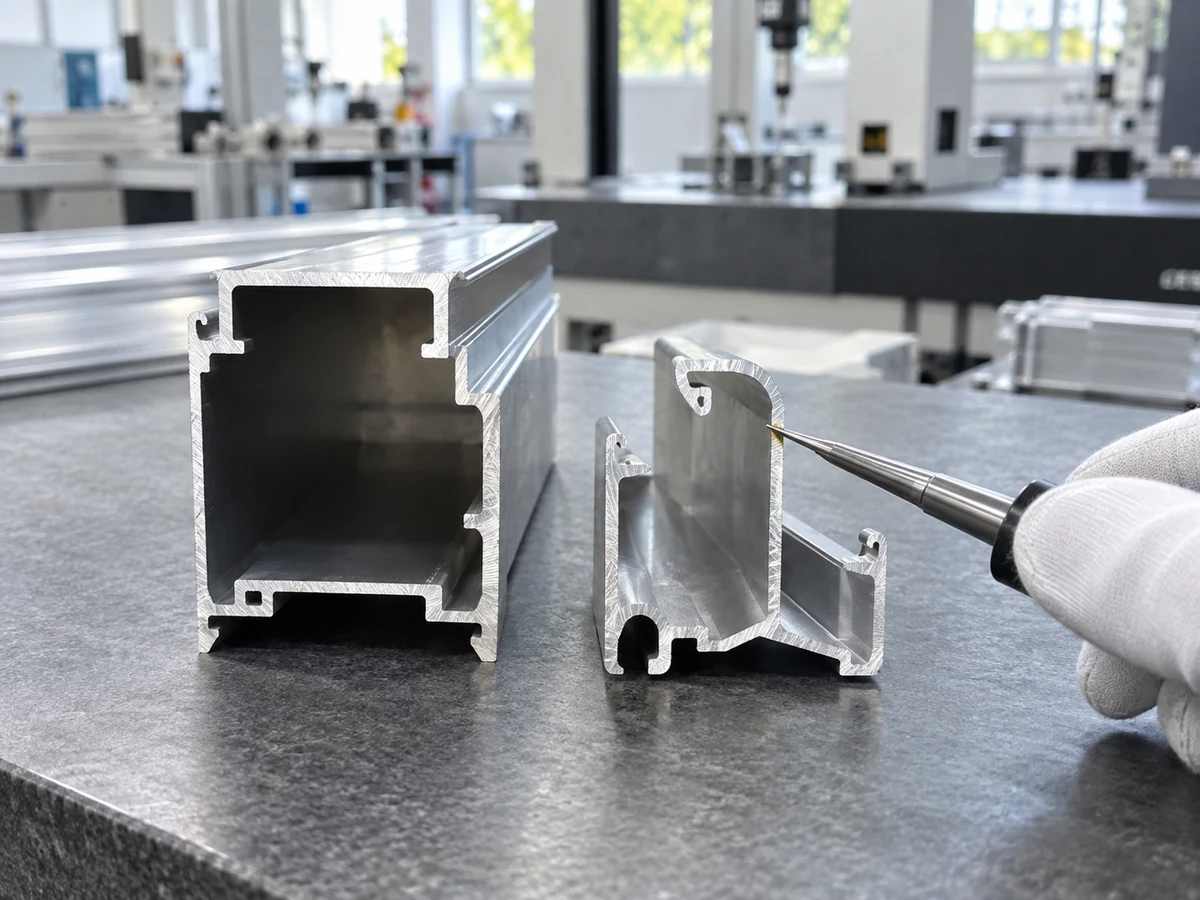
The profile itself must be released, not inferred from the generic word “channel.” A photo of a U-channel may help a buyer discuss open faces and support points, but it does not identify a slatwall insert or prove groove fit.

2. Release the groove and insert interface together
Ask the panel-system owner for the insert drawing and the panel or groove revision it fits. Record the actual input form and condition: extrusion or another approved section, surface finish, any coating, and the orientation in which the supplier receives it. Identify the features the system uses for retention and accessories without assuming every slatwall has the same shape. A supplier can then choose support surfaces that do not crush a lip or mark the visible face.
A useful release package shows which side faces the customer, which face contacts the panel, and which small edges or returns are functional. Keep the dimensions and tolerances on the drawing; do not try to recreate them from a photograph. The panel material and groove geometry may change across product lines, even when two boards look alike. The Displays2Go panel example describes removable aluminum inserts in an MDF slatwall, while its separate insert listing has its own named compatibility limit. That is product-specific evidence, not a universal metal-insert standard.
Also distinguish a loose insert from an installed panel component. If installation requires drilling, fastening or another panel operation, the RFQ should assign that step to the proper party. Do not call a saw-cut blank “ready to install” solely because its length is correct. Any fixture load statement must come from the approved complete system and its specified installation, not from the cut edge or this equipment guide.
3. Define the length datum and end condition
Panel width is not automatically insert cut length. The insert may stop short of a finished panel edge, pass under a side trim, meet another member, or be supplied as a set for several grooves. Put the measured cut-part length on the release drawing and name its reference faces. If an order mixes panel sizes, list each insert length, quantity and revision separately. Specify whether the cut is square, handed, or otherwise shaped only if the approved system requires it.
The RFQ should state whether a visible cut end must be cosmetic, whether a cover hides it, and whether any burr or edge condition could interfere with insertion. The buyer should provide a physical good part or a signed edge acceptance description. A supplier must not silently add deburring, drilling, coatings or end treatment to a quotation that covers sawing alone. Outwater’s published cutting options separate freight-reduction cuts from secondary cuts to specific lengths and say tolerance and cost depend on the product and material. The useful lesson is to state the purchased cut stage and acceptance requirement, not to borrow its tolerance values for this job.
4. Make the saw trial representative
Send the actual approved stock, or a sample that the buyer has confirmed is equivalent for the trial. Include the shortest and longest released lengths, the most delicate contact face, and any finish variation that changes handling. Ask the supplier to document how the member is supported, stopped and clamped in the quoted configuration. A thin lip or open channel can move under the wrong contact arrangement; a clean cut on a more robust sample is not proof for the released section.
Define a first-off sequence before a production-rate discussion. The supplier makes a sample, measures the specified cut-part references, shows the end and visible surface, then the panel owner checks the sample in the approved groove and accessory arrangement. Record who signs each result. If that fit check fails, determine whether the section, length, edge or receiving-panel revision caused it before changing the saw setup. A fit judgment belongs to the approved panel system, while the saw trial documents what the cutter produced.
Keep the comparison honest when asking about automation. Feed, stop setting, clamping, sample inspection and operator handling all belong in the quoted process. Jiurun manufactures industrial aluminum and nonferrous circular-saw cutting equipment, but this article does not claim that a particular Jiurun model has been validated for a slatwall insert. Request a trial on your released profile and the exact proposed configuration. For a broader explanation of contact surfaces, see our back-fence reference-face guide.

5. Quote the whole released set and receiving stage
A purchasing table should contain panel family, insert profile ID, revision, stock condition, cut length, end condition, quantity, visible-face rule and the next operation. Add an identifier for the board or kit that receives each batch. If a kit requires fifteen strips, for instance, a quote for fifteen indistinguishable pieces is still incomplete when multiple panel sizes are mixed. Require length groups and revision labels that the assembler can verify without remeasuring every part.
Separate the cost of released cut inserts from the cost of preparing panels, installing inserts and certifying the finished fixture. Include setup and changeover across actual length families, sample approval, inspection, handling protection, packing and any supplier-sourced stock. If the alternative is to buy accepted insert sets or complete panels, compare like-for-like receiving stages for the same order mix and time period. Avoid comparing a bare cut-part price with a finished panel price as if both delivered the same result.
Before dispatch, agree on how exposed faces and cut ends are separated, how batches remain associated with panel revisions, and how a short or damaged member is replaced. The receiving check should be explicit: count, ID, length reference, visible surface and a system-owner fit check where required. The cut-part batch release guide explains how to distinguish first-off, in-run and last-off evidence. None of those inspections substitutes for approval of the complete wall fixture.
A practical RFQ package
- Released insert section drawing and matching panel or groove revision.
- Actual stock form, finish and protected faces; approved physical sample if available.
- Length and end-condition schedule by panel size, orientation and quantity.
- Cut-part dimensional and visual acceptance criteria, plus downstream work ownership.
- Representative trial samples and named sign-off for cut result and panel fit.
- Batch labeling, packing and replacement rules for the assembler.
The video below shows a Jiurun aluminum-cutting equipment example. It is general machine context only: it does not show this insert, this panel, a specified model configuration, a customer job, a verified trial or a performance result.
If your factory is comparing long-stock purchase, cut-insert supply and an in-house saw for aluminum slatwall insert cutting, send Jiurun the released insert profile, panel-family schedule, representative stock and first-off acceptance plan through our contact page. We can discuss a cutting trial and the equipment scope to quote; final panel-system compatibility and fixture approval remain with the responsible system owner.