
An aluminum sawing and deburring line should be bought against the condition of the part that leaves the entire route, not against the saw’s cycle time alone. A fast cut can still feed a slow edge-finishing station, create mixed work-in-progress, or leave the buyer uncertain about who releases a piece after a fault. The purchasing choice is between a stand-alone saw and separate finishing, a directly linked line, and a deliberately decoupled handover. Each can be sound for a different product mix. The comparison becomes useful only when the same accepted output, product families, inspection method, and responsibility boundary are applied to all three.
This article is a buying framework for production planning. It does not claim that every Jiurun saw includes a deburring machine or that a particular linked configuration has been tested. Confirm the offered saw model and options in a written quotation. Specify any separate edge-finishing equipment, integration work, and complete-route acceptance with the responsible suppliers before ordering.
Start with the released part, not the machine list
Write down what a downstream operation may receive. Is it a cut blank whose end will be processed later, or a finished cut end that must pass a defined edge requirement now? Define which face and edge matter, how the part is oriented, whether a visible burr is acceptable, and which inspection method will decide. A phrase such as “deburr after cutting” is too open: it leaves the removal method, allowable residual condition, and ownership of rejected parts to be decided after installation.
Build a representative family sheet before comparing suppliers. Include cross-section and wall variation, length range, alloy and temper where relevant, surface sensitivity, batch size, changeover pattern, and any subsequent machining or assembly. Mark the family that needs finishing and the family that may bypass it. Add an agreed sample or drawing reference for every critical edge. The distinction between a cut-end specification and a finishing-process promise is explained in our cut-part deburring requirements guide.
Three routes solve different production problems
Independent saw and finishing stations
A separate saw can supply a manual or independently controlled deburring station. This gives the plant freedom to route some parts around finishing, change one station without redesigning the other, and share edge-finishing capacity across jobs. It can also suit irregular batches that require visual sorting or several finishing methods. The cost is a deliberate handover: operators must identify each batch, protect its cut surfaces, record the saw program and orientation, and control waiting stock. A trolley between stations is not a process definition.
Ask who signs off the sawn blank, who owns damage during transfer, and how a rejected or held part is marked. Define the maximum practical intermediate buffer in pieces or containers for the actual job mix. If one operation runs faster, the buffer may absorb short variations; it does not create finished output. Include labor, handling, queue time, and rework when comparing the route.
Directly linked cutting and edge finishing
A linked route moves workpieces from sawing into edge treatment under a defined sequence. This may reduce loose handling and make traceability simpler for a stable family. It also couples stoppages: a downstream brush, extraction, transfer, or inspection issue can prevent the saw from producing accepted pieces unless the line has a designed bypass and hold procedure. A brochure rate at one station therefore cannot stand in for output from the complete line.
Integrated systems do exist in the wider market. For example, Rattunde describes a combined sawing and brush-deburring system that includes aluminum among its applications. That is an example of a possible architecture from another manufacturer, not a Jiurun configuration or a performance comparison. A buyer should request the exact offered scope, supported family, transfer arrangement, safety interface, and acceptance test from the supplier quoting the complete route.
Decoupled, but engineered, handover
A third route uses separate stations with a repeatable intermediate interface. It may include identified trays, a defined part orientation, a controlled buffer, and a release record, while allowing the finishing station to operate independently. This is more than a manual workaround. It can preserve flexibility when the job mix changes while reducing the ambiguity of an informal transfer. Compare its handling time and controls against the cost and coupling of a direct link.

Compare one accepted output measure across all options
Make the denominator an accepted, edge-compliant part at the agreed handover. For each route, map loading, clamping, cutting, transfer, edge treatment, inspection, reject isolation, and unloading. Note when manual work is counted and when a machine waits. Then run the same representative family and batch sequence through the estimate. Avoid comparing one supplier’s saw-only pieces per hour with another supplier’s fully inspected pieces per hour.
A practical worksheet has a row for each family and columns for demand, cutting time, finishing time, handling, changeover, inspection, yield and expected hold events. Record assumptions separately from demonstrated results. Test mixed batches as well as the easiest continuous run. A high-volume family may favor a link while a low-volume family needs a bypass or separate station. Our saw bottleneck purchasing guide explains why extra station speed may not increase accepted output.
Specify the aluminum sawing and deburring line interfaces
The important interface is the state of the part and its information at each boundary. Define which station knows the work order, material family, target length, saw program, finishing recipe, piece count, and accepted or rejected status. If the route includes automatic transfer, ask how orientation is maintained, how two different parts are kept separate, how a jam is cleared, and what happens after an emergency stop. If operators move containers, define equivalent labels and release rules rather than assuming that manual work is self-explanatory.
Also separate responsibility for extraction, chip control, electrical and control interfaces, guarding, access, and commissioning. A saw supplier may quote only the cutting station. A finisher may quote only edge treatment. If an integrator is involved, make the contract identify who designs the transfer and who demonstrates the full sequence. Do not infer from a general equipment photograph that these items are included in any offered model.
What to inspect at the cut and after finishing
Inspect the sawn blank before the finishing step when diagnosis matters. Document cut length against the agreed datum, end condition, orientation, and visible damage. After finishing, inspect the edge requirement with the agreed method and viewing conditions. Keeping the two checkpoints distinct makes it possible to tell whether a defect arose in cutting, transport, or finishing. It also stops the final station from masking an upstream quality problem.
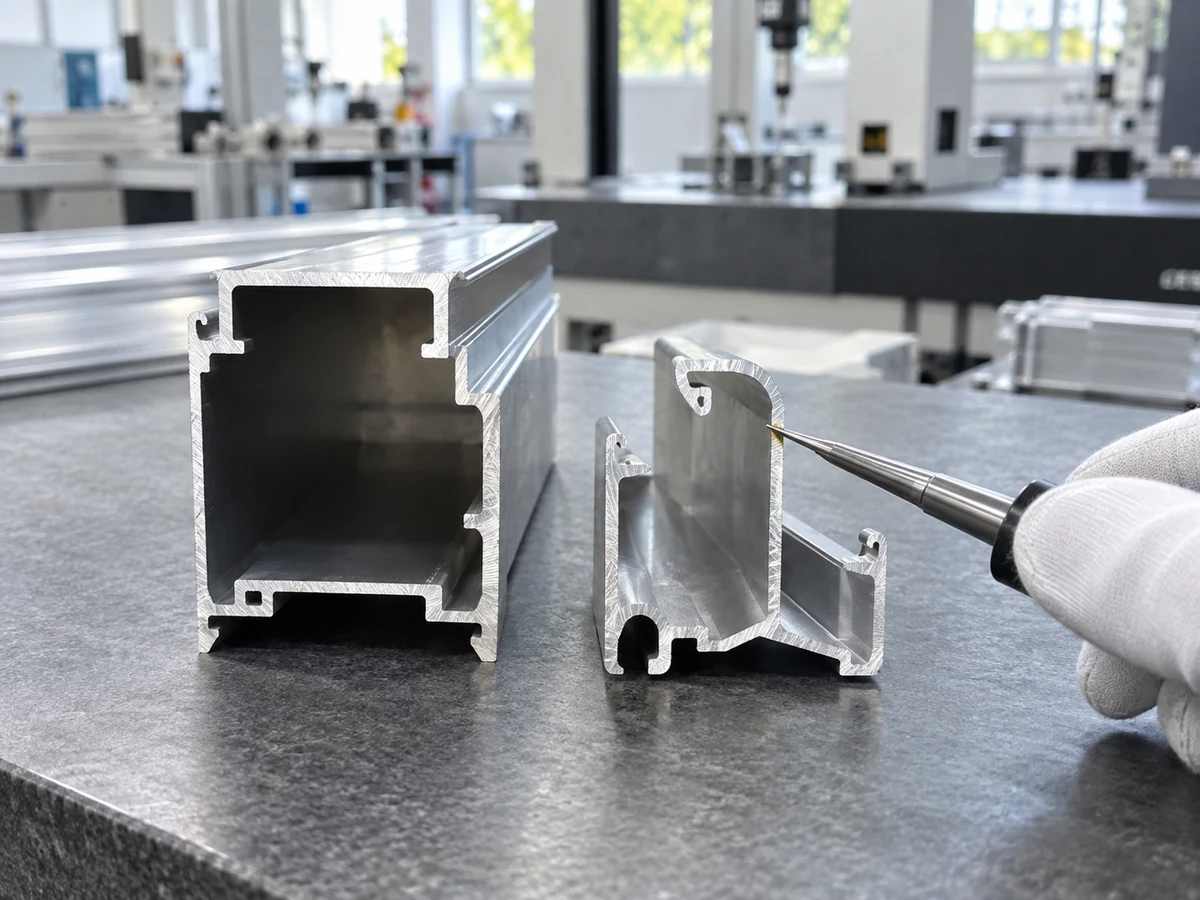
Prepare a traceable sample plan: identify the material and profile, record the route and program revision, isolate first-off parts after a change, and label any held pieces. A photograph can support discussion but cannot replace a measured acceptance record. The image below illustrates an edge review at a bench; the actual requirement and result must come from the buyer’s drawings, samples, and agreed inspection procedure.
Test changeovers, stoppages and service separately
Ask suppliers to describe the change from one profile family to another through the entire route. The saw may need a blade, clamp, support or program change, while the edge finisher may need a different brush, recipe, fixture, or inspection instruction. The line is available again only when the next family can produce accepted parts. Record the first-off verification and any cleaning or stock segregation between jobs.
For service, map failures rather than assuming that an integrated line is always less reliable or a separate route is always easier to maintain. Can the saw run into a safe, identified buffer if the finisher is down? Can the finishing station process previously cut parts if the saw stops? What controls prevent an unreleased piece from going straight to assembly? Ask which supplier restores each interface and who owns software or electrical revisions. Compare the cost of an interruption using the plant’s own demand and inventory policy.
Use one complete-route acceptance trial
Before an order, turn the family sheet into a witnessed acceptance plan. Include difficult but representative parts, the normal mix of long and short runs, at least one changeover, startup, a controlled stop and restart, reject isolation, and both the saw-only and final-edge inspections. State where output is counted and how long the run lasts. Record every manual intervention, held piece, rework, and unplanned stop. Suppliers can then explain which outcomes are within their quoted scope and which require an integrator or separate operation.
Do not borrow another manufacturer’s speed, accuracy, or certification values for a Jiurun offer. Saw feeding specifications are also not finished-part accuracy. The appropriate figures belong to the exact model, tooling, material, setup, measurement method, and witnessed acceptance record. If one vendor quotes a saw station and another a complete line, request a side-by-side scope table before discussing price.
A short RFQ package that makes the choice answerable
- Representative drawings, material families, lengths, quantities, and changeover pattern.
- Required condition of the cut end before finishing and of the released part after finishing.
- Which families need edge treatment, which bypass it, and what traceability each route needs.
- Proposed handling, orientation, buffer, reject and hold procedures.
- Station-by-station scope, interface ownership, guarding, extraction and commissioning responsibility.
- Common complete-route acceptance plan with recorded interventions and measured results.
For an aluminum sawing and deburring line decision, choose the architecture that meets the released-part requirement with an ownership model your plant can run and maintain. If the requirement is only for sawn blanks, a stand-alone saw may be sufficient. If many stable parts require the same controlled edge treatment, evaluate a linked line. If product families and finishing routes vary, an engineered decoupled handover may be stronger. The result must be established against real drawings and a scoped quotation, not inferred from a generic clip.
Equipment video: general saw example
The video below is from Jiurun Machinery’s YouTube channel and shows general aluminum saw equipment footage. It is an equipment illustration only. It does not show this article’s complete sawing-and-deburring line, a specific material, a quoted model configuration, a customer, a sample cut, or verified performance.
To assess the saw station in your own production route, send Jiurun your representative drawings, material and volume mix, required handover condition, and proposed downstream finishing scope. Ask for the exact saw model and options in the quotation, and arrange a separate complete-route proposal with the responsible finishing and integration parties where needed.