
A supplier reference can help a buyer understand another company’s experience. It cannot automatically demonstrate that a proposed aluminum saw will satisfy a different cutting job. The recommendation may concern responsive communication, a straightforward installation or work on a part that has little in common with the buyer’s own requirement.
Use aluminum saw supplier references to answer a defined question. Establish what the reference source actually experienced, which equipment and job it concerned and how that experience relates to the present offer. Keep the useful information without turning it into an unsupported capability or service guarantee.
This guide provides an original purchasing worksheet and hypothetical comparison questions. It contains no customer testimonial, named reference, claim about Jiurun customers or verified production case. A real reference discussion and any technical assessment must be established separately.

What should aluminum saw supplier references establish?
There are several possible questions behind a request for references. A buying team may want to understand how a provider handled technical clarification, whether the delivered scope matched the offer or what information helped another buyer prepare the site. It may instead be looking for experience with a similar cutting task. Those questions should not be treated as interchangeable.
The International Trade Administration’s guidance for exporters evaluating foreign representatives includes trade references and information about whether specific requirements can be met among the information to request. See its foreign-representative evaluation guidance. That is an exporter-partner context, not an assessment of any saw supplier. The questions below apply our own purchasing analysis to offered reference information.
Write the present decision before asking for a contact or a case summary. For example: “We need to understand which technical information this provider requested before it confirmed the quoted cutting scope.” That question has a more useful target than “Was the supplier good?” A positive general impression may still leave the actual quotation question unanswered.
Keep commercial experience and application evidence in separate fields. Someone may have first-hand experience of ordering and delivery without being responsible for evaluating the cut pieces. A different person may know the assessed cutting task but not the later service history. Identify the role and relevant period rather than expecting one source to answer everything.
Identify the reference and the limits of its knowledge
Ask the provider how the reference information was obtained and what it is offering to share. Is it a published case summary, an approved introduction to a customer or a description supplied by the salesperson? Keep that source type attached to the record. Do not present a forwarded sales description as an independently obtained customer account.
For a proposed discussion, identify the person’s relevant role and the part of the purchase they experienced. The useful record can state that a source was involved in equipment selection, commissioning coordination or production review without placing private personal details into a broadly circulated spreadsheet.
Ask what time period the reference covers. An earlier delivery experience does not establish the provider’s current staffing, stock availability or response arrangements. If the present quotation makes a commitment, that commitment should be addressed in the current offer. Historical experience can inform questions; it should not silently become a present undertaking.
Record an unavailable answer accurately. A reference contact may not know how the machine was configured or may be unable to share production details. That leaves the particular question unresolved. It does not, by itself, prove a supplier failure or justify inventing a favorable answer.
Compare the cutting job, not just the machine name
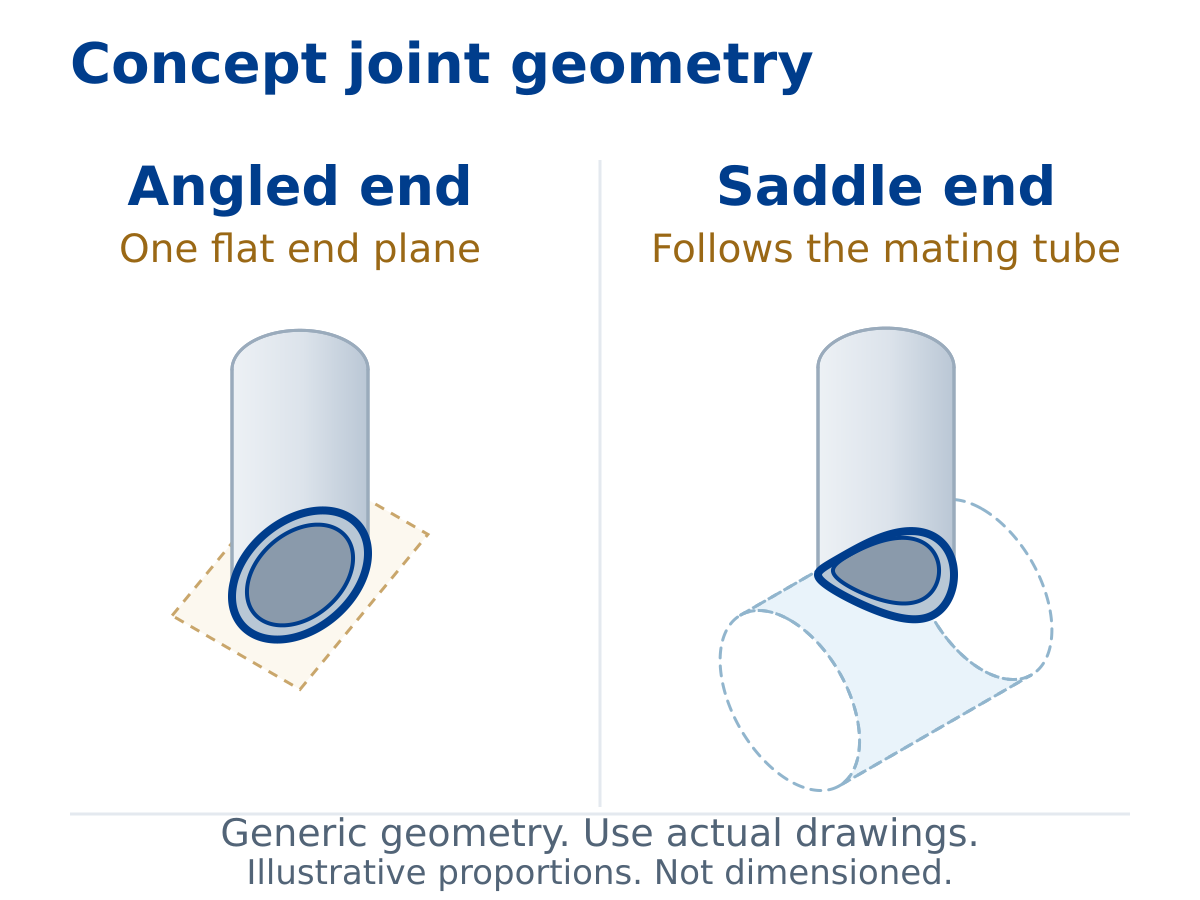
A shared model name is only one part of a comparison. Identify the supplied configuration, the input material and form, the intended cuts and the stage at which the resulting parts were evaluated. A broad phrase such as “cuts aluminum profiles” does not connect a reference job to a detailed new workpiece requirement.
Keep differences visible. A reference may concern straight cuts on one section while the buyer requires particular angled ends on a different section. Another may concern rough blanks followed by machining while the buyer wants an accepted feature directly after sawing. These are hypothetical differences, not descriptions of actual customer jobs.
The difference does not make a reference useless. It changes which question it can help answer. The reference might still be relevant to how the provider handled drawing clarification or supplied the agreed documents. It may be insufficient to support a conclusion about the new cut requirement. Ask for the missing technical basis through the equipment provider’s response to the actual job.
Do not combine an unrelated reference result with an unrelated catalog specification and describe the combination as a demonstrated application. In particular, a feeding-repeatability statement is not proof of an accepted finished cut dimension on the buyer’s part. The evidence needs to correspond to the claim being evaluated.
Use a relevance worksheet with separate conclusions
| Question | Reference information to record | Limit to preserve |
|---|---|---|
| What was supplied? | The identified equipment package and relevant configuration. | An unspecified model or option may differ from the current offer. |
| What job was assessed? | Material, stock form, cut requirement and evaluated output stage, where available. | A different part or acceptance stage leaves a different technical question. |
| Who knows the result? | The source’s relevant role and first-hand involvement. | Ordering experience and production assessment may come from different people. |
| What period is covered? | The purchase or operating period described by the source. | Earlier experience is not a current availability or service commitment. |
| What supports the account? | The record or discussion basis that can appropriately be shared. | An unsupported assertion should remain identified as such. |
| What does it change? | The specific question the reference helps answer. | Do not expand that conclusion to the entire proposed purchase. |
Use the worksheet as a record of relevance, not a numerical rating of the customer or supplier. A missing production detail should not be replaced with a guessed score. If the record supports a useful commercial-experience conclusion but no technical one, state those results separately.
Retain the present quotation question beside the reference note. That prevents an apparently relevant story from distracting the team from an excluded item, a configuration difference or an unanswered workpiece requirement in the offer it is actually considering.
A hypothetical comparison without invented testimonials
Imagine a buyer seeking a saw for angled finished profiles. One offered reference relates to straight rough blanks. Another relates to a similar family of profiles, but the supplied configuration and accepted output are not described. These are invented comparison conditions, not favorable or unfavorable customer statements.
For the first reference, the buyer can ask about matters the source actually experienced, such as how the technical scope was clarified. It cannot infer that a straight-blank result demonstrates the required angled finish. The current supplier still needs to address that workpiece and requirement.
For the second, familiar material wording is not enough to complete the comparison. Ask which configuration and output requirement were involved, if that information can be shared. If those details remain unavailable, record the limit rather than presenting the reference as a confirmed comparable application.
The purchasing result may be a better question rather than an immediate supplier selection. The team might identify that it needs an assessment of its own profile, a clarification of the offered support scope or a current response about a particular handover item. None of those steps requires manufacturing a customer case to fill an evidence gap.
Keep permission and information handling clear
When a supplier offers a reference introduction, ask how the contact is intended to be arranged and what the reference source is willing to discuss. Let the relevant parties agree the appropriate scope of the discussion. An introduction for a private purchasing inquiry should not be treated as permission to publish a name, contact information or quotation.
Limit the purchasing record to the information needed for the decision. A process description or appropriately shared summary may answer a question without requiring another company’s drawings, customer identities or private production records. Do not pressure a source to disclose information it cannot share.
If identifying details are withheld, preserve the limitation. An anonymous summary may help frame follow-up questions while leaving independent contact or application details unverified. That does not make it a verified customer testimonial. It also does not automatically make the underlying supplier account false.
This is a practical information-handling approach, not a statement of the legal requirements for every country. The buyer’s organization should apply its own relevant information and permission procedures to real reference discussions.
Turn the reference discussion into the next supplier question
Ask about the sequence of technical clarification: what information the provider needed, how open questions were resolved and whether the reference source can identify the scope it actually accepted. These questions can help the new buyer prepare a more useful inquiry without copying another factory’s configuration.
Where service experience is discussed, identify the particular event and period. Avoid translating that account into a universal response-time promise. Ask the present provider to state the service arrangements included in the current proposal. Jiurun’s actual service commitments and verified customer experiences are not supplied by this article.
Where production experience is discussed, retain the material, configuration and acceptance limits. A reference is one input to evaluating the present offer. It does not replace the supplier’s explanation of the actual proposed cutting task or the buyer’s responsible assessment.
Prepare a short, decision-specific reference discussion
Before arranging a conversation, send the reference source a brief outline of what the buyer wants to understand. Keep it tied to the person’s actual involvement. A procurement participant can describe the clarification and delivery process without being asked to certify a finished-part result they did not assess. A production participant can identify the work they reviewed without being expected to explain every commercial commitment.
For an original, hypothetical request, a buyer might write: “Our current offer leaves the completed-part handoff unclear. If this falls within the experience you are willing to discuss, which handoff did your accepted equipment package include, and which activities remained with your factory?” This wording asks for a described boundary. It does not lead the source toward a favorable testimonial or ask them to disclose their private drawing.
Follow up with a question about the basis: “Were you personally involved in checking that scope, or is this information from another team?” Record the answer as a source-role limitation. If the source refers to someone else, agree an appropriate introduction rather than treating the second-hand account as a direct production assessment. Preserve the difference between the conversation itself and a document that was actually reviewed.
Close with the remaining question: “Does your experience cover this same output stage, or should we ask the equipment provider to explain the difference?” The useful outcome can be an identified gap. That gap belongs in the present quotation review, with an owner for the follow-up. A reference conversation should leave the team with a clearer decision record, even when it cannot supply a comparable cutting result.
Write a reference note that another buyer can assess
Use a compact record with fields for the purchasing question, source type and role, relevant period, described job, relevant answer, limit and next action. Write factual descriptions of what was discussed rather than broad labels such as excellent service or proven machine. Keep any quotation in its agreed context and information-sharing scope. The purchasing record should not become public marketing copy by default.
For the invented angled-profile comparison, a suitable note could state: “The offered account concerns straight blanks followed by another process. It may inform our question about drawing clarification. It does not establish the finished angled-end requirement in our current offer. The equipment provider must address that requirement separately.” This is an invented recording example, not a report of a real customer conversation.
Keep the reference note connected to the quotation revision that prompted it. If the supplier later changes an option or an output assumption, review the specific relevance rather than carrying the whole note forward as blanket approval. A newer proposal does not automatically inherit a prior reference’s scope. Equally, a useful account should not be discarded merely because it leaves another question open; retain the conclusion it actually supports.
View equipment context separately from customer evidence
This Jiurun video provides equipment context for an inquiry. It is not a customer recommendation, a reference introduction or proof of the hypothetical applications discussed above.
Questions to send with the reference request
- Which purchasing question should the offered reference help us answer?
- What equipment package and period does the reference concern?
- What part of the purchase or production work did the source experience first-hand?
- Which workpiece and output details can appropriately be shared?
- What differences from our proposed job should remain explicit?
- Is the account a provider summary or an independently obtained discussion?
- How should any approved introduction and information sharing be arranged?
- Which current quotation question remains for the equipment provider to resolve?
The machine RFQ checklist helps define the present job before comparing offered experience. To discuss a Jiurun configuration, send the workpiece, cut requirements and the evidence questions you need answered. Ask what relevant supporting information can actually be provided. A reference becomes useful when its experience and limitations are connected to the purchasing decision, rather than used as a substitute for it.