
Aluminum saw offline operation is a purchasing question, not a feature to assume from a touchscreen or an Ethernet socket. If a proposed cutting cell exchanges jobs, reports results, or receives remote support over a network, ask exactly what the operator can and cannot do when the plant LAN, internet connection, or vendor service is unavailable. The answer should be tied to the quoted configuration and an observed acceptance test.
A saw can have local controls without supporting the same workflow offline. Conversely, a networked reporting system may fail while a separately approved local cutting task remains possible. Neither outcome can be inferred from a brochure photo. The buyer needs a function-by-function boundary: job preparation, job selection, machine motion, safety response, result capture, and reconciliation after service returns.
First separate the three connections
“The network is down” is too broad for a useful supplier answer. A plant LAN interruption, an internet outage, and loss of a vendor-hosted service affect different paths. Draw the actual proposed route from the buyer’s order system to the saw, and from the saw back to the receiving record. Mark every local PC, server, gateway, wireless bridge, remote-access device, and external service that the quote includes. Ask which component is essential to start an approved job and which only supports convenience, monitoring, or later reporting.
Do not substitute a generic product-family claim for the offered machine. Record the model, controller or HMI version where available, optional software, license terms, and the specific integration scope. If the quote contains no networked job transfer, say so and assess the local workflow on its own terms. If a connected module is optional, require separate answers for the base and optioned configurations.
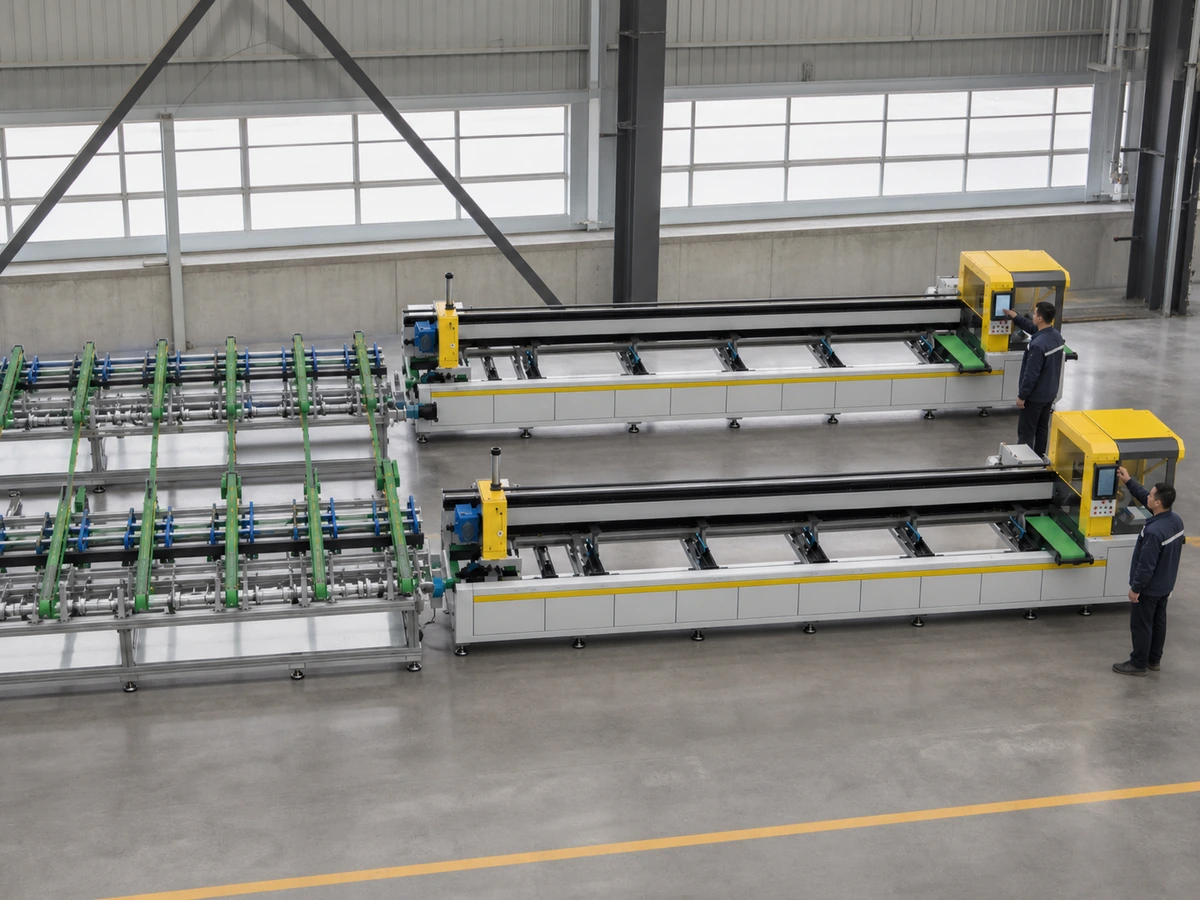
Aluminum saw offline operation: build an outage matrix
Ask the supplier to complete a short matrix for each connection-loss scenario. For every function, record the normal source of data, whether it remains available locally, what the operator sees, who may authorize the next action, and what evidence the supplier will demonstrate. A blank cell is an open quotation question, not permission to assume continuity.
| Function to check | Question during a connection outage | Evidence to request |
|---|---|---|
| Approved job and cut list | Can the intended revision be identified locally, or must a server provide it? | On-screen job identity and revision in the quoted setup |
| Start and resume | Can an authorized operator start, pause, and resume this approved job? Under what conditions? | Witnessed sequence with the specified connection interrupted |
| Machine safeguards | What state does the controller enter, and what operator checks are required? | Supplier explanation and a supervised demonstration |
| Part counting and disposition | How are accepted, rejected, and unfinished pieces recorded? | Local record, manual fallback, or explicit gap |
| Return to service | How are queued records, duplicate jobs, and conflicting revisions handled? | Reconnection and reconciliation demonstration |
The matrix is a request for proof, not a claim that any particular Jiurun model performs these functions offline. A useful response may be “production stops safely until the connection returns.” That can be a valid design boundary if it is explicit, understood by operations, and reflected in the buying decision.
Define the safe stop and the permitted restart
Connection loss should not be described merely as a productivity issue. Ask the machine supplier and the site’s controls owner what the proposed controller does on loss of the relevant signal, whether a cycle already in progress can finish, and what requires operator intervention. Separate loss of a data link from loss of electrical power, air supply, a guard signal, or an emergency-stop circuit. These events are not interchangeable.
The US National Institute of Standards and Technology’s Guide to Operational Technology (OT) Security, SP 800-82 Rev. 3 treats lost communications as a possible trigger for a fail-safe response and recommends defining how a system operates when capability is reduced or disrupted. It also frames continuity across data, applications, infrastructure, and supporting utilities. This is general OT guidance; it does not certify any saw or specify its outage behavior. Use it to frame the acceptance questions, then verify the actual quoted cell with the responsible people.
For restart, request the exact operator sequence: identify the last completed piece, inspect stock and clamping state, confirm the active program and revision, determine whether an interrupted length or count must be discarded, and release the next part according to the buyer’s own quality process. The supplier should explain the machine-specific steps; the buyer should own acceptance criteria for product and records. Do not infer cut accuracy, scrap rate, or safe restart from a successful normal-cycle video.

Test records and revision control, not just blade motion
A machine may keep moving while the production system loses traceability. Define the minimum record needed to release parts during an outage: job number, drawing or cut-list revision, material identity, operator, quantity, disposition, and time. Decide in advance whether the operator may use a controlled paper record, a local electronic queue, or neither. Ask how those records are reconciled when the connection returns, and who resolves duplicates or contradictory revisions.
If the normal workflow sends job files from an office system, demonstrate what happens when the connection fails before transfer, halfway through transfer, and after the job is already loaded. “Works offline” could mean only that an existing local job remains selectable; it might not allow a new revision to be released. The acceptance record should distinguish these cases. A supplier’s remote diagnostic access is another separate function: loss of remote support should not be confused with loss of local machine control, unless the offered architecture actually couples them.
When planning the site discussion, combine this checklist with a remote aluminum saw site-survey checklist. Provide the planned network topology, available utilities, operator position, and the plant contact responsible for controls and production records. The supplier can then respond to a concrete installation rather than a generic request for “offline mode.”
Make the supplier demonstration repeatable
Before a purchase decision, agree on one representative part family, approved cut list, input stock, normal operator roles, and the exact connection to be interrupted. Preserve a baseline run with the link available. Then repeat the same planned job with the specified link unavailable under supplier supervision. Observe the HMI message, permitted actions, machine state, material disposition, and record created. Restore the connection and check what synchronizes, what needs review, and whether any job or part is counted twice.
Keep the trial within the supplier’s approved operating and safety procedure. Do not improvise by disconnecting safety circuits or modifying a live production machine. If the quoted integration does not yet exist, obtain a written functional statement and place the witnessed outage-and-recovery demonstration in the acceptance plan. A demo on another controller or a different software package is useful background but not acceptance of the purchased configuration.
Video: general equipment context
The following Jiurun channel video shows a cutting machine and its operating environment. It is general equipment footage only. It does not test network loss, prove offline operation, identify the configuration offered to your plant, or establish any material, customer, trial, safety, or performance result.
What to send with your RFQ
- The intended saw model or part family, stock section, cut list, and drawing revision.
- A diagram of the plant LAN, internet path, local PC/server, and any vendor service expected in the quoted workflow.
- The outage scenarios to test separately, including when the job is already loaded and when a new job is requested.
- The required operator, quality, and record-keeping decisions during each scenario.
- The expected recovery demonstration and the person who will accept its evidence.
Ask the supplier to mark each function as included, optional, unavailable, or still to be confirmed for the exact quote. Request screenshots, a supervised trial plan, and written exceptions. That answer lets purchasing compare continuity and integration risk without treating a touchscreen, network port, or promotional video as proof of aluminum saw offline operation.