
Aluminum saw line integration is decided at the boundaries between the saw, the equipment that feeds it, the people who operate it, and the system that receives the cut parts. A quotation can name a saw and a loading line while leaving those boundaries undefined. Before you place an order, put each handoff in writing: what crosses it, who supplies each side, who makes the connection, and how both parties will prove that it works.
This guide is for a buyer connecting an aluminum cutting machine to an existing or planned production flow. It is an RFQ and acceptance framework, not a claim that a particular Jiurun model includes every device or interface mentioned below. Confirm the offered configuration and documents in the supplier’s written proposal.
Aluminum saw line integration starts with a boundary drawing
Sketch the route from stored stock to the point where an accepted cut part leaves the cutting cell. Mark every change of equipment, operator, controls, utilities, and responsibility. A useful boundary drawing shows the stock presentation position, loading and transfer equipment, saw infeed, cutting station, part collection, scrap collection, and the next production step. If the project uses a line integrator, show that company as a separate party from the saw supplier and the plant.
A Jiurun catalog illustration of an automatic loading and cutting line can help a team discuss possible modules and floor space. It does not establish the modules, dimensions, controls, or performance included in your quotation. Ask for a project-specific layout and bill of supply.
1. Define the incoming-stock handoff
Write down the profile forms and length range that will arrive at the cell, how they are bundled or separated, their orientation, and where the upstream party releases them. State whether an operator loads a rack, a supplied loader takes stock from a defined position, or another machine transfers it. The phrase “automatic loading” is too broad to allocate that work by itself.
Ask who supplies the rack, roller table, stops, guarding and transfer mechanism; who resolves bent or mixed stock; and what happens when a profile is absent, mispositioned, or rejected. Record the physical interface height, approach direction, clearance, and access for maintenance on the approved drawing. Our separate guide to where profiles enter a cutting line goes deeper on the route into the saw. Here the additional decision is who owns and tests the connection between parties.

2. Assign controls and safety signals explicitly
For each connected machine, list the signals or operator actions needed to request a new piece, confirm that stock is ready, permit a cut, report a completed cycle, indicate a fault, and recover after a stop. These are questions for the project, not a list of signals promised by any standard Jiurun configuration. The supplier and integrator should agree on signal direction, connector or communication method, timing, ownership of logic, and which party changes software when a test fails.
Safety deserves a separate interface review. The parties should agree on the cell boundary, access points, emergency-stop behavior, guarding responsibilities, isolation procedure, and who validates the integrated installation under the rules that apply at the destination site. A saw’s own safety features do not by themselves validate the combined line. Obtain the actual electrical and control documents for the ordered configuration before approving the interface design.
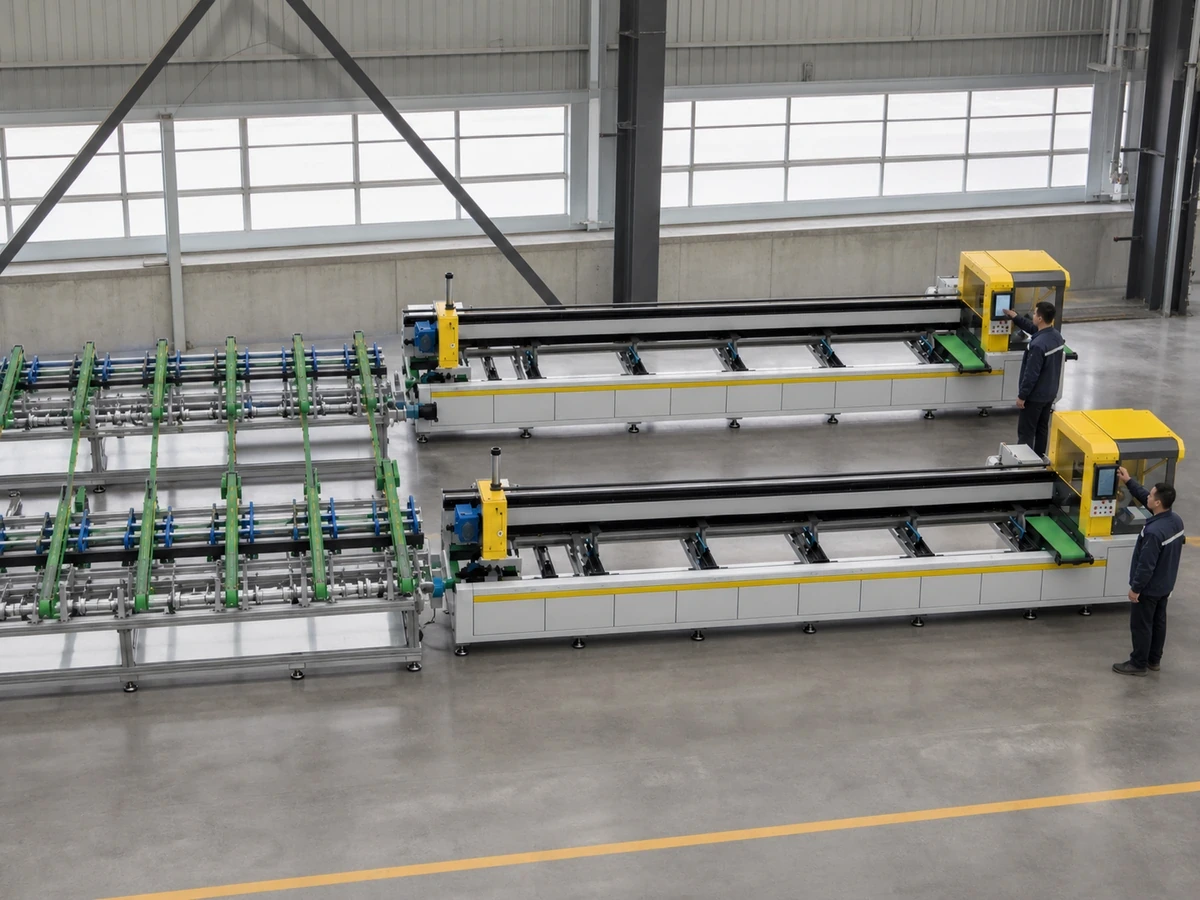
3. Specify the cut-part and scrap handoff
The downstream boundary starts before a finished part reaches the next process. Decide who removes cut pieces, how accepted pieces are distinguished from setup pieces or rejected pieces, whether a person or conveyor transfers them, and where the receiving party takes responsibility. Include maximum part envelope and collection-space constraints in the approved layout. If a robot, sorting device, bin or traceability system is expected, name its supplier and the interface owner; do not assume it is included because a drawing shows a complete line.
Give scrap and offcuts their own route. A machine may complete its cutting cycle while the cell still stops because a collection area is full or an operator cannot safely clear it. State who supplies containers, who detects a full or blocked condition, and who restores the line. If any downstream identification or production data is required, specify the data fields and the party responsible for creating and receiving them.
4. Put site services and installation work into the same scope
Request a project-specific utility and installation schedule before the purchase order. It should identify the supplied equipment footprint, service clearances, power and air requirements where applicable, extraction or waste arrangements where applicable, lifting and access routes, foundation or anchoring work if specified, and who makes the final connections. Values must come from the quoted configuration and site survey; a generic product page cannot settle them.
Record the last point supplied by the machine vendor and the first point supplied by the plant for each service. Also identify who provides the installation drawings, who checks them against the real floor, and who pays for a change if site conditions differ from the approved assumptions.
Use a responsibility matrix in the RFQ
For aluminum saw line integration, a one-page matrix is more useful than a long “turnkey” sentence. For every boundary, ask the bidders to fill in the same five columns:
- Interface: the named physical, electrical, control, data, or operator handoff.
- Supply: the party providing each device, cable, document, and software element.
- Integration: the party making the connection and resolving mismatches.
- Evidence: the drawing, signal list, test result, or observation that will demonstrate completion.
- Exclusions: any item outside the quotation, with the responsible alternative named.
Have the saw supplier, line integrator, and plant review the same revision. An “included” mark is insufficient when two suppliers each assume the other will program the handshake or provide the last transfer conveyor. If the vendor proposes an automatic loading line, request the exact bill of supply, model/configuration, layout revision, control documents, and boundary points for that offer.
Agree on factory and site acceptance before delivery
Factory testing can show what is assembled and available there. Site testing must cover the interfaces that only exist after the equipment meets the plant’s upstream and downstream systems. Write separate acceptance steps for stock presentation, start/stop handshakes, normal cutting flow, fault and restart, removal of accepted parts and scrap, and operator access. Identify sample profiles and drawings supplied by the buyer, the observations to record, and who signs each interface.
A successful stand-alone saw test does not prove an integrated line. Conversely, a failed site handshake should have a named owner and correction path rather than becoming an argument about the word “turnkey.” Keep the final accepted drawings, software revision, and open-item log with the commissioning record.
See a general Jiurun cutting-machine example
What to send with your inquiry
Send the profile drawings and material description, cut-length and volume requirements, current floor layout, upstream and downstream equipment descriptions, preferred stock and part handling, site service information, and the person responsible for integration. Ask bidders to return a boundary drawing, bill of supply, interface matrix, open assumptions, and proposed factory and site acceptance plan. Use those documents to compare the real project scopes rather than comparing only saw names or headline prices.
To discuss aluminum saw line integration for an offered Jiurun cutting-machine configuration, contact JiurunCut with your line layout and the handoff points you want priced. The automatic aluminum cutting machine overview can provide product context, while the written project quotation should define what is actually supplied.