
An aluminum saw for Venetian blind manufacturing is a sensible purchase only after the factory defines which straight members it will actually cut. A complete blind contains far more than a pair of rails: slats, lift and tilt parts, tapes or cords, end caps, brackets, and finishing steps may come from different suppliers. A saw quotation for rail stock cannot stand in for a quotation for finished slats or a complete assembled blind. Start with the retained operations and the accepted output.
This guide is for buyers comparing in-house cutting of aluminum headrails and bottom rails with prepared rail kits or complete blinds. It does not assume that Jiurun equipment forms slats, punches controls, assembles mechanisms, or meets a particular blind-system specification. The blind-system owner must approve the drawing, materials, operating components, and final assembly.
1. Draw the boundary around the rail job
Write one line for each member: headrail, bottom rail, optional trim or valance, and any other extruded straight piece. Give each a drawing revision, cross-section, stock length, finish, cut length, end condition, annual mix, and downstream operation. Mark a component “buy finished” when its shape, slots, holes, or mechanism are supplied complete. Do not put thin formed slats into the rail saw trial merely because both are aluminum.
Metal blind product information from Hunter Douglas distinguishes the slats from the headrail and bottom rail. Its horizontal-blind guidance also places lift components in the headrail. These are useful scope reminders, not specifications for a Jiurun machine or for your chosen blind model. Your own bill of materials controls the purchase.
2. Compare three supply routes for the same order
| Route | What the buyer retains | What must be checked |
|---|---|---|
| Cut rail stock in-house | Approved extrusion purchasing, rail cutting, labeling, inspection, and kit handoff | Stock condition, cut-end acceptance, downstream slots or holes, rework, and operator time |
| Buy prepared rail kits | Kit receiving, revision control, and assembly | Rail lengths, handed or control-specific pieces, packing, and missing-part replacement |
| Buy complete blinds | Finished-product inspection and installation handoff | Size, configuration, operating-system approval, damage, service, and lead time |
Compare these routes against one real order mix. The lowest price per cut is not necessarily the lowest cost per accepted blind. Include stock yield, finishing damage, kit sorting, assembly delay, and the cost of a wrong rail that stops a batch. Keep bought-in slats and mechanisms in the complete-order comparison even if their manufacturing lies outside the saw scope.
3. Build an acceptance matrix before choosing a saw
For every rail family, agree which datum controls length and which end is referenced during assembly. Specify whether the rail arrives bare, coated, or otherwise finished. Note any visible face that must avoid clamp marks, the permitted end condition, and how the end cap or mating part is checked. A blanket “clean cut” instruction is too vague for a purchase trial: the buyer and supplier need an observable acceptance method.
Also separate operations. If a rail requires a control opening, slot, or hole, identify who performs it and whether it occurs before or after cutting. A machine that cuts the blank should not be described as delivering an assembly-ready headrail unless the remaining steps are included in the agreed scope and demonstrated. Do not infer punching, slat production, or mechanism fitting from a generic saw photograph.
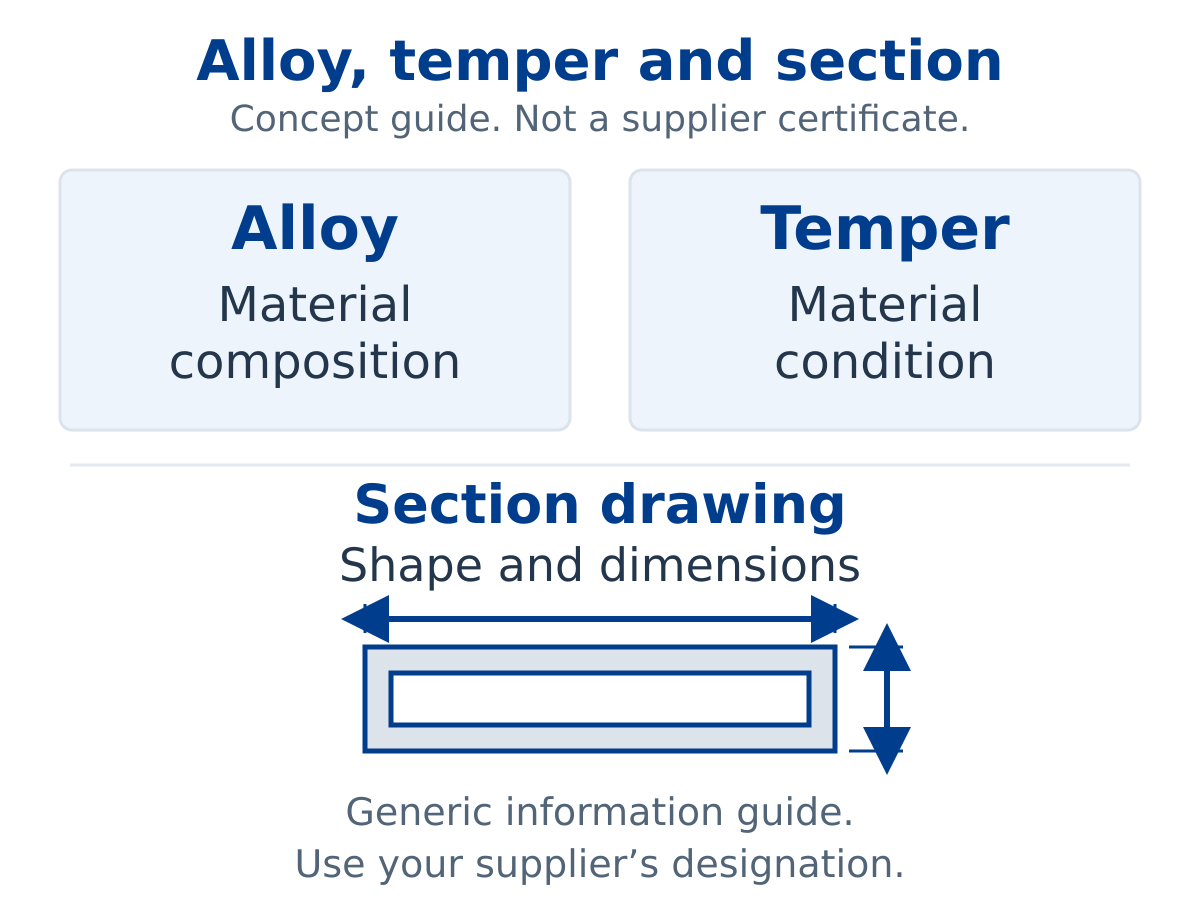
Material identity, material condition and the section drawing are separate inputs to this acceptance matrix. The following generic guide shows the distinction; it is not a certificate or a drawing for a blind rail.
4. Trial an aluminum saw for Venetian blind manufacturing on retained rails
For an aluminum saw for Venetian blind manufacturing, supply representative stock from the approved rail family, including the longest practical member, a short member, and the finish that is most sensitive to handling. Record stock straightness and packaging on receipt. Agree the trial drawing revision, target lengths, batch quantity, inspection method, and witness before any cut. Check loading support, secure workholding, cut-end condition, length result, removal, labeling, and the handoff into the next operation. Only qualified personnel should run equipment under the applicable site procedures.
A short, unrepresentative sample can hide the work involved in long-rail support or mixed-length changeovers. Conversely, a rail trial says nothing about slat forming, ladder-tape assembly, lift-mechanism performance, or a complete blind’s operation. Record the trial’s limits on the result sheet so the buyer does not turn a narrow demonstration into a broader equipment claim.
Where several headrail or bottom-rail profiles share a proposed cutting route, list the section and finish differences. Ask which were physically tested and which are only proposed. The supplier should state what additional trial would be needed for an untested family.
5. Decide where the rail kit becomes complete
After cutting, who pairs each headrail and bottom rail with its slats, controls, brackets, and paperwork? Define the kit label and revision identifier. Agree whether cut rails are packed individually, grouped by order, or staged for immediate assembly. A saw may produce acceptable lengths while the overall blind order still fails because one rail is missing or belongs to a different control configuration.

Ask the kit supplier or the internal assembly lead to sign off the receiving checklist. It should identify the member, quantity, finished length, orientation if relevant, finish, and downstream work still required. That handoff is where a rail-cutting purchase becomes a reliable supply route rather than an isolated machine cycle.
6. Send a six-part request for quotation
- Retained scope: list precisely which headrails, bottom rails, and optional straight members the proposed saw must cut.
- Stock: provide approved drawings, alloy or material specification, section and wall details, finish, stock lengths, and condition.
- Output: state the accepted lengths, end and visible-face criteria, identification, and inspection method.
- Mix: give realistic short and long lengths, batch sizes, changeovers, and annual order families.
- Interfaces: assign slots, holes, end caps, mechanisms, slats, sorting, packing, and final assembly to named operations.
- Proof: request a witnessed trial on agreed stock, with results, exclusions, and any untested variants recorded.
Ask each supplier to quote the same retained scope and show exclusions next to the offered price. If your best route is prepared rail kits or complete blinds, document that decision instead of buying cutting capacity the factory will not use.
Equipment view: an illustration, not a blind-rail trial
The following video comes from Jiurun Machinery’s own channel and shows general aluminum-cutting equipment. It does not establish that the pictured machine cuts this article’s rail section, forms slats, fits a control, serves a named customer, or meets any stated performance result. Use an approved drawing and representative trial to evaluate those questions.
Request a scope review
If your team is deciding between cut rail stock, prepared kits, and finished blinds, send the rail drawings, order mix, finish requirements, and the downstream operation list to Jiurun’s contact page. Ask for a quotation and trial plan tied to the retained straight-member job. The right first decision is what output the factory must own.
Reference context: Hunter Douglas metal blinds and horizontal-blind lift comparison distinguish product elements; the Levolor metal-blind technical guide illustrates component separation. These third-party products are context for purchasing questions, not approvals of Jiurun equipment.