
Choose an aluminum saw for two-shift production by asking the supplier to assess the complete operating day against your parts and work plan. Two shifts can provide more scheduled time, but they do not automatically double accepted output. The machine configuration, material presentation, receiving work, maintenance requirements and people supporting the second shift must all be included in the proposal.
The purchase requirement should therefore state more than a number of operating hours. Define the output due from each shift, the work allowed within those hours, how the machine and unfinished jobs are handed over, and when required maintenance takes place. Ask for an explicit supplier response to that daily schedule, rather than treating a motor rating or a short demonstration as a whole-day production commitment.
This guide develops a purchasing brief for an industrial aluminum sawing system. It does not prescribe a machine operating schedule or claim that any Jiurun model has been demonstrated for your two-shift application.
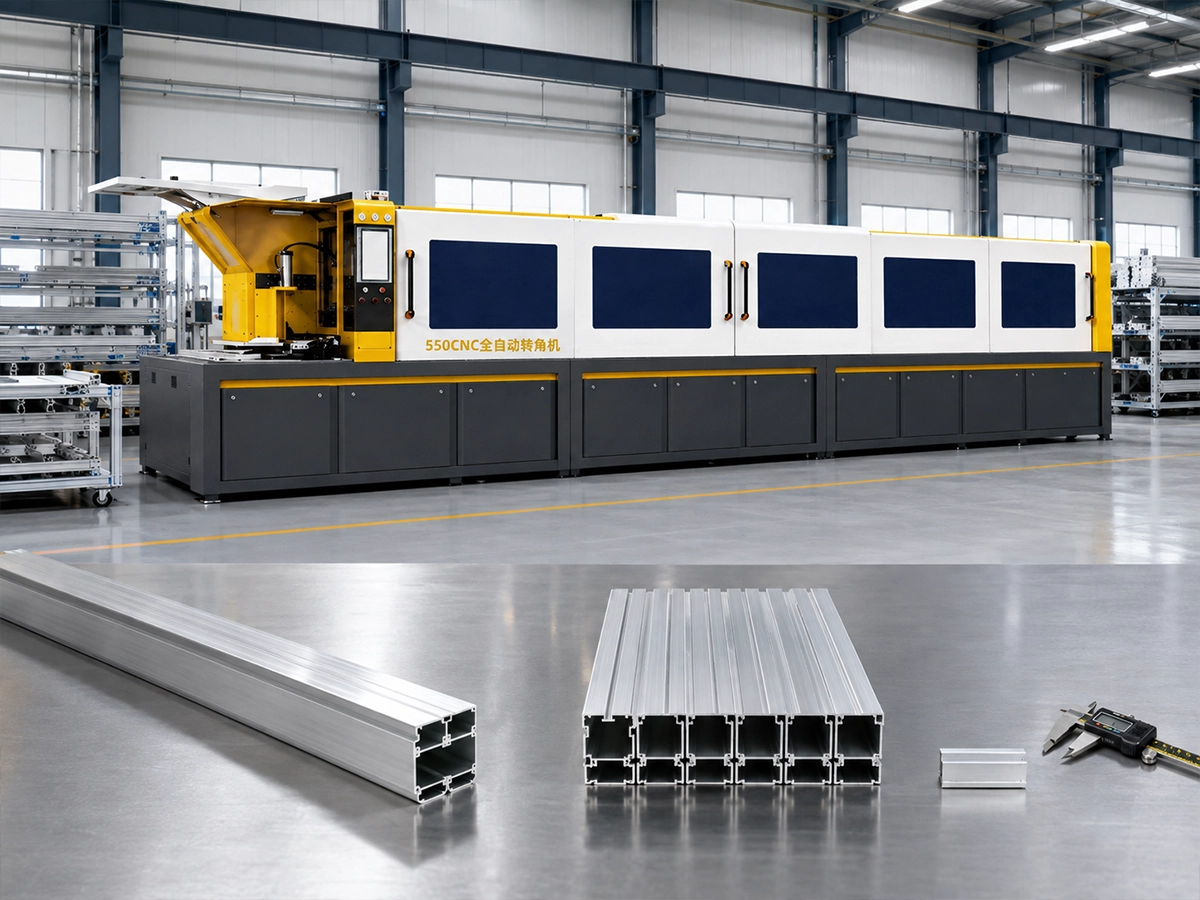
Define the workload for an aluminum saw for two-shift production
Begin with approved part families. Supply section drawings, aluminum alloy and temper, incoming stock dimensions and condition, cut lengths and angles, finished-part requirements and the applicable drawing revisions. Distinguish protected cosmetic faces from ordinary handling surfaces. Identify the shortest and longest output pieces and the stock formats that must reach the infeed.
Then allocate demand by shift. The second shift may repeat the same job, complete what the first shift started, or produce different profiles for the next day’s assembly. Those are different workloads. A supplier reviewing one repeated straight-cut part has not necessarily assessed a later mixed-angle batch or a different receiving arrangement.
Record how accepted output is counted. If parts are held for inspection until the next morning, the second shift’s produced quantity and released quantity should remain separate. If matched sets are required, an incomplete set should not silently become a completed order in the daily capacity calculation. State the actual cutting-stage deliverable and the point at which it is available to the next process.
Use a family-by-shift table in the RFQ. Include quantity, required completion time, material readiness, setup or angle changes, receiving destination and the person responsible for production release. Place possible extra orders in a separate scenario. This allows the supplier to distinguish the confirmed operating day from an aspirational peak day.
Build a time account for the full day
Separate scheduled attendance from time available for the approved production sequence. Identify preparation, planned changes, replenishment, inspection and receiving work, handover, and the maintenance periods required by the actual machine instructions. Some activities may occur outside the production window or overlap safely under an approved arrangement; others occupy the same people or equipment. State those assumptions explicitly.
For an invented example, suppose two shifts each contain 480 scheduled minutes. Each reserves 30 minutes for preparation or handover, 30 minutes for planned breaks and 40 minutes for agreed non-production work. Each then has a candidate window of 380 minutes, or 760 minutes across the day. These figures are planning assumptions, not recommended break periods, maintenance durations or validated machine availability.
If the illustrative demand is 600 accepted blanks per shift, the planning comparison is 600 blanks against 380 candidate minutes. It is not 600 blanks against 480 minutes. Across both shifts, 1,200 blanks against 760 minutes is about 1.58 accepted blanks per candidate minute. This is a requirement to verify, not a demonstrated saw rate.
Check that every deduction and overlap is counted consistently. If receiving occurs within the supplier’s measured production sequence, do not subtract the same receiving time again from that evidence. If an employee must also replenish stock, a proposal assuming continuous independent loading needs a different staffing arrangement. Record the boundary of both the schedule and the demonstration.
Use the example to ask for representative evidence over a suitable agreed period. Do not multiply the fastest observed cycle by every minute of two shifts. Explain the material mix and planned work so the supplier can assess output under those conditions, including the periods when the saw is not producing accepted parts.
Ask for a whole-system response to the extended day
The offered system includes more than its blade drive. Identify the actual model and configuration, material feed, workholding, support tables, receiving equipment and any included chip or lubrication equipment. Ask the supplier which elements of the proposed schedule they have assessed and what conditions or limits apply. A rating for one component is not evidence that the complete installation supports your planned day.
Describe the site conditions for both shifts. State the available utilities using the supplier’s required information, ambient conditions, material staging and the space available for output. If shared services or receiving staff are unavailable later in the day, record that difference. A workstation that works with full daytime support may encounter a different workflow in the second shift.
| Daily condition | Information to submit | Response to obtain |
|---|---|---|
| Same family across both shifts | Stock, output, total schedule and replenishment plan | Assessed configuration and evidence covering the stated sequence |
| Different families between shifts | Drawing revisions and planned changes | Change requirements, preparation scope and representative evidence |
| Reduced second-shift support | Available people, receiving and services by period | Limits and additional resources needed for the proposed job |
| Required maintenance within the day | Proposed maintenance window and responsible team | Actual machine instructions, resources and schedule implications |
Where a supplier uses terms such as continuous operation or automatic production, ask for their scope in the actual offer. Determine whether the statement refers to a component, a particular cycle or the supplied system under defined conditions. Do not interpret automatic feeding as permission for unattended production or as a guarantee of staffing savings.
Keep technical evidence and commercial commitment distinguishable. A comparable production record can support suitability, while an offer must state the configuration and conditions supplied to you. If evidence excludes a required profile, support device or part-handling task, identify the gap before accepting a daily output commitment.

Specify the handover between shifts
The next shift needs the state of the actual job, rather than just yesterday’s machine settings. Define the record that travels with remaining stock and work in progress: job and drawing revision, material identity, quantities completed and awaiting release, unfinished quantities, receiving locations and open issues. Include the actual status of the machine and any restriction that prevents production from continuing.
For another invented example, an order contains 600 blanks. The first shift has 420 accepted, 30 awaiting a decision and 150 not yet produced. These categories reconcile to 600, but only 420 are presently accepted. The next shift should not see “450 complete” without learning that 30 remain unresolved. The quality decision and any resulting work must be assigned to the responsible people.
Agree who may release a new job or resolve a reported issue during the second shift. If the relevant person is available only during daytime, establish the approved response for that limitation. Do not assume that an operator can substitute a material, approve a changed drawing or alter a machine arrangement merely to keep the production counter increasing.
Request a handover method appropriate to the actual supplied controls and your factory records. A spreadsheet, traveler or supported production-data function may be sufficient if it carries the necessary information. Do not assume that a CNC label includes shared job history, permissions, remote access or a connection to your business software.
Finally, identify what the incoming shift checks before starting its assigned work under the actual instructions. The purchasing brief should secure usable information, preparation and responsibilities. It should not replace the site’s approved operating or safety procedures.
Compare two offers against the second shift as well as the first
Consider two fictional proposals for the same family and the same 600-blank target in each shift. Proposal A describes a cutting arrangement with a defined receiving device; proposal B requires the purchaser to provide receiving work separately. Neither description by itself establishes that 1,200 accepted blanks will be available at the end of the day. Ask both suppliers to assess the same part schedule and list the people, stock preparation and output transfers assumed in their evidence.
If the factory supplies receiving staff only during the first shift, proposal B has an unresolved second-shift interface. That is a scope gap, not proof that proposal A is faster or more economical. Proposal A also needs confirmation of what its device receives, how filled output is removed and which tasks remain with the buyer. An equipment inclusion should be traced through the complete day before it is counted as additional usable time.
Record the answer for each shift in the quotation review. Identify the supplied configuration, buyer-provided resources, representative output evidence, required non-production activities and any hours when support is unavailable. A broad daily total may conceal a shortage in the period when the next process actually needs parts. Conversely, an unfilled requirement should not be closed by moving all output to the earlier shift unless that revised arrangement has been evaluated.
Keep accepted, held and unfinished work distinct at handover
Return to the fictional 600-piece order with 420 accepted, 30 held and 150 not produced. The incoming shift has 150 pieces still to make and an unresolved decision affecting 30 others. It does not automatically have a confirmed 180-piece production order: the responsible reviewer might accept, reject or require further assessment of the held pieces. Record the actual decision before assigning replacement or additional production.
A useful handover preserves the relevant material and drawing references beside these quantities. It also states where each group is located, what restriction applies and who owns the next decision. If the second shift has a separate confirmed order, retain that order as its own row instead of silently blending it with the previous hold. These records give the supplier concrete job-input and receiving questions without implying that the offered controls already manage your factory approvals.
Protect maintenance and support time in the proposal
Ask for the actual machine maintenance requirements before deciding where work fits. Request the relevant tasks, conditions affecting their scheduling, required consumables or parts, and competence needed. Use those requirements to review the proposed daily timetable. Do not invent a universal maintenance interval or assume that adding a shift leaves maintenance arrangements unchanged.
The UK’s Health and Safety Executive advises planning maintenance using manufacturers’ instructions, assigning competent people, communicating the work and using shutdown periods where practicable. It also identifies a need for workers to report problems. This is jurisdiction-specific guidance that informs procurement questions; it is not a maintenance procedure or approval for this saw installation. See HSE’s work-equipment maintenance guidance.
Define how an identified issue is handed to the support team, how its status is recorded and who authorizes return to production. A second shift should not inherit an undocumented assumption that a fault has been corrected. Make the supplied instructions and reporting contacts accessible to the people who need them during that period.
Commercial support coverage also needs an explicit answer. State the hours and time zone when assistance may be required, the information the supplier needs for a report, and the support channels included in the offer. Ask about response commitments and spare availability without assuming same-night assistance. Keep confirmed commitments separate from general statements about after-sales service.
If support is unavailable in part of the day, assess the production consequences using the actual order and your approved arrangements. Resolve this before treating the second shift as assured extra capacity. Do not remove a required stop, check or maintenance activity from the schedule to make a capacity number appear sufficient.
Accept a proposal against the defined day, then track the result
Compare offers using the same drawings, quantity allocation, schedule and receiving requirements. List included equipment, preparation, documentation, training and support. Ask each supplier to mark accepted requirements, conditions and open items. A lower price for an offer that excludes your second-shift receiving or maintenance needs is not yet a comparable complete proposal.
Agree the evidence needed before production approval: the representative parts and materials, supplied configuration, measured quality, observed output period, relevant non-production events and the acceptance criteria. A successful demonstration should retain those boundaries. It should not become a blanket promise for every later part family or a guarantee of two-shift availability.
After introduction, record planned and actual accepted outputs by shift, with reasons for differences. Keep material delays, quality holds, configuration changes and machine faults distinguishable. These records help you decide whether the purchase meets the agreed job and whether a change in future demand requires a revised proposal.
Send Jiurun your part-family drawings, aluminum alloy and temper, incoming stock, cut lengths and angles, quantity by shift, required quality and full-day schedule. Include the maintenance window, receiving resources and second-shift support needs. Request a model-and-configuration assessment against those conditions and evidence for the proposed job, rather than an unsupported promise that two shifts will double your production.
Use equipment video to discuss the daily scope
This Jiurun equipment video provides cutting-stage context. It does not demonstrate two shifts of accepted output or establish support coverage for your factory.