
An aluminum saw for motor housing manufacturing is worth buying only when a factory has identified a repeatable blank-cutting job that it intends to retain. A motor housing may arrive as a finished purchased component, a cast or machined preform, or a long extruded section. Those are different supply routes. A saw quotation for one route cannot be judged against the price of a finished housing as if both delivered the same thing.
The purchasing decision begins with the approved housing family, incoming form, cut-blank drawing, and next receiving operation. This guide shows how to define that boundary, compare realistic alternatives, and request evidence from a supplier without treating a catalog machine photograph as proof that it can run your part.
Aluminum saw for motor housing manufacturing: define the blank route first
Map each housing family from the material you actually receive to the unit your production team accepts. If you buy a finished casting or a machined housing, a new saw may add no useful operation. If you buy an extruded profile and release individual lengths to a machining cell, the saw can be evaluated for that specific profile-to-blank transfer. A mixed factory may have both routes; do not aggregate their annual motor output into one saw demand number.
Hydro describes motor housings among its aluminum component supply categories and separately lists extrusion, casting, fabrication and finishing capabilities. FONNOV describes an extruded electric-motor housing supply route with optional machining. These supplier examples demonstrate why the incoming form and purchased stage must be specified; neither proves which route your factory uses or which Jiurun machine fits it. See the Hydro application overview and FONNOV motor-housing extrusion example.
For each family, record the approved part identifier and revision; supplier and receiving stage; material designation and condition stated by the drawing or purchase order; stock cross-section and length range; the blank length and end condition released to the next station; and the destination of the remaining stock. If any of those are undecided, ask engineering to release the requirement before asking a saw vendor to promise an outcome.
Separate blank dimensions from finished-housing dimensions
The housing assembly drawing may show a finished bore, end-face relationship, mounting features, overall assembly envelope, and model-specific interfaces. A cut blank drawing needs its own length reference and receiving condition. Do not copy a finished overall length into the saw RFQ without accounting for the approved downstream machining route. Equally, do not ask a saw supplier to certify finished bore alignment, motor fit, sealing, cooling or electrical performance from a blank-cutting demonstration.
For two end variants that share a nominal extrusion, list both identities. A change in end allowance, end orientation, lot traceability or downstream machining may alter the blank job even when the visible section looks alike. The purchasing pack should state which features are present before cutting and which are created later. Use a representative drawing and a labeled sample for each family; label photographs as illustrations when they are not your actual approved stock.
A practical release table has one row per housing/blank revision: incoming stock ID, received condition, measurable section features, required blank length and allowable variation, end-face requirement at the saw handoff, quantity per batch, next operation, and the acceptance document used by that operation. It can also note the cut method currently used, but the baseline should be measured rather than guessed. Keep finished motor performance requirements in the product qualification process, not in the saw’s dimensional promise.
Check the real section and holding problem
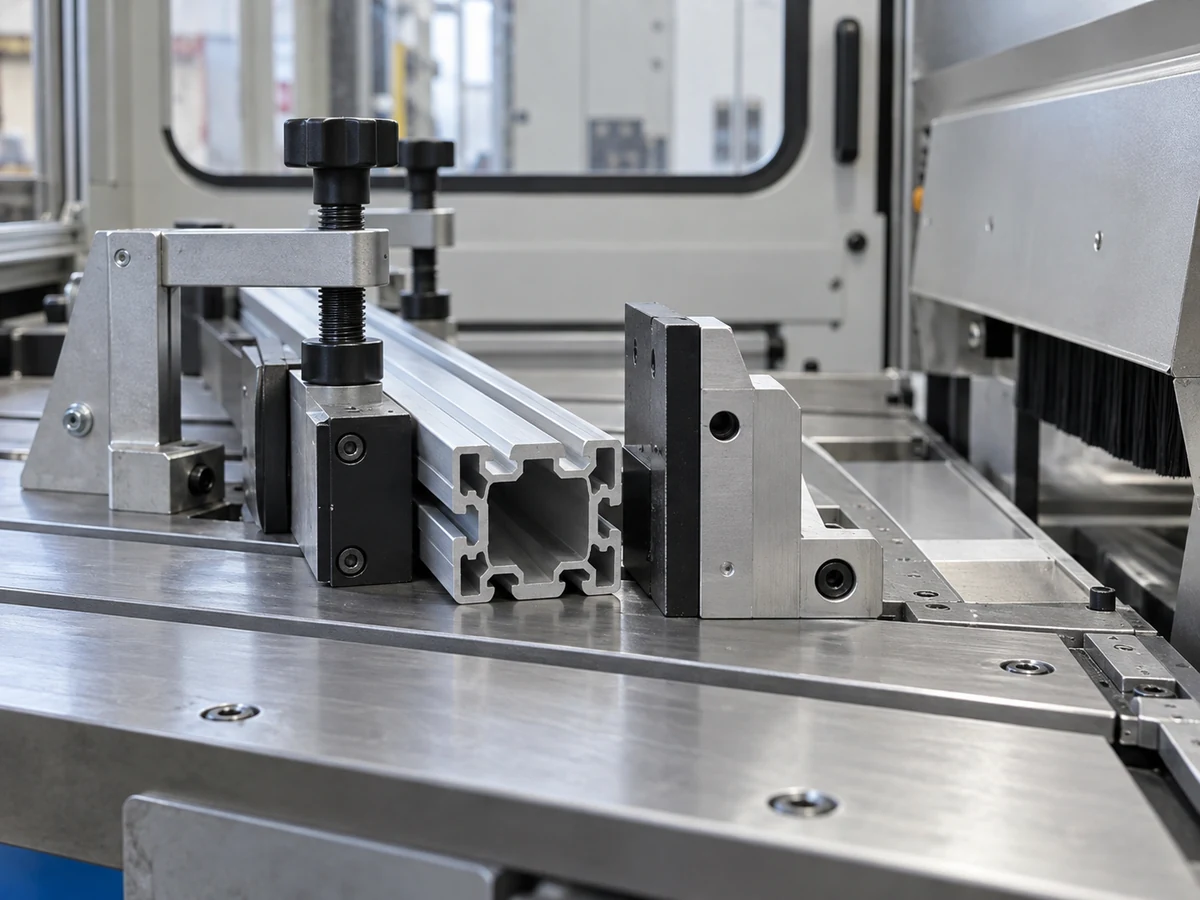
For an extruded route, a circular central opening does not describe the whole profile. External grooves, local wall changes, ribs, protrusions, finish and the location of acceptable contact areas affect how the stock can be presented, supported and held. A supplier needs the actual cross-section and straight stock length, plus the faces that must remain protected. Ask the vendor to propose a fixture and support approach for the supplied profile and confirm it with a controlled sample; do not infer fixture suitability from a machine’s generic capacity figure.
If multiple extrusion revisions are used, say which changes require fixture adjustment or a different setup. A quote for a single easy sample is not coverage for the entire family. Request a setup/changeover description, identified tooling, handling of the first and last usable pieces, and a clear statement of any manual intervention. Include the receiving team’s limits on visible marks and part separation only when those limits are approved and measurable.
Compare complete supply routes at the same receiving stage
There are at least three meaningful alternatives: keep buying accepted finished housings; buy prepared or cut blanks and retain the later operations; or retain a released stock-to-blank operation with a saw. In some factories a casting route makes the second or third option inapplicable. Compare only routes that deliver the same agreed unit to the same receiver, in the same period and product mix. Otherwise a lower blank price may simply move machining, inspection, scrap, logistics and scheduling work into your factory.
For an in-house saw route, price the installed equipment, relevant handling and tooling, staff time, training, utilities, maintenance, blade service, inspection, stock losses, rework and space. Include the stock supplier’s minimum order, material condition and delivery assumptions. For bought blanks or finished housings, include the quoted scope, transport, acceptance and any work retained after receipt. Show changes in inventory and lead-time exposure as separate assumptions rather than treating them as guaranteed savings.
Capacity comparisons need the actual mix: short and long blanks, each cross-section, changeovers, inspection and downstream receiver pace. A catalog cycle time for one cut cannot establish line output. If your blank is not the bottleneck, extra saw capacity may have little value. For a wider procurement template, see our aluminum cutting machine RFQ checklist; for a downstream boundary, see the inspection-cell purchase route.
Run a trial around the approved handoff
Before accepting a machine, agree which stock lots, housing revisions and length groups must be represented. Record the as-received section and condition, fixture and blade configuration used, the planned blank output, operator involvement, changeover, nonconforming pieces and remaining stock. The test should yield labeled blanks that the named next operation can inspect against the released blank specification. Ask the next receiver to sign off its own requirements; the saw supplier’s end-face photo alone is not a housing acceptance.
Where a sample cannot cover the full portfolio, label the result as limited. Ask what differs in production stock, finishing condition, length and annual mix, then define a second test or contractual limit. Record whether a proposed tool, support, guard, feeder or downstream handling device is included in the quoted machine configuration. A model family name by itself is not a configuration register. Any numerical capacity or accuracy claim must be tied to the exact selected machine and verified conditions; a feed repeatability figure is not a guarantee of finished-housing accuracy.
RFQ checklist for a motor-housing blank route
- Supply boundary: bought finished housing, bought prepared blank or retained stock-to-blank operation, with a named receiver.
- Portfolio: housing and blank identifiers, revisions, end variants, lots, lengths and forecast mix.
- Incoming input: actual stock form, section drawing, material/condition, straight length, finish and protected faces.
- Released output: blank drawing, length/end requirements, identification, inspection method and destination.
- Station scope: loading, support, fixture, cutting, offcut management, discharge, guarding, tooling, operator tasks and changeover responsibility.
- Evidence: sample and production-condition trial plan, measurement record, receiving acceptance and limits of any trial.
- Commercial comparison: identical receiving stage and period, installed and running resources, exclusions and support terms.
Questions buyers often ask
Can one saw cover both extruded and cast motor housings?
Only if both routes contain a released cutting task and the supplier demonstrates the actual input and output requirements. A finished casting may need no saw operation at all. Keep the routes separate until engineering defines a common job.
Does a cut blank prove the motor housing is qualified?
No. A blank trial can test the saw handoff agreed for that blank. Bore, mounting, finish, assembly and motor-system acceptance remain with the downstream process and product owner.
Which machine model should we request first?
Send the approved stock and blank portfolio first. Jiurun makes industrial circular-saw equipment for aluminum and other nonferrous stock, but model, fixture and configuration suitability require a review of the actual section, length range, volume and trial criteria. Do not select from an unrelated brochure number alone.
General equipment footage
The video below is general Jiurun machinery footage from our YouTube channel. It shows an equipment example only. It does not document this article’s motor-housing material, machine configuration, customer, trial cut or performance.
Prepare a useful inquiry
Send Jiurun the actual incoming section drawing, stock length, material condition, blank drawing and revision, protected surfaces, family mix, batch schedule and the receiver’s measurable acceptance criteria. Identify what you buy finished today and what work you intend to retain. We can discuss a candidate saw configuration and the sample evidence needed to judge it, without assuming that a photograph or another factory’s housing route fits yours. Share your blank-cutting requirement with Jiurun.