
An aluminum saw for football goal manufacturing is a sensible purchase only if the factory still cuts released aluminum members. A company that buys finished goals has a different equipment question from one that receives long extrusions and makes its own uprights, crossbars and support pieces. Goal width is a product dimension; it is not a saw cut list. Before comparing machines, identify the exact stock that reaches the cutting station, the accepted output leaving it and the work performed elsewhere.
Start with the supply route, not the goal size
Write one route sheet for each goal family. Does the supplier deliver a complete goal, a prepared frame kit, pre-cut members, or long profile stock? Which party owns the joint design, finishing, net, support and final product release? A saw can only be justified against the member preparation that remains with your factory. If a bought kit already contains accepted-length members, a second cutting operation may add handling and quality risk without producing value.
A published FORZA Alu110 product specification is a useful example of why this boundary matters. Its frame, connectors, net supports, net, clips and fasteners are specified as different objects and materials. That is one other manufacturer’s product description, not a Jiurun customer case, saw configuration or approved drawing. Your own released bill of materials and supply contracts must decide which of those kinds of objects are actually made in-house.
Separate cut members from purchased and downstream work
For each retained member, record the drawing revision, profile section, alloy and temper if specified, incoming length and surface condition, finished cut length, end form, quantity per goal or delivery set, and the next operation. Keep bought nets, fasteners, clips, weights or steel supports outside the aluminum saw workload unless a separate material and machine review explicitly brings a component into scope. Do not infer that an aluminum circular saw should cut steel simply because steel belongs to the finished goal.
| Object in the purchase file | Question for the saw decision | Separate owner or evidence |
|---|---|---|
| Released upright or crossbar blank | Does long aluminum stock require a straight or angled cut at this station? | Actual section drawing, cut datum and next-operation acceptance |
| Rear or side support member | Is it aluminum stock, already prepared, or another material? | Controlled material and supply record |
| Corner or joint component | Is the saw making a simple end face, or is further shaping needed? | Joint designer and downstream process plan |
| Net, clips, ballast and hardware | Usually no aluminum profile saw duty follows from these names alone. | Purchased-component and final-assembly control |
This separation prevents a quote for “one goal” from quietly assuming that every item in the carton travels through the proposed machine. It also makes capacity discussions meaningful: count accepted member sets through the cutting station, then count complete goals or paired delivery sets separately.
Release the actual section and cut list
Football goals are not one universal extrusion. A frame may use an elliptical profile, a round tube, a square tube or a proprietary section. The example above describes an elliptical reinforced frame and a different aluminum net-support section. Neither a marketing photograph nor the outside dimensions of a completed goal gives the blade clearance, wall support or clamping face of the stock you will buy. Request the current section drawing and a physical sample for every family you intend to quote.
On the cut list, name the measuring datum and end hand. Distinguish the supplied stock length from the accepted cut-piece length. If a corner is welded or assembled with a connector, state which cut face enters that operation and whether a burr, out-of-square face or surface mark would cause rejection there. Record any finish applied before cutting; a protected visible surface can change how stock may be handled and clamped. Do not substitute a nominal goal width for any of these member dimensions.
Test clamping and support for an aluminum saw for football goal manufacturing
A shortlist should be based on the usable machine envelope with the actual section and length, not on a single catalog maximum. Ask each supplier to show where the stock touches the fixture, how a hollow wall is supported, which faces remain visible, and how the last short piece is held and released. Check the longest bar through infeed and outfeed, the shortest accepted part, the most awkward orientation and the changeover between unlike members. An automatic feeder may reduce repeated manual positioning for one stable family, while a staffed station may be easier to change across a varied list; neither route is inherently correct without a full-cycle trial.
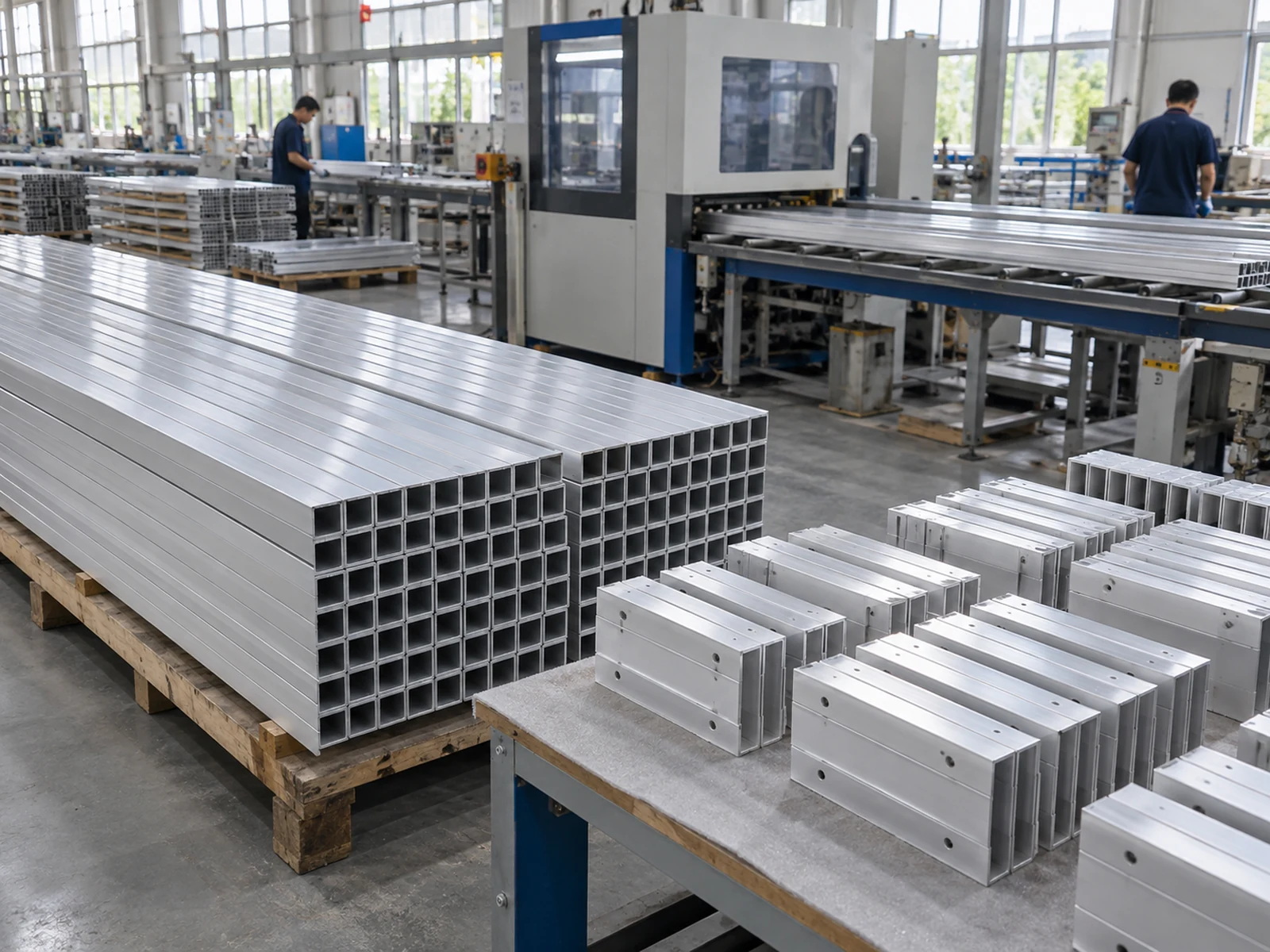
Use a floor sketch to identify stock staging, lift and loading method, infeed supports, saw access, finished-member collection, inspection and the route to assembly or shipment. Mark who supplies each rack, stop, fixture and chip-management item. A machine-only price omits the handling that often decides whether the quoted cycle is realistic.
Keep end geometry and goal design in separate decisions
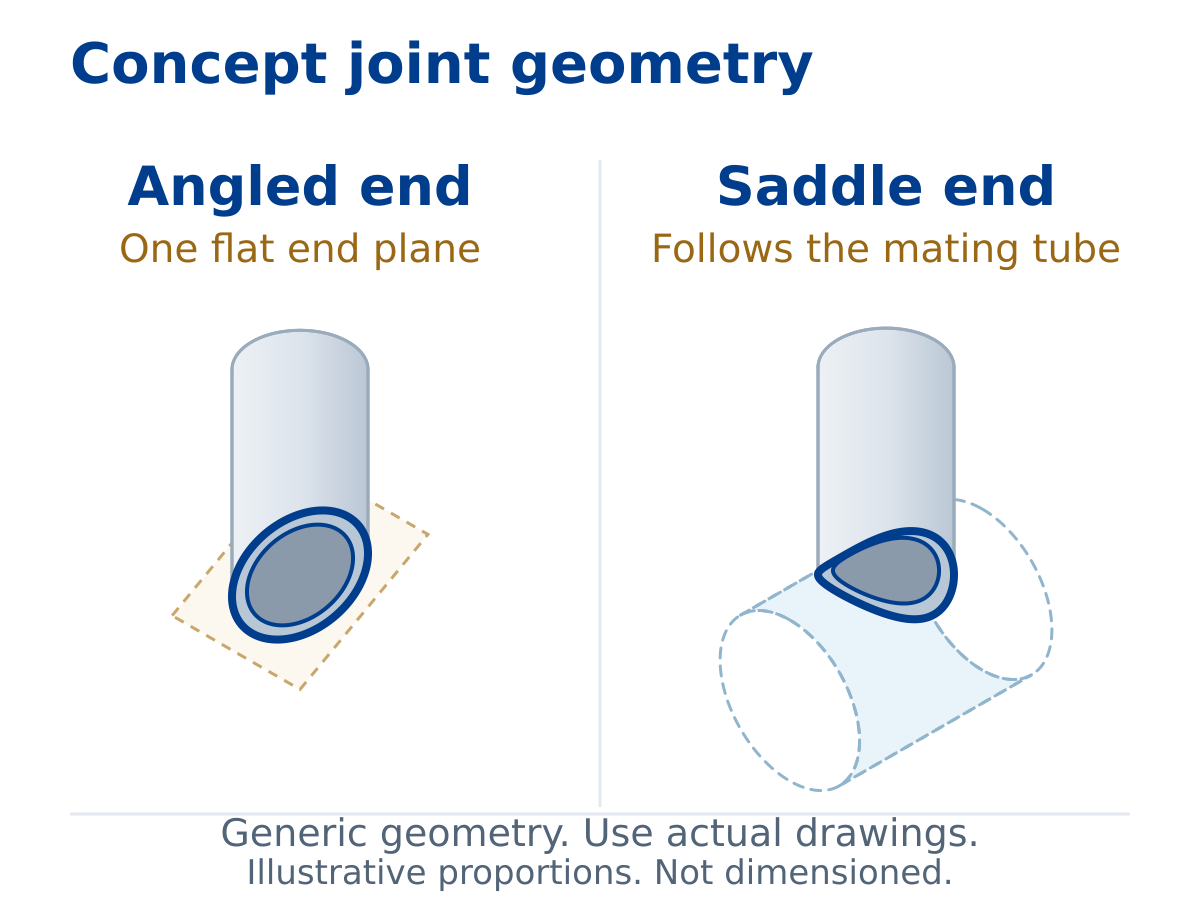
A planar angled end and a saddle-shaped end against a mating tube are different shapes. A conventional circular-saw pass may establish a planar face, but a curved fit may require another process or a specially reviewed operation. Ask the goal or joint designer for the approved end drawing, then ask the machine supplier to identify exactly which geometry its proposed setup can demonstrate. Do not turn a saw trial into approval of a weld, connector, frame or finished product.
Joining, finishing, net attachment, stability and use-site suitability need their own owners and evidence. A passing cut length or appearance check does not establish those outcomes. Keep the saw acceptance document limited to the released cutting operation and its direct downstream handoff.
Make the sample trial answer a purchase question
Send representative stock, drawings and acceptance limits before booking a demonstration. Select samples that can overturn the purchase decision: the largest and smallest relevant sections, longest incoming bar, shortest accepted piece, protected finish, and any angle or end-hand change that requires a different setup. Agree the blade, fixture, clamp pressure, support arrangement and measurement method. If the seller cannot trial the intended stock, record the substitution and the conclusion it cannot support.
Inspect a sequence of pieces, not just a photogenic first cut. Measure accepted length from the specified datum, check end angle or squareness where required, note burrs, ovalizing or wall deformation, visible-surface marks and fit at the next operation. Record setup changes, rejected pieces, rework and the operator steps from load to identified output. A feeding-position specification is not a finished-member accuracy guarantee; measure complete cut parts under the buyer’s agreed method.
The trial report should name the exact machine configuration and what was observed. It should not claim that a saw certifies goal loading, anchoring, stability, installation, safety standard compliance or performance in use. Those are separate product and site responsibilities.
Compare offers on accepted member sets
Ask every bidder for the same response format: standard machine, optional fixture, blade and consumables, stock supports, outfeed, controls, guarding, training, installation duties and trial conditions. Request a clear list of exclusions and unresolved samples. Compare the time and resources needed for the full released member portfolio, including changeovers, inspection and handling. Quote economics should use the same period, same accepted output and same boundary for every option; a cheaper bare saw cannot be compared with a supported line as if both deliver the same station.
Decide whether the receiving unit is one cut member, a complete member set for one goal, a frame kit, a goal, a pair or another contracted delivery set. Track missing parts and rework at each boundary. If a bought kit or subcontracted cut route already meets the contract, compare that route against the complete cost and risk of retaining saw work. The business case is the accepted output your factory can actually release, not a projected number of strokes.
Video: general saw equipment, not a goal trial
The Jiurun Machinery channel clip below shows a semi-automatic aluminum saw, roller supports and a guarded cutting area. It is general equipment footage to help buyers ask about loading, support and operator access. The visible material is not a verified football-goal profile. This video does not prove the article’s material, goal model, customer, quoted machine configuration, test cut or performance. Require a separate, documented trial with your released stock.
What to send for a useful quotation
Provide the released member drawings and revision list, actual stock sections and samples, material/finish records, cut list with datum and end hand, quantity by family and batch, accepted-member inspection rule, the next-operation interface and a site-flow sketch. State which items arrive bought or pre-cut and who owns joining and final goal approval. Ask Jiurun to mark the parts it can assess with a proposed industrial aluminum saw, the configuration required for a trial, and every item left outside that assessment. Send the cut list and sample details before requesting a model-specific quote.