
Choosing an aluminum saw for awning manufacturing starts with the work your factory will actually retain. Which members will you cut from released stock, and which will arrive as complete awnings, prepared kits or finished components? A saw quote can be compared fairly only after that boundary is fixed for the product families and order patterns in scope.
This guide treats a folding-arm awning as a purchasing and production-routing problem. It does not prescribe awning structure, wind rating, installation or drive design. Use the approved product drawings and supplier documents to decide whether cassette and front-member cutting belongs in your plant; then test the proposed saw on those exact released profiles.
Define the retained work before requesting a machine quote
List each awning family separately: open, semi-cassette or full-cassette products may create different sets of aluminum members. A published product category alone is not a cut list. For every family, identify the approved product revision, sold width and projection variants, single or coupled arrangement, actual member drawings, and the supplier stage at which each member is received. Record whether the factory buys a complete awning, a prepared component kit, a finished profile, or an uncut stock length.
The potential saw workload is the portion of released aluminum member work retained in-house. Keep bought spring arms, rollers, fabric, drive components, fasteners and outsourced finishing outside that workload unless the purchase specification explicitly brings them into the project. A tubular motor described in a roller tube does not turn the saw into a drive-system supplier. Likewise, a cassette drawing does not prove that every cassette extrusion needs a cut at your site.
Compare supply routes at the same accepted stage
Start with a complete-awning purchase route. The supplier owns the member preparation and assembly scope, while your operation receives an accepted product. A prepared-kit route moves final assembly to your plant but may leave profile cutting and feature work with the supplier. A precut-member route brings identified lengths to your site for drilling, finishing or assembly. An uncut-stock route adds the saw station and its handling, inspection, inventory and scrap responsibilities. None of these routes is inherently cheaper; compare the cost of delivering the same approved awning family at the same acceptance point.
For each route, mark the exact handoff: who owns drawings and revisions, who supplies the blank, who cuts and identifies it, who performs slots or holes, who protects the visible finish, who delivers a complete member set, and who replaces a rejected part. Include stock minimums, changeover time, offcuts, labor, handling and schedule risk. Do not compare a quote for bare cut lengths with a quote for a finished, checked awning kit.
Build a member matrix from released parts
Ask engineering and the current supplier for a member matrix, not just a product brochure. Each row should carry the family and revision, member identifier, cross-section drawing, alloy and temper where specified, incoming surface condition, blank length, quantity per awning, cut angle or orientation, exposed-face rule, required end condition, later features, inspection method and annual order pattern. Add the proposed purchased stage and the retained operation. Where the supply contract gives only overall awning width, obtain the authorized conversion to each member length from the product owner. A sold width is not automatically a saw stop setting.
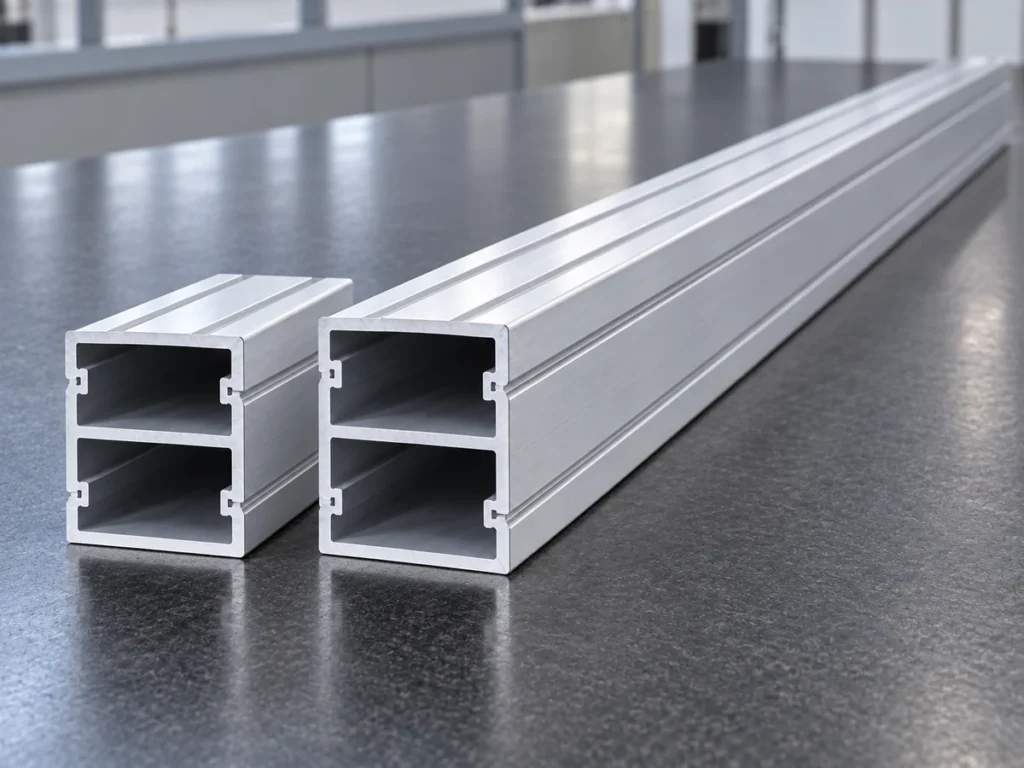
Separate cassette bodies, front profiles and any other released aluminum members by their real section and surface state. A multi-chamber extrusion may need a different support and clamping approach from a slim cover strip; a painted or anodized visible face may need a different handling and inspection plan from unfinished stock. Do not infer a machine capability from a generic photograph or a different customer cut. Send actual section samples and drawings for the quotation and trial, with the approved acceptance criteria attached.
Specify the complete saw station rather than an isolated blade
The RFQ should request a process route from identified incoming stock to identified accepted members. Define material arrival and storage, loading direction and maximum stock envelope, safe support along the feed path, positioning and clamping for each family, cut orientation, chip extraction interface, outfeed and part segregation. Ask vendors to state which fixtures, supports, clamps, guards, measuring devices, controls and handling aids are included in their quoted configuration. The eventual method must be checked against the actual delivered machine and site layout.

A vendor may propose manual, semi-automatic or automated feeding; the choice follows the approved part mix and production rhythm. For repeated lengths, compare changeover and identification effort as well as cutting cycle. For mixed-width orders, check how the operator calls the correct revision and how the station prevents a correctly cut piece from being assigned to the wrong awning. Treat quoted feed repeatability as a machine-stage statement, not a guarantee of finished awning dimensions or installation fit.
General equipment footage
General JR aluminum-cutting equipment footage for process context only. This video does not document the awning material, the proposed machine configuration, a customer job, a trial cut, or performance for this article.
Run a trial that represents the sold portfolio
Agree the test plan before a supplier demonstration. Use identified samples from the released cassette and front-member families, including the section and finish conditions that are difficult to support or protect. Include the shortest and longest authorized member lengths, the cut orientations actually ordered, and the changeovers that occur in a normal campaign. If a proposed machine is intended for only one subset, state that exclusion in the RFQ rather than letting a successful easy cut stand for the whole portfolio.
For each trial piece, retain its stock identity, drawing revision, machine and fixture configuration, cutting parameters, operator sequence and output label. Inspect length and end condition using the approved drawing methods; inspect visible faces under the product owner’s criterion; then pass the member through the next real operation. A sample that meets a bench measurement yet cannot enter a cassette assembly or match its companion front profile is not an accepted production route. Conversely, a dry fit on an unrelated sample is not proof of dimensional capability.
Observe set-up, loading, clamping, cut, outfeed, chip handling and changeover. Record any rework, rejected pieces, finishing damage and missing parts. Have the buyer and supplier sign the actual accepted sample set and the configuration used. Do not translate one demonstration into a promise about every extrusion or all awning products. Installation, structural performance, weather resistance and motor operation require separate product-level evidence outside a saw trial.
Compare total cost and responsibility by order pattern
Build the business case with the same order period and accepted output for every route. Count complete purchased awnings or prepared kits at their contracted stage. For in-house cutting, include stock purchase and freight, usable yield and offcuts, storage, material handling, fixtures, saw and extraction, utilities, scheduled labor, programming and revision control, inspection, maintenance and consumables, rejects, and the remaining outside operations. Separate one-time installation and qualification work from recurring production cost. If volume is uncertain, test a low and high order scenario instead of assuming full utilization. For commissioning and ramp-up costs after selection, see our aluminum saw production ramp guide.
A plant may keep complete-kit supply for low-volume custom products and cut repeated cassette members in-house for a stable family. Another may retain only late-stage trimming while buying the difficult finished extrusions precut. Both are valid if the handoff and acceptance record are explicit. A saw is justified by a defined, repeatable retained workload and an achievable accepted-member route, not by the fact that a catalogue shows aluminum profiles.
When an aluminum saw for awning manufacturing is justified
Proceed to a machine order only when the released member matrix is complete, the vendor’s quoted configuration covers the retained sections and stages, representative trial members pass the next-operation checks, responsibilities for rejected and changed parts are assigned, and the comparison uses equivalent accepted output. If drawings, supply stage or production mix remain unsettled, keep the proposal conditional. Ask the vendor to quote the missing configuration and trial work explicitly; do not silently fill the gaps with assumptions about a standard machine.
For a focused quotation, send Jiurun the approved member drawings, actual stock samples, finish condition, cut list by product family, incoming and accepted stages, order pattern and inspection criteria. Request a written configuration and a buyer-witnessed trial plan against those materials. Jiurun can then discuss the saw-stage work in the proposed route; your product owner remains responsible for the awning’s complete design, compliance and final acceptance.
Sources and scope note
Weinor’s folding-arm awning product information distinguishes open, semi-cassette and full-cassette product arrangements. Markilux’s 3300 product material shows extruded aluminum cassette/front-profile members for that specific system. Somfy’s patio awning guide places a tubular motor within a roller-tube assembly. These examples explain why the product bill of materials and bought-versus-retained boundary must be checked for each released design; they are not Jiurun machine qualification evidence or a universal bill of materials.
Product references: Weinor folding-arm awnings; Markilux 3300 product material; and Somfy patio awning guide. Verify the applicable revision and your own product drawings before using any example in a purchase decision.