
A proposed aluminum cutting machine can look sensible against one annual volume and unsuitable against another. That does not necessarily mean either supplier has quoted the wrong equipment. The buying team may be using different assumptions about which customer programs will start, how quickly quantities will grow and what work the factory will actually release to the saw.
Before turning a sales forecast into a machine requirement, build a small set of aluminum saw demand scenarios. Keep the customer demand evidence separate from the equipment performance evidence. An expected order is not an accepted order, and an accepted order does not demonstrate that a particular saw configuration will produce the required parts within the available working time.
This guide provides an original purchasing worksheet and a hypothetical workload comparison. It helps identify which demand assumption changes the proposed purchase. It does not predict sales or establish a Jiurun machine’s output.
Separate the demand statement from its supporting evidence
A requirement such as “we need capacity for our new product” leaves several decisions hidden. Is the quantity based on current releases, a customer’s planning forecast, a commercial opportunity or an internal growth target? Does the quantity describe finished assemblies or the individual pieces that must leave the cutting station? Does it belong to a week, a month or one concentrated delivery window?
Label the demand basis in the RFQ. Use the actual status of each input, its date and the person responsible for confirming it. The objective is not to assign an invented probability to every opportunity. It is to prevent a tentative quantity from becoming an unexplained mandatory acceptance requirement.
| Demand input | What to record | Question for the buying team |
|---|---|---|
| Current released work | Part identity, quantity and required period, with its actual release status. | What must the proposed arrangement support at the intended start date? |
| Customer forecast | Forecast date, planning horizon and the parts or programs included. | Which quantities remain subject to customer confirmation? |
| New opportunity | Proposed part requirements and the assumptions behind the possible volume. | Which technical or commercial milestone would make this a firmer requirement? |
| Internal growth target | Target period and the assumptions being tested. | Is management asking for this as a purchase requirement or as a separate comparison case? |
Keep confidential commercial information under your own disclosure rules. A supplier can be given the relevant production scenario without being told an unsupported story about a guaranteed customer program.
Build scenarios around the decision that could change
NIST MEP describes a planning cycle linking forecasts, demand planning and capacity planning. It explains that operations considers available capacity and resources and may return to sales to validate or adjust a forecast. See NIST’s discussion of manufacturing supply-chain risk management. This general planning principle does not validate a particular equipment choice.
For a saw purchase, useful cases might be current released work, a higher-volume forecast and a different product mix. They need not be optimistic, average and pessimistic versions of one total. A lower quantity with more demanding parts or more distinct setups can pose a different purchasing question from a larger repeat batch.
Give each case the same planning period. State which quantities are required within that period, which part requirements change and which resources are assumed available. If a forecast covers a month but the work must be completed in two short release windows, keep that timing visible. Spreading the quantity across the entire month would answer a different question.
Do not combine every possible future opportunity into one peak and then describe it as certain. Conversely, do not remove an important case because it makes an attractive quotation difficult to justify. The buying team should decide which case is mandatory and which is a conditional comparison.
Convert the cases into an explicit workload model
A simple discussion model can express workload as the sum of quantity multiplied by an estimated time per accepted part for each task, plus separately counted setup time. Compare that workload with the time available for the same defined activity and period. This is a screening calculation, not a complete production simulation.
The boundary of each time input matters. State whether it includes stock presentation, feeding, cutting and normal receiving work. Identify inspection, replenishment or other activities that consume the same constrained resource but have not been included. Include each activity once. If tasks occur concurrently, a simple addition may overstate elapsed time; if they require the same person or machine in sequence, assuming overlap may understate it.
For an existing task, use relevant recorded work as a starting point and document the differences from the proposed task. For a new task, label supplier estimates and untested assumptions clearly. A blade travel time, catalog feeding specification or isolated demonstration should not silently become a time per accepted production part. Unknown inputs should remain unknown until assessed.
A hypothetical comparison: equal quantities can mean different workloads
The following numbers are invented solely to demonstrate the arithmetic. They are not Jiurun specifications, customer records or recommended planning allowances. Assume one defined planning window has 240 minutes available for the modeled work. Task A is assumed to require 0.4 minute per accepted part and Task B 0.7 minute. Those assumed times exclude the separately listed setups. No additional concurrent or omitted work is modeled.
| Hypothetical case | Task A parts | Task B parts | Setup minutes | Calculated workload | Against 240 minutes |
|---|---|---|---|---|---|
| Base case | 300 | 100 | 30 | 300 × 0.4 + 100 × 0.7 + 30 = 220 minutes | 20 minutes remain in this simplified model. |
| Higher-volume case | 450 | 150 | 45 | 450 × 0.4 + 150 × 0.7 + 45 = 330 minutes | 90 minutes exceed the modeled window. |
| Changed-mix case | 200 | 200 | 90 | 200 × 0.4 + 200 × 0.7 + 90 = 310 minutes | 70 minutes exceed the modeled window. |
The base and changed-mix cases both contain 400 accepted parts. Their calculated workloads differ because the assumed mix and setups differ. A specification consisting only of “400 parts per window” would hide that difference. The higher-volume case asks another question: whether its extra workload is a firm requirement or a forecast case whose timing and evidence still need confirmation.
The 20 minutes remaining in the base case is an arithmetic difference, not a validated contingency allowance. It does not establish that interruptions, rejected parts, inspection or other omitted work will fit. Likewise, the two shortfalls do not prove that buying a faster saw is the correct response. First identify the assumptions and resource responsible for the difference.
Ask what changes the result before asking for more machine speed
Review the inputs that have the largest effect on the purchase decision. A wrong part mix can change workload even if the total volume is correct. An untested setup assumption can make a configuration appear adequate. A receiving or inspection constraint may remain unresolved when the cutting estimate improves.
Change one stated assumption at a time in the worksheet. For example, compare the changed-mix case with its setup estimate separately confirmed, then with the actual release window separately confirmed. Keep a record of what changed and why. This helps distinguish a demand question for the buyer from a technical assessment question for the supplier.
A technical response should identify the offered configuration and the specific work it has assessed. Ask whether the quoted handling arrangement, tooling and task sequence correspond to each mandatory case. Do not translate a proposed faster cycle into a complete accepted-part output guarantee without matching evidence.
If the uncertainty is commercial, the buying team needs to settle the commitment level. If it is technical, arrange a defined assessment with the responsible supplier. If it concerns resources at the factory, confirm the actual planned resource availability. Purchasing extra equipment on an unexplained assumption does not resolve the missing evidence.
Compare purchase routes against the same aluminum saw demand scenarios
Before selecting a configuration, ask the buying team to describe what it is prepared to commit to each case. The purchase can be reviewed against current released work while a larger forecast stays as a separate comparison. Alternatively, management may choose to make a named future case part of the order requirement. That choice changes the scope the supplier must assess; it does not turn the forecast into a confirmed customer order.
| Route to compare | Evidence needed | Decision left open |
|---|---|---|
| Purchase for the stated current case | Defined current parts, release windows, resources and assessment of the exact offered configuration. | Whether later demand can use the same arrangement. |
| Include a named future case in the purchase requirement | Management confirmation of that scope and supplier assessment of its actual mix and timing. | The commercial uncertainty of the forecast itself. |
| Order a defined current scope and separately evaluate a later route | A current quotation plus a separate, explicit response on the later configuration and work required. | Later availability, compatibility, price and delivery until reconfirmed. |
For an invented buying example, the current case could fit the initial discussion model while the changed-mix case does not. One bidder may propose a broader equipment package; another may leave the future case outside its offer. Ask both to describe the case they are actually accepting and the work they have not evaluated. Comparing their totals as though both cover all three cases would hide a purchasing difference.
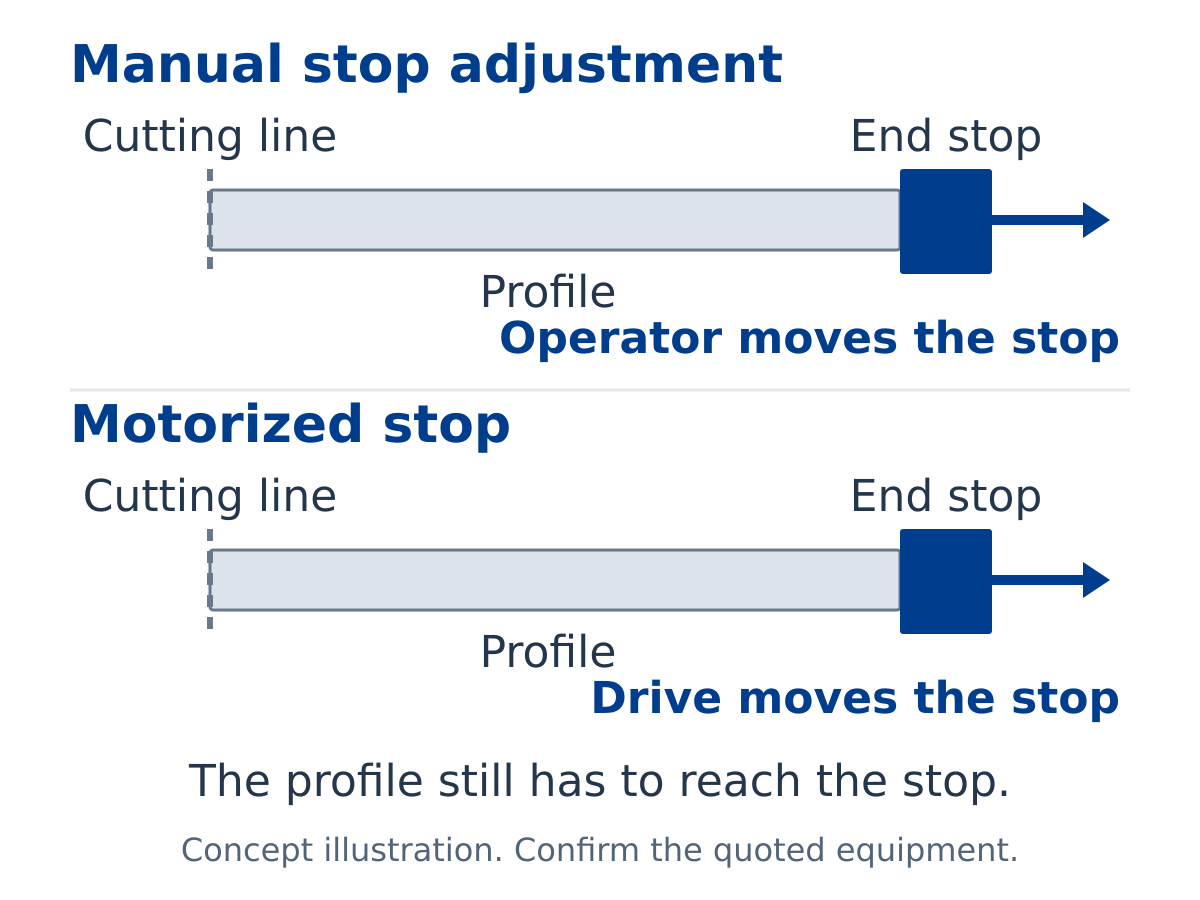
The buying team should also distinguish an option included in an offer from a possible future change mentioned in a conversation. A future route needs an identified scope, limitations and a basis for reconfirmation. Do not assume that a drive, loading device, extra shift or second machine will be available, compatible or sufficient because it appears in a planning worksheet. The supplier response and the factory resource plan must cover the actual proposed route.
Keep a short decision record with the selected case, quotation revision, unresolved assumptions and the event that starts the next review. That record helps a later buyer understand why the chosen scope was reasonable on its stated basis. It also prevents a later forecast revision from being mistaken for proof that the original equipment was incorrectly specified. Review the changed requirement and the evidence supporting it before changing the order.
Use the same scenario pack for every quotation
Send suppliers the same identified scenario pack and ask them to state the basis of their response. One offer may assess only the base case while another includes additional handling for the higher-volume case. A difference in scope should be visible before the prices are compared.
- Identify the parts, revisions, materials, cut requirements and accepted output for each case.
- State the common planning period and any concentrated release windows.
- Label the demand evidence and date for each case.
- Mark mandatory purchase requirements separately from forecast comparisons.
- Identify the available machine and operator time assumed in the worksheet.
- List measured time inputs, supplier estimates and unresolved assumptions separately.
- Ask which configuration and assessment evidence support each mandatory case.
- Ask which change in volume, mix or timing would require reconfirming the offered scope.
The aluminum cutting machine RFQ checklist can help organize the underlying quotation information. The additional purpose of this scenario pack is to show how uncertain future demand changes the required assessment.
View Jiurun equipment as discussion context
This equipment video provides context for a saw inquiry. It is not a production assessment of the hypothetical tasks above, evidence of a customer forecast, or proof of the output of any proposed package.
Agree a review trigger instead of treating the forecast as permanent
Record which case the purchase decision used and which conditions would require a new review. Useful triggers could include a customer release becoming confirmed, a new part family entering the plan or a change in the required production window. These are project-specific management decisions, not universal thresholds.
Describe the response to a trigger as a review of the affected requirement. Do not assume it proves that a later retrofit, a second shift or a specific expansion package will be available. Those options need their own technical, resource and commercial confirmation. A scenario worksheet is not evidence of an upgrade capability.
For an initial discussion with Jiurun, share the identified cutting tasks and demand cases and ask which questions the proposed configuration can actually address. A useful reply connects the offer to a stated case, identifies the remaining assumptions and explains what needs confirmation. That gives the buying team a clearer basis for deciding what to commit now and what to keep under review.