
Aluminum dock board curb cutting starts with a material check, because one board may contain very different kinds of metal work. A tread plate can be cut and formed as a broad sheet, while a side curb may start as a long extrusion. Those are not interchangeable saw jobs. Before an equipment buyer asks for an aluminum saw quotation, the board manufacturer should identify the exact member it will cut, the approved input stock, and the stage at which its own factory accepts the blank.
This guide concerns the released aluminum curb extrusion blank for a dock board that actually specifies one. It does not set the board’s capacity, ramp geometry, installation method, or safe operating procedure. The board designer and manufacturer own those decisions and the completed product’s validation.
First confirm that the curb really is aluminum extrusion
The words “aluminum dock board” do not prove that every side member is aluminum. Bluff Manufacturing’s product description distinguishes an aluminum tread-plate board with bolted structural-steel side curbs from its all-aluminum welded ATD, which uses aluminum tread plate with welded extruded aluminum curbs and legs. Koke’s aluminum dock board description likewise identifies steel side curbs on its board. These are examples of product constructions, not specifications for your own design.
Request the approved bill of materials and drawing before assigning any curb to an aluminum extrusion saw. If the actual product uses steel curbs, buy or prepare those through the approved steel route. If it uses a formed sheet edge, a saw for long extrusion stock may have no curb work at all. A buyer who assumes that the name of the finished board specifies the feedstock risks pricing the wrong machine and excluding necessary downstream work.
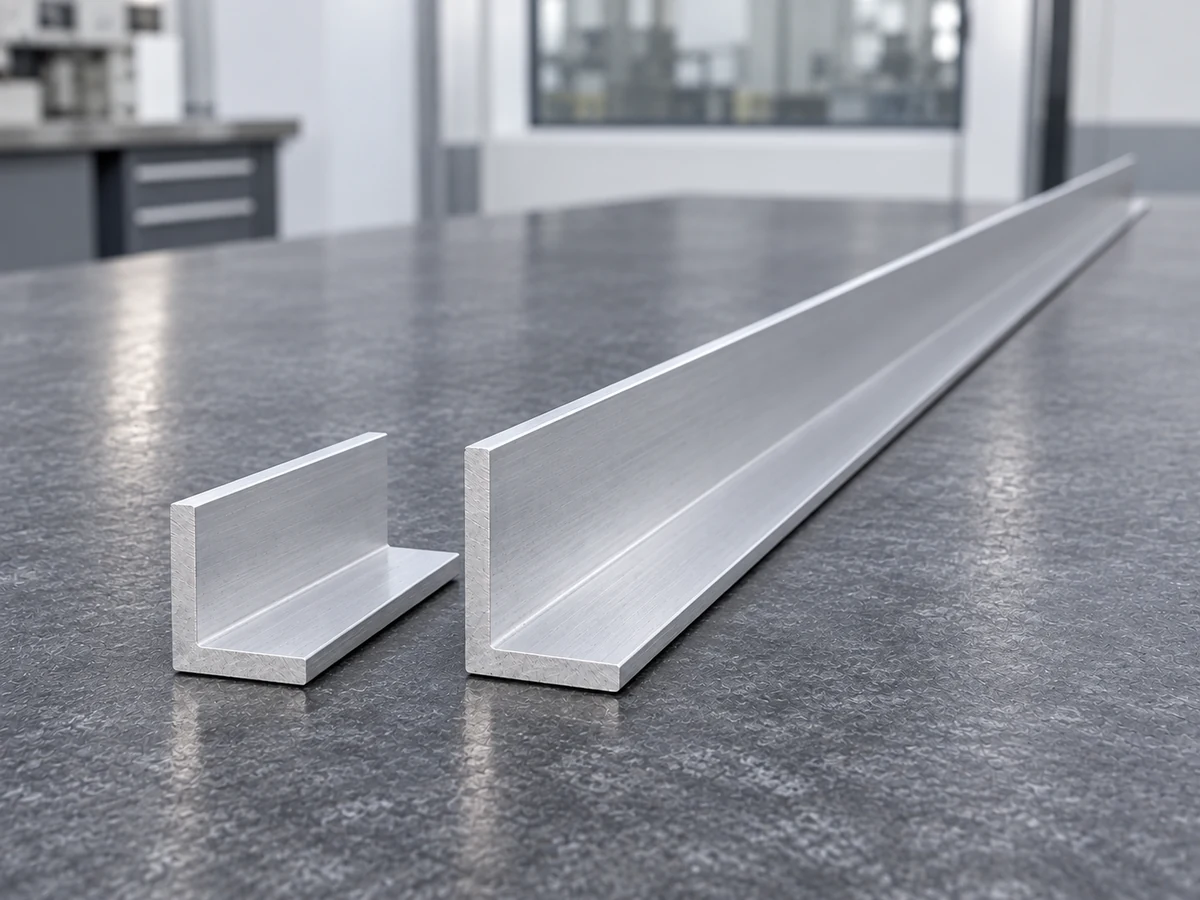
Aluminum dock board curb cutting: release the blank drawing
A board’s nominal width and length describe an assembled product. They do not automatically give the saw length of a side curb. The released curb drawing should say which side, variant, and revision it belongs to; whether the input is a straight extrusion; which end faces are cut; and which dimensions are blank acceptance dimensions. Record any later holes, formed details, welding preparation, coating, or assembly features as later operations unless they are explicitly included in the purchase scope.
For a useful RFQ, prepare one line for each controlled blank reference. Include the section drawing and orientation, alloy and material condition if specified by the designer, incoming surface condition, stock length range, finished blank length and tolerances, end geometry, planned quantity and batch mix, and packaging identity. If the two curbs are mirror or handed parts, explain how the receiving team will distinguish them. A right-hand board dimension is not a substitute for a right-hand curb cut list.
Ask the responsible engineer which datum will be used to measure the cut length and which face must remain protected for the following join or weld. A nominal saw setting is only a process input; the accepted output is a measured physical blank against its released drawing. If the drawing has not fixed the reference end, hold the buying comparison at the requirement stage rather than turning a supplier’s guess into an acceptance criterion.
Keep plate, curb, leg, and finished board routes apart
A saw quote can cover straight extrusion cutoff and still leave most of a dock board unfinished. The tread plate may require a sheet or plate cutting and forming route. Legs and attachment hardware may be extruded, fabricated, or bought parts. Joining, surface treatment, product labeling, and completed-board inspection belong to their assigned operations. A vendor’s ability to cut the curb blank proves nothing about the load rating or safe use of the assembled board.
Map the purchased stage explicitly: ready-to-join curb blanks, prepared curb components with authorized secondary features, a partly assembled board, or a completed board. Compare supplier offers at the same accepted stage. A cheaper bare blank can require more in-house drilling, welding preparation, handling, scrap control, and receiving work than a prepared component. Conversely, a shop that already owns these later processes may gain control by retaining the cutoff step. Neither route is automatically best.
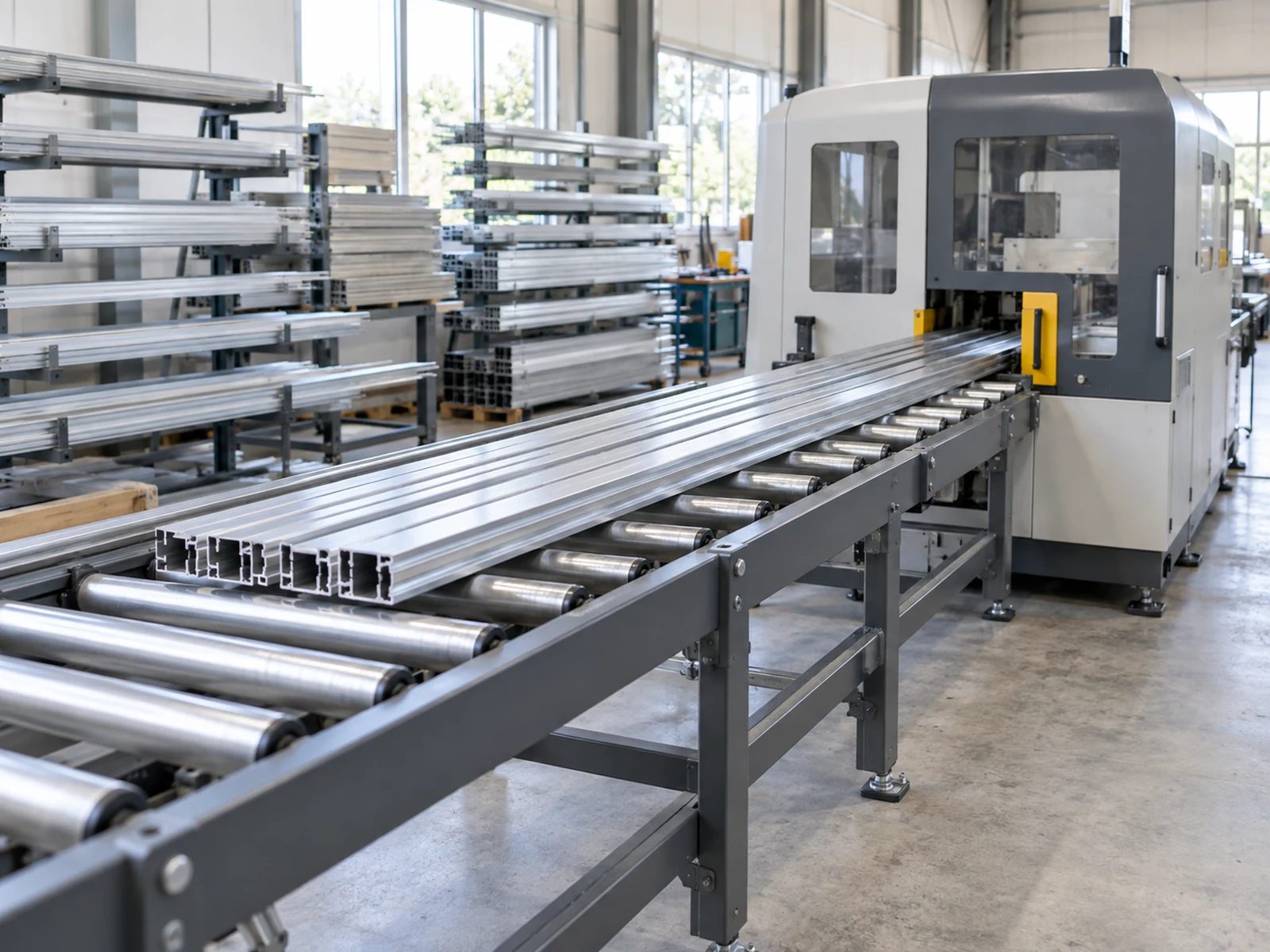
Specify stock handling and contact before a trial
For long, asymmetric stock, the sample drawing alone is insufficient. Show the proposed supplier the actual extrusion cross-section, standard and longest stock, expected cut-length spread, surface condition, and whether the member can rotate on the infeed. Ask it to identify a stable reference face and a support arrangement that does not let the far end lever the part out of position. Check whether the short blank can be removed and identified without mixing variants.
Do not assume that two parallel bars can be loaded together because a catalog image shows multiple sections. Parallel loading is a separate trial condition: part orientation, clamp contact, length consistency, separation at the saw, and individual blank traceability must all be proved on the actual stock. For a curb with a visible or joining surface, agree on where contact marks are acceptable. If the approved input is already finished, surface protection may change the feasible fixture and handling route.

Make the first-off trial answer a buying question
Send a representative, released stock sample with the approved drawing and an agreed measurement sheet. Include the most demanding retained cases, such as the longest stock, shortest accepted blank, both handed versions, and any incoming finish that changes clamping. Do not invent a trial from a generic “aluminum profile” when the production part has a different wall, leg height, or contact surface.
At the stopped setup, document the reference face, support and clamp positions, planned end orientation, and method for removing the first blank. Then let the qualified operating team run the approved trial under the machine maker’s instructions. Examine actual first-off parts for length from the drawing datum, end squareness or specified angle, burr condition, visible-face damage, and downstream fit where the product engineer has defined a receiving gauge. Record measured results and rework separately from a visual impression of a clean cut.
The acceptance record should identify the part revision, material lot, machine and fixture configuration, operator or trial authority, measured first-off results, repeat samples as agreed, and any unresolved issue. A saw vendor’s sample is evidence for the tested cutoff setup only. It is not a completed board test, a welding procedure qualification, or a capacity certification.
Compare quotations on the same delivered blank
Request comparable offers for stock-to-cut blank and, where relevant, a prepared-component route. Each quotation should identify what arrives, what the supplier will measure, who provides tooling, how scrap and short remnants are counted, and who owns packaging and transport damage. For an in-house saw, add labor, fixture changes, blade and maintenance costs, material handling space, inspection time, and downstream operation ownership. Compare these costs against the same accepted curb reference and time period.
A practical decision table has four columns: approved input; work retained at the saw; work after cutoff; and accepted delivery object. Use one row for a bought curb, one for outsourced cutoff, and one for in-house cutoff. If a board family mixes steel-curb and aluminum-extrusion variants, calculate the aluminum-eligible share only. Total board sales are not a valid proxy for aluminum saw loading.
RFQ checklist for an aluminum curb cutoff
- Released board variant, curb part number, revision, and handedness.
- Proof that this curb is an aluminum extrusion, not a steel curb or formed plate edge.
- Section drawing, alloy or condition where specified, actual stock lengths, and incoming finish.
- Cut blank length, datum, end condition, quantities, and changeover mix.
- Protected faces, approved support and contact locations, and short-part removal.
- First-off sample plan with measurements tied to the blank drawing.
- Clear handoff to drilling, welding, finish, assembly, and completed-board validation.
- Quotation at a common accepted stage, including inspection and material loss.
Frequently asked questions
Can an aluminum saw make the whole dock board?
No. The scope here is a released straight extrusion blank where the product design uses one. Plate preparation, forming, joining, legs, inspection, and completed-board approval require their own processes and responsible parties.
Does a rated aluminum board guarantee aluminum curbs?
No. Manufacturer examples show both steel-curb and aluminum-extruded-curb constructions. Check the exact model’s approved BOM and member drawing before quoting a nonferrous extrusion saw.
What should a supplier trial prove?
It should prove the agreed cutoff requirements on the actual released stock and configuration: stable handling, measured length and end geometry, acceptable surface condition, repeatability, and an identifiable accepted blank. The board maker separately validates the finished product.
See a generic aluminum cutting process
The following video from Jiurun Machinery shows a general aluminum saw process. It is an equipment demonstration, not a dock-board curb, a specified machine configuration for this part, or evidence of board strength or safety.
For the difference between an L-shaped section and an angled cut end, see our angle-profile versus angled-end guide. If you have a released curb drawing and want a cutoff equipment discussion, contact JiurunCut with the section, stock condition, blank schedule, and first-off acceptance sheet. We can discuss the saw stage without claiming to approve the finished dock board.