
Air handling unit frame repair is a parts-identification decision before it is a cutting job. A bent corner, damaged panel edge, loose connector, or corroded base can look like a single aluminum member to replace. Yet the same visible edge may also locate a door, compress a seal, retain a panel, bridge a module joint, or carry a service load. Ordering generic extrusion by outside dimensions—or buying a saw because the damaged part appears straight—can leave an unusable or unapproved repair.
This guide helps a maintenance buyer or AHU fabricator compare three routes: an original equipment manufacturer (OEM) assembly, an approved replacement member kit, and in-house cutting of an approved profile. It addresses the decision and the evidence to request, not a universal repair instruction. The AHU owner, its manufacturer, and the responsible engineer must determine whether a particular modification is permitted and what post-repair tests release the unit.
Air handling unit frame repair: identify the failed item first
Start with the AHU’s maker, model, serial number, as-built drawings, module position, and the exact damaged item. Photograph the whole casing and both ends of the member before removing anything. Record adjacent panels, doors, gaskets, corner pieces, fasteners, and any base or lifting connection. Ask whether the item is a casing frame member, a separate base frame, a filter frame, a panel edge, or a non-structural trim. These are different purchases even when they all look like aluminum sections.
The distinction is real across AHU designs. For example, Daikin Applied describes a casing with an extruded aluminum frame and polymeric corner pieces in one air-handler catalog, while TROX describes different frame, panel, base, and module-connection arrangements in its X-CUBE documentation. Those documents illustrate why a profile section cannot be treated as a universal replacement. They do not specify the construction of your unit. Check the actual approved drawing and the manufacturer’s parts route.
Make a short damage map: item identifier, quantity, location, measured condition, suspected cause, adjacent items affected, and whether the unit can be isolated. If the original frame is distorted because a panel or base has shifted, a cut-to-length bar may only hide the cause. If a seal or insulated interface is involved, ask the OEM or responsible engineer to define the required replacement scope.
Compare the three procurement routes
1. Order the OEM module or assembled casing part
This route is the default question when the failed item is inseparable from a factory joint, weather or hygiene boundary, door, insulated panel, or base structure. Ask for the exact part number, revision, orientation, included seals and hardware, installation instructions, and lead time. Confirm whether the supplier ships one member, an assembled panel, or an entire module. A higher quoted part price may include interfaces and verification that a loose extrusion does not.
2. Order an approved cut-member kit
Some manufacturers or approved fabricators may supply the correct profile already cut, drilled, labelled, and bundled with matching connectors or gaskets. This can shorten site work while preserving the approved interface. Request a kit drawing and bill of materials, including handed parts and the revision of the unit it fits. Clarify who checks fit, sealing, and any required unit-level performance after installation. Do not assume an aftermarket kit is interchangeable merely because its cross-section resembles the old one.
3. Cut an approved replacement member in-house
Use this route only after the unit owner and responsible authority release a member-level repair. Obtain the exact approved profile, temper and finish where specified, a current cut drawing, end geometry, allowable stock condition, and a decision on holes or secondary operations. The cutting machine is only one step. The buyer must also account for connectors, protective surfaces, cleaning, labelling, assembly, inspection, and AHU-level release. If any of those remain undefined, price the job as conditional rather than promising a finished repair.
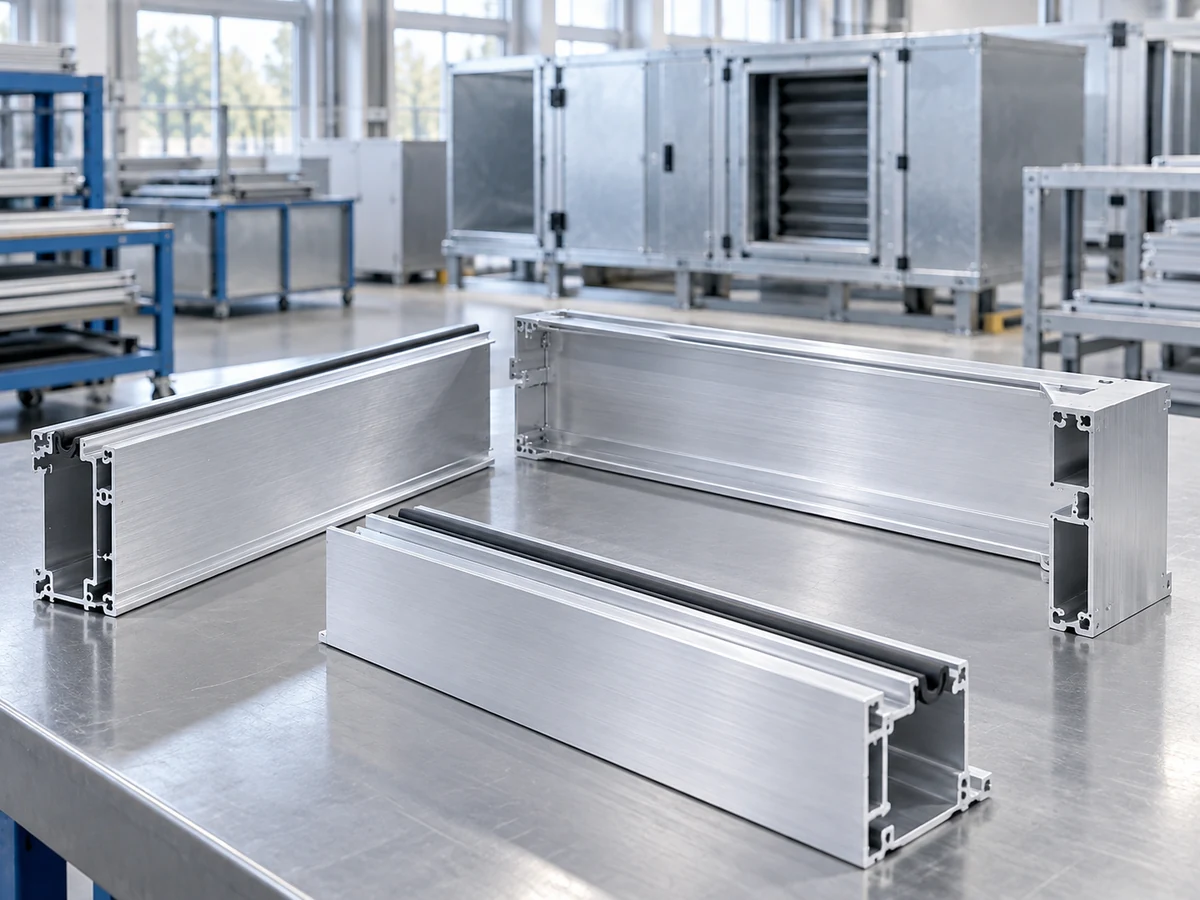
The photos in this article are illustrative views of aluminum AHU-style frame sections and joints. They are not evidence that a particular manufacturer’s casing can be repaired with the pictured members or that a Jiurun saw has qualified the repair.
Pass four gates before specifying a saw trial
Gate A: profile identity and revision
Request the profile drawing or OEM part reference, not just a nominal width and height. Compare the internal cavities, lips, grooves, corner engagement, wall thickness, finish, and any thermal or seal interface. Verify whether the proposed stock is actually released for this serial-number range. A sample of the removed part can help identify a section, but wear, damage, or an earlier field modification may make it a poor master.
Gate B: end and joint geometry
State whether the member needs a square end, mitre, notch, drain feature, mounting hole, or a later machining operation. Define the length from the correct datums and identify which face will contact a panel, gasket, corner block, or neighbouring member. A neat-looking saw cut is not proof of assembled fit. Keep mating components and an approved drawing in the trial package, then check the resulting joint rather than the loose bar alone.

Gate C: repair authorization and release test
Write down who may approve the repair and who will sign off the assembled unit. Depending on the design and application, this could include seal contact, door operation, alignment, corrosion protection, drainage, cleanliness, or other manufacturer-defined checks. TROX’s installation guidance, for example, calls for using the specified module fixing points and warns that incorrect casing assembly can damage the unit or admit water. That guidance is product-specific; it reinforces the need to follow the actual AHU manual instead of applying a generic frame-cutting recipe.
Gate D: cutting capacity and workholding
Only after the first three gates pass should the buyer ask whether a saw can handle the approved stock. Supply the complete profile cross-section, maximum outside envelope, cut length range, target end shapes, piece mix, annual and urgent-repair quantities, and the surfaces that must remain unmarked. Ask the saw supplier to show how stock is supported, clamped, fed, cut, and removed. A machine’s catalogue capacity is a screening input, not acceptance for this profile and fixture combination. Jiurun’s aluminum profile cutting machine range is a starting point for matching the approved job to a machine; request model-specific confirmation rather than inferring it from a general photograph.
Build a witnessed trial around the replacement part
If the in-house route remains eligible, send representative approved stock and the current drawing to the machine supplier. Include the worst relevant cross-section, the shortest and longest required members, both end geometries if applicable, and any finish that is easily marked. Agree where the datum sits, how many consecutive parts will be inspected, what measuring method is used, and who accepts results. Do not turn a single attractive cut face into a claim about sustained accuracy or a finished AHU repair.
Inspect four outputs separately. First, check the cut member against its drawing: length reference, end form, burr or edge condition, and visible handling damage. Second, try the member with the actual approved connector, panel, and seal interfaces. Third, confirm that the required secondary work and part identification can be completed without losing traceability. Fourth, have the responsible party define and perform the unit-level post-repair release. Record any failure and its cause; a machine trial can qualify a cutting step, but it cannot certify the whole casing.
For a broader example of deciding cut-end and assembly checks before choosing a saw, see our HVAC aluminum frame cutting guide. Its general checks still have to be replaced by the damaged unit’s current documents.
Equipment footage: general cutting-process context
The following JR-455CNC video from Jiurun Machinery shows general aluminum cutting equipment, controls and a feed/clamp area. It is not evidence of the AHU material, a permitted repair, the model configuration for this job, a customer unit, a trial cut or any performance result. Verify the actual cutting step against the released frame-member package.
Compare the complete cost and downtime
Quote all three routes on the same boundary. For an OEM assembly, include the part, freight, removal and installation, and expected lead time. For a cut-member kit, include approvals, exact matching hardware, labelling, site work, and required tests. For in-house cutting, include approved stock procurement, cutting and secondary operations, scrap and setup, inspection, assembly, and AHU-level verification. Add the cost of waiting for approval and the effect of downtime; a low raw-bar price is not a low repair cost if it delays release.
Separate one urgent replacement from repeat demand. An occasional isolated repair may not justify a dedicated saw, while a fabricator with released member drawings and a recurring approved parts program may reasonably assess one. The decision should follow actual eligible jobs, not a forecast that quietly includes prohibited or unapproved repairs. If the OEM offers only a complete module, ask why: an inseparable joint or required test may make a loose-member quote the wrong comparison.
RFQ package for a defensible buying decision
- AHU maker, model, serial number, module position, and current drawing revision.
- Photo map of the damaged member and every adjacent interface; reason for replacement if known.
- OEM part number or approved profile specification, including corner pieces, seals, panels, hardware, and finish.
- Permission and responsible sign-off for module replacement, kit installation, or member-level fabrication.
- Cut list with datums, end forms, quantities, stock lengths, and surfaces to protect.
- Required inspection method, mating-part trial, unit-level release test, and records to retain.
- Delivery route, lead time, installation responsibility, downtime window, and exclusions in each quote.
Ask every bidder to mark unknowns and alternatives visibly. A proposal that assumes a generic profile, omits the seal or connector, or guarantees unit performance from a saw trial has not answered the same RFQ. Close those gaps before ranking price.
What if the original drawing is missing?
Do not reverse-engineer an approval from a photograph alone. Start with the OEM and the AHU owner to recover the as-built record or current parts identification. A measured sample can support a quotation discussion, but it cannot establish hidden interfaces, revisions, load paths, or the permitted repair method. If authorization remains unresolved, keep the cutting route conditional and price the approved assembly route in parallel.
Decision to take to the supplier
Choose the OEM module when the interface or approval cannot be separated from the casing. Choose an approved kit when the correct members and accessories are released as a package. Assess in-house cutting only when the stock, geometry, interfaces, inspection, and unit-level release are specified and authorized. This order protects the repair decision from being driven by the availability of a saw.
Have a released AHU frame-member job to evaluate? Send JiurunCut the approved profile drawing, cut list, representative stock details, and acceptance plan. We can discuss the cutting step and an appropriate machine trial; the AHU owner or its designated authority remains responsible for the finished unit’s repair approval and performance.
Sources and scope
See the Daikin Applied Destiny air handler catalog for one extruded-aluminum-frame casing example, and the TROX X-CUBE product documentation and transport and installation manual for a different manufacturer-specific casing and assembly approach. These sources establish variation and the need for actual unit documentation; they do not approve a repair to another AHU.