
A cut length can meet its saw specification and still arrive at the next operation with a marked face, bent fin, or bruised corner. For a buyer, the receiving tray is part of the handoff decision: can identical parts share an open tray, or does each piece need a separated position? The answer depends on which surfaces may touch during unloading, carrying, and retrieval—not on a generic promise of a “gentle” saw.
This guide sets out a practical way to specify aluminum saw cut part tray dividers. It covers the short transfer from saw outfeed to the next operation. It does not assume that a particular Jiurun saw includes a tray, divider, or automated placement device.
Start with the surface that must survive transfer
Mark the functional and cosmetic surfaces on the part drawing before choosing a container. A concealed web on a robust hollow section may tolerate contact that a visible anodized face, a thin fin, or a sealing edge cannot. Also mark any burr or sharp cut edge that could scratch the neighboring part. This makes the question concrete: which two surfaces might meet when the tray is filled, moved, tipped slightly, or emptied?
Do not use the first tidy-looking photograph as proof of safe transfer. The finned profiles in the related sample-tray image show why protruding geometry deserves a separate contact review. The picture does not show a verified divider design or a production acceptance test.

When an open tray may be enough
A shared tray can be reasonable when the parts are short and stable, the exposed surfaces are not critical, the load remains below a defined fill height, and an operator can retrieve a piece without dragging it across another. These are conditions to test with the actual profile and finish, not specifications for every aluminum part. A trial should include the fullest permitted tray and the ordinary route to the next station.
Set an unambiguous fill rule. “One batch per tray” is insufficient if batch size changes. State the maximum count or layer arrangement, the permitted orientation, and whether the cut ends face a protected surface. If the parts can shift during normal handling, the buyer needs a different receiving method even if the saw itself cuts accurately.
When aluminum saw cut part tray dividers earn their cost
Dividers become more compelling when neighboring pieces can strike a visible face, when a narrow edge or fin carries the load, or when part identity must remain separated for the next operation. A divider is useful only if it controls the actual contact path. A tall wall between parts can still leave corners or cut ends free to meet; a soft liner can protect one face while allowing a protruding feature to bend.
Aluminum angles make the point especially clear. Their corners and open legs may nest, hook, or rub in a shared compartment. The related sample-tray photograph below shows angle sections for geometry reference only; it does not depict a divided production tray or prove surface protection. Ask the tray supplier to show how the angle is supported, which face bears weight, and how an operator removes it without scraping another part.

Specify the handoff, not just the tray
Before requesting a quote, map where the part first rests after the cut, who or what transfers it, how far the tray travels, and whether the next operator empties it all at once or one piece at a time. A good tray at the destination cannot undo marks acquired while parts accumulate at the saw. Conversely, a carefully controlled outfeed loses value if parts are then poured into an unsuitable box.
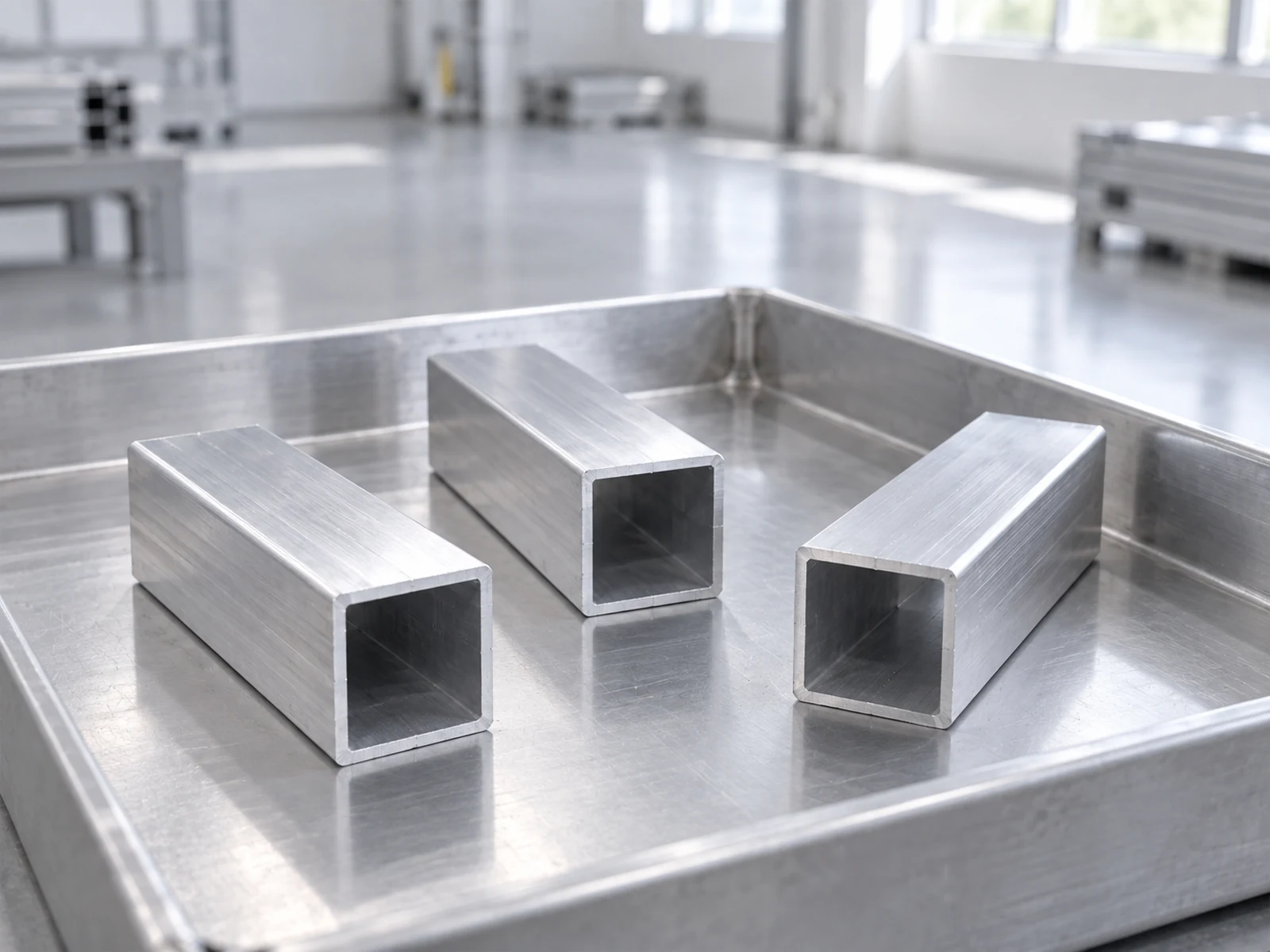
Square hollow profiles may be robust on one face yet still have vulnerable cut corners or a visible exterior finish. The related image shows sample pieces in an open tray; it is a prompt to inspect their contact points, not evidence that the pictured arrangement is acceptable for a given order.
Run a receiving test that can fail
Use representative cut lengths with the actual finish and the normal burr condition. Fill a shared tray to its proposed limit, carry it along the real route, retrieve parts in the usual order, and inspect the protected surfaces under the agreed lighting. Repeat with the proposed divider or individual nests. Record the part orientation, count, tray material, contact locations, and any marks or deformation. If the acceptance criterion is a cosmetic standard, obtain a physical reference or written inspection rule from the buyer rather than inventing an allowable scratch size.
Check the handling burden as well as surface condition. A divider that prevents contact but slows loading enough to create a pile at outfeed may require a different tray quantity, operator method, or discharge arrangement. The procurement decision is the complete receiving method and its acceptance test. Aluminum saw cut part tray dividers should be specified only when that test shows a meaningful protection benefit.
What to include in the RFQ
- Profile drawing, cut length range, finish, and protected faces or edges.
- Expected part count per tray, permitted layers, and maximum fill condition.
- Transfer path and whether parts are hand placed, slid, or automatically discharged.
- Tray or divider materials that may touch the part, with a removable sample if possible.
- Inspection standard at the next operation and the test quantity for sign-off.
- Who supplies and owns the trays, dividers, and replacement liners.
Jiurun can discuss the saw outfeed and cut-part handling interface against your drawing and process. Confirm any tray, divider, or automation option in a written configuration proposal; this article is not a claim that a specific model includes one.
Related saw video: what it shows
The Jiurun Machinery saw video below provides general saw-operation context for where cut parts originate. It does not show the divided trays discussed here, demonstrate this receiving test, or prove a particular outfeed configuration.
Choose the tray after the contact test
Use an open tray when the representative transfer test preserves the required faces at the proposed fill level. Specify separated positions when uncontrolled contact, part mixing, or difficult retrieval creates a real risk. Either way, write the receiving conditions into the equipment and process discussion so that cut quality is preserved after the blade stops.
Send your profile drawing and receiving requirements to Jiurun to discuss the saw-to-tray handoff and request a configuration review.