
Hydraulic hose routing can be the least expensive line on an aluminum saw quotation and still determine whether a future service job is straightforward. The buying question is not simply whether a machine has a hydraulic hose. It is whether the quoted hose assembly and its installed route can accommodate the relevant saw movement, remain protected in the chip and maintenance environment, and be identified and reached when service is needed.
This guide applies only to a proposed saw configuration that actually uses hydraulic actuation. JiurunCut supplies industrial aluminum and other nonferrous cutting equipment, but a photograph of another model cannot establish the hydraulic circuit, hose specification or access on the machine you will receive. Ask for configuration-specific documents and an installed walk-through before placing this requirement in the order.
Hydraulic hose routing starts with a route drawing
“Hydraulic hoses included” tells the buyer almost nothing about where a line runs. Request a drawing or marked photographs that identify the power unit, each moving actuator, fixed connection, hose support and protected passage on the proposed machine. Distinguish a flexible hose from rigid tube and electrical conduit. The supplier should mark which parts are included with the saw, which are installed at the factory, and whether any connection is completed at the buyer’s site.
The purchase decision is between a documented, serviceable route and an offer that leaves the route to be resolved after delivery. If the supplier proposes a variant or a later routing change, record the approved revision and its effect on guarding, floor clearance and access. Do not turn a generic brochure image into a claim about the delivered hose assembly.
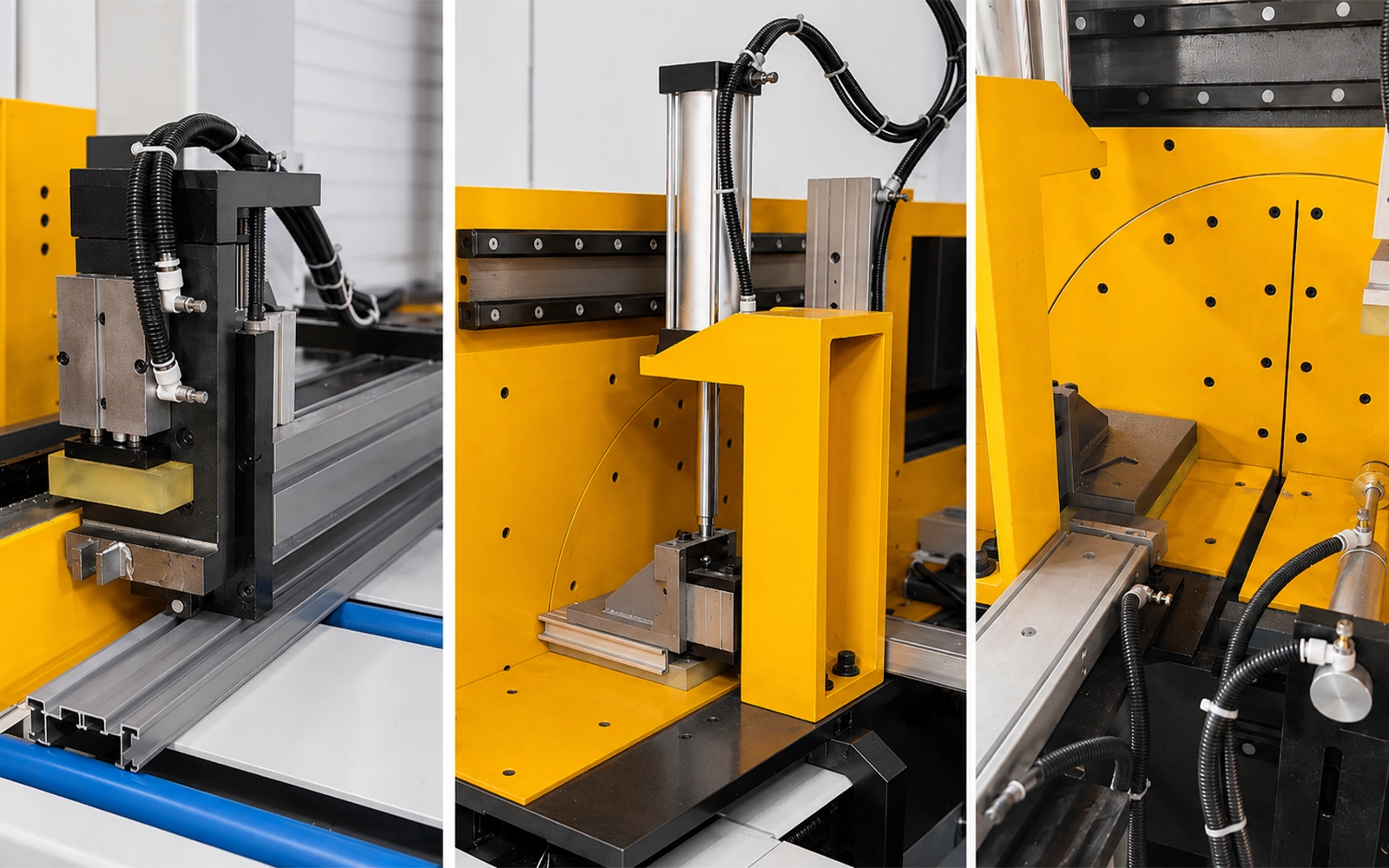
Walk the moving and stationary boundaries
For hydraulic hose routing at the quotation review, separate the route into fixed machine sections, moving sections and points close to heat, chips or routine cleaning. Ask the supplier to show the route in each relevant machine state, including the full motion used in the proposed cutting cycle. A static “door closed” photograph may hide a line that rubs, is pulled tight or blocks a service cover during motion.
The Parker hydraulic hose technical handbook explains that route, movement, slack, twist and bend radius affect assembly life. The Gates hydraulic catalog likewise treats abrasion protection, movement and fittings as part of hose selection. Those are supplier references for the engineering questions; neither document certifies any particular JiurunCut configuration.
- Motion: Which clamp or saw-head movements change the hose path? Who confirms that the selected assembly accommodates those movements?
- Protection: Where can chips, sharp edges, covers, another hose or regular washdown contact the line? What protection or alternate route is included?
- Access: Which guard or panel must a qualified technician remove to inspect or replace the assembly, and what space is required once the saw is installed?
- Responsibility: Who approves the final route after shipping, installation and any site connection?

Specify a replaceable assembly, not an anonymous length
A hydraulic hose routing review should also name each spare. A spare hose request should refer to the complete approved assembly and the actual machine location. Ask for the machine serial or build revision, line or station identifier, hose and fitting assembly reference, connection orientation, compatible fluid, and supplier-approved replacement route. The manufacturer or qualified hose specialist must determine the correct pressure, temperature, fluid and fitting compatibility for the real circuit; do not infer these from a visible hose diameter or a photograph.
Gates describes hose selection as a combination of size, temperature, application, medium, pressure, ends and delivery conditions. Its catalog also notes that the assembly’s working-pressure limit follows its lowest-rated component. A buyer therefore needs an approved assembly record, not an isolated hose number with unspecified end fittings. If the quote offers a locally made replacement, require the assembly specification, traceability, test or inspection record and responsibility for fit to be stated explicitly.
Stocking the spare is a separate decision. Compare the interruption cost of waiting for a matched assembly with the cost and shelf-management burden of holding one. Confirm that the spare belongs to the exact delivered revision; another saw in the shop may have a visually similar line with different ends or route.
Make service clearance a purchase criterion
Before finalizing the footprint, ask for a safe service-access demonstration on the proposed arrangement. The supplier can identify how a qualified technician would reach and remove a failed assembly after the machine is isolated and made safe under the applicable manual and plant procedure. The buyer should witness the access path, the panel or guard removal boundary, nearby stock supports and the space taken by adjacent equipment. This is a procurement acceptance question, not a do-it-yourself hydraulic repair instruction.
Compare offers using one record: proposed hose location and route revision; identified assembly and fittings; protection and support; access from the installed aisle; spare lead time; factory versus site responsibility; and evidence promised at acceptance. A cheap option with no route drawing, no assembly identity and no service access answer is not equivalent to a documented installed package.

Witness the delivered route without claiming a lifetime result
At factory or site acceptance of hydraulic hose routing, compare the installed route and labels with the approved revision. Under supplier control, witness the relevant clamp and cutting motions with the specified profile or representative setup, observing from a safe permitted position for contact, snagging or loss of clearance. Ask the supplier to record any corrective change and recheck the affected motion. Confirm that inspection and service access remains possible after site supports and extraction are in place.
A short witnessed cycle can establish that the delivered route matches the agreed arrangement at that moment. It cannot prove future hose life, pressure capacity, hidden internal condition or suitability for every later job. Keep those claims tied to the approved assembly documentation and the supplier’s technical acceptance.
Video boundary: a related saw cycle, not hose evidence
The Jiurun Machinery video below shows a related semi-automatic aluminum cutting machine and its cutting/guarding motion. It does not show the hydraulic hose route in this article, certify that the video machine uses hydraulics, or demonstrate the proposed assembly, service access or life. Use the footage only to frame the questions to ask about the actual ordered machine.
Send a hose-routing RFQ the supplier can answer
Send JiurunCut the profile family, required saw movements, expected production pattern, intended floor position, nearby equipment and the service aisle available. Ask whether the proposed machine uses hydraulics; if it does, request the marked route, complete assembly identities, protection, access plan, spare route and acceptance witness described above. A supplier answer should identify the exact configuration and revision rather than promising that every model has the same circuit.
For a confirmed leak on an existing machine, use the separate hydraulic saw leak evidence guide to preserve observations before anyone selects a repair part. For a new purchase, contact JiurunCut with the proposed installation and ask for a configuration-specific quotation.
Frequently asked questions
Does a visible black line prove the saw uses hydraulics?
No. A photograph may show a protected electrical, pneumatic or fluid line. The delivered circuit drawing and supplier identification must establish the line type.
Can we order a spare using only hose length and diameter?
No. The complete approved assembly, ends, fluid, pressure and route must be matched to the actual installed circuit by the responsible supplier or qualified specialist.
What is the most useful acceptance evidence?
An approved route and assembly record, followed by a supplier-led walk-through on the installed machine that confirms clearance during relevant motion and access from the planned service space.