
The finished part on your drawing is longer than the single-feed travel in a saw quotation. Does that rule out the machine? It might, but the travel figure alone cannot answer. An aluminum saw multi-stroke feed must advance the stock, transfer the holding duty, return its feeder, and advance again without losing the cut datum. Ask for that entire sequence on the exact configuration offered before accepting a long-part claim.
The featured image is an illustrative long-extrusion feeding scene, not evidence of the proposed machine or a trial. This is a purchasing check for automatic profile cutting, not a statement that every Jiurun saw can make a multi-stroke cut. The JR-650CNC-3A-1S configuration checklist addresses conflicting catalog presentations and section fit. Here the decision is narrower: can the proposed machine produce your longest finished blank through successive feed movements, at the required quality and rate?
Put three different lengths on the drawing
Write down the raw stock length, the finished cut length, and the quoted single-feed stroke separately. Add the trim allowance, saw kerf, allowable remnant, and the position of any end stop or gripper clearance. A longer finished length does not follow from adding nominal strokes on paper. The last stroke must still leave enough material to hold and support the stock at the blade.
For example, if a finished blank exceeds the quoted one-stroke travel, a supplier may propose repeated indexing. Ask which controller mode enables it, how many indexes the specific job requires, and whether the programmed length is measured from the leading end, a prior cut face, or another datum. A drawing with the cut positions is more useful than a brochure line saying “automatic feed.”
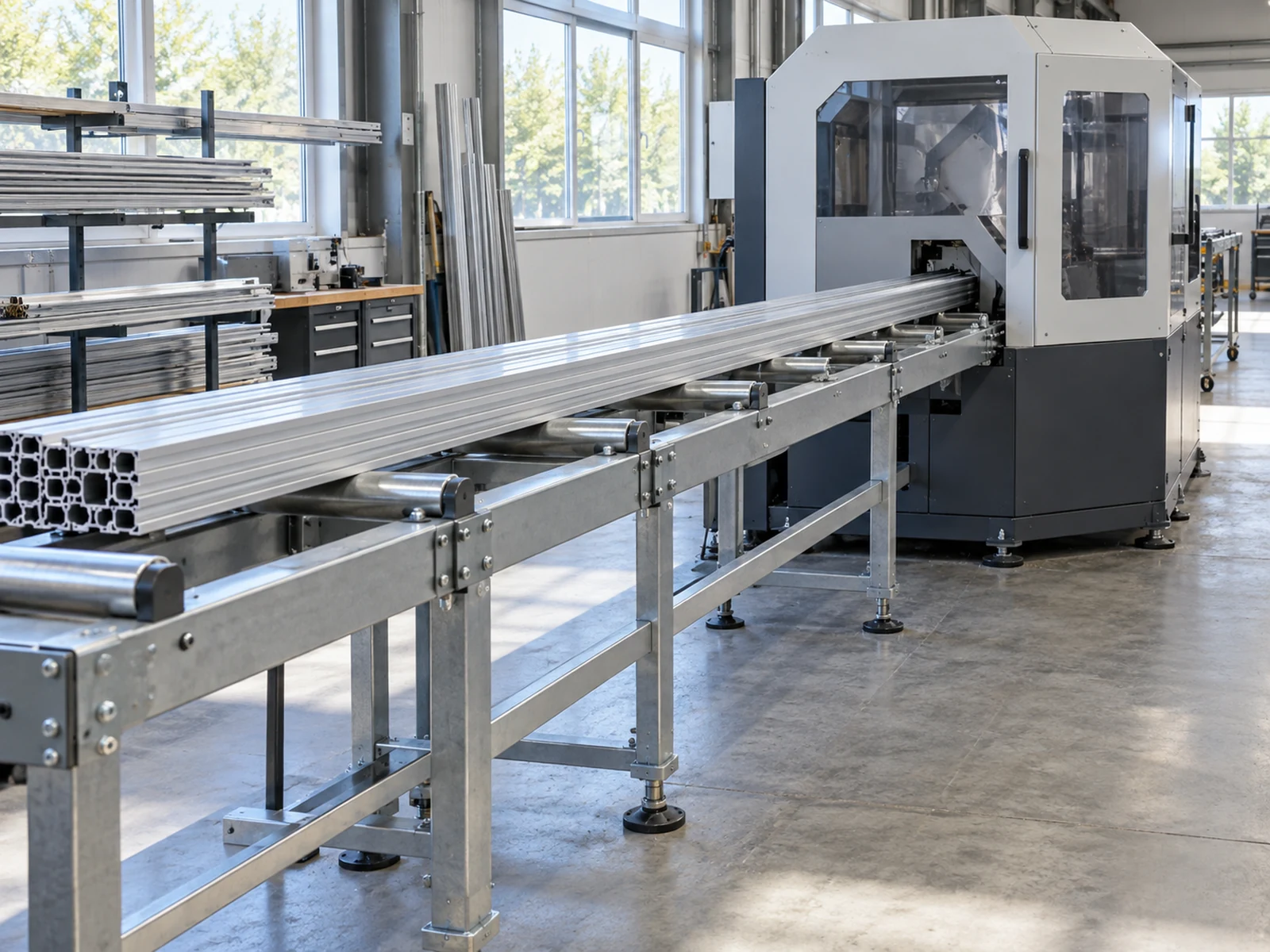
Aluminum saw multi-stroke feed: follow each regrip
Ask the supplier to narrate one complete long-part cycle, not just the first advance. Which clamp holds the profile when the feeder releases it? Is the saw head clear while the feeder returns? When does the feeder regrip, and how does the controller prevent a position shift at that handoff? Identify the surfaces that locate the extrusion so a thin wall or open channel is not crushed or rolled during repeated gripping.
The handoff is especially important when stock passes from upstream rollers into the saw clamp. Long profiles need support through their whole travel, but support must not fight the feed axis. Request a layout showing roller heights, guide locations, clearances and the maximum supported stock length for the proposed installation. The view below is related equipment imagery; its visible belts and rollers are not evidence that any quoted Jiurun model uses this exact arrangement.
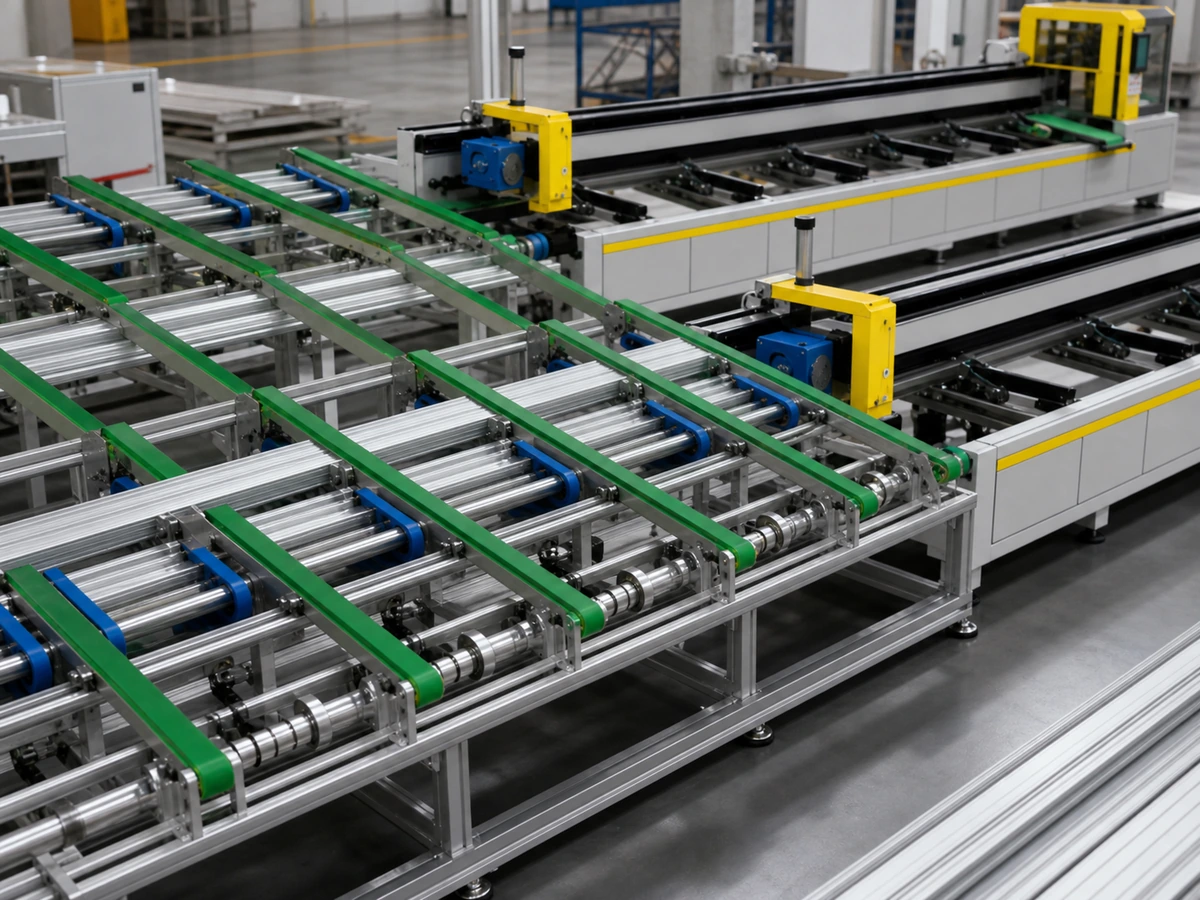
The last cut is the hardest claim to prove
For an aluminum saw multi-stroke feed, a demonstration of the first long blank can hide a tail problem. Ask what happens after several parts have been cut from one bar. Where are the feeder and cut clamps when the remaining stock approaches the minimum holding length? Can the proposed system finish the final usable part without manual intervention, or must the remnant be removed? State the accepted tail length and the rule for stopping or changing over in the quotation.
This check also affects the cut face. A profile that moves during regrip may produce an apparently correct overall length while the cut face is not square to the agreed datum. Specify where length, squareness, burr and surface marks will be measured, on which representative section, and after how many successive indexes. Record results for an early part and a late part from the same bar.
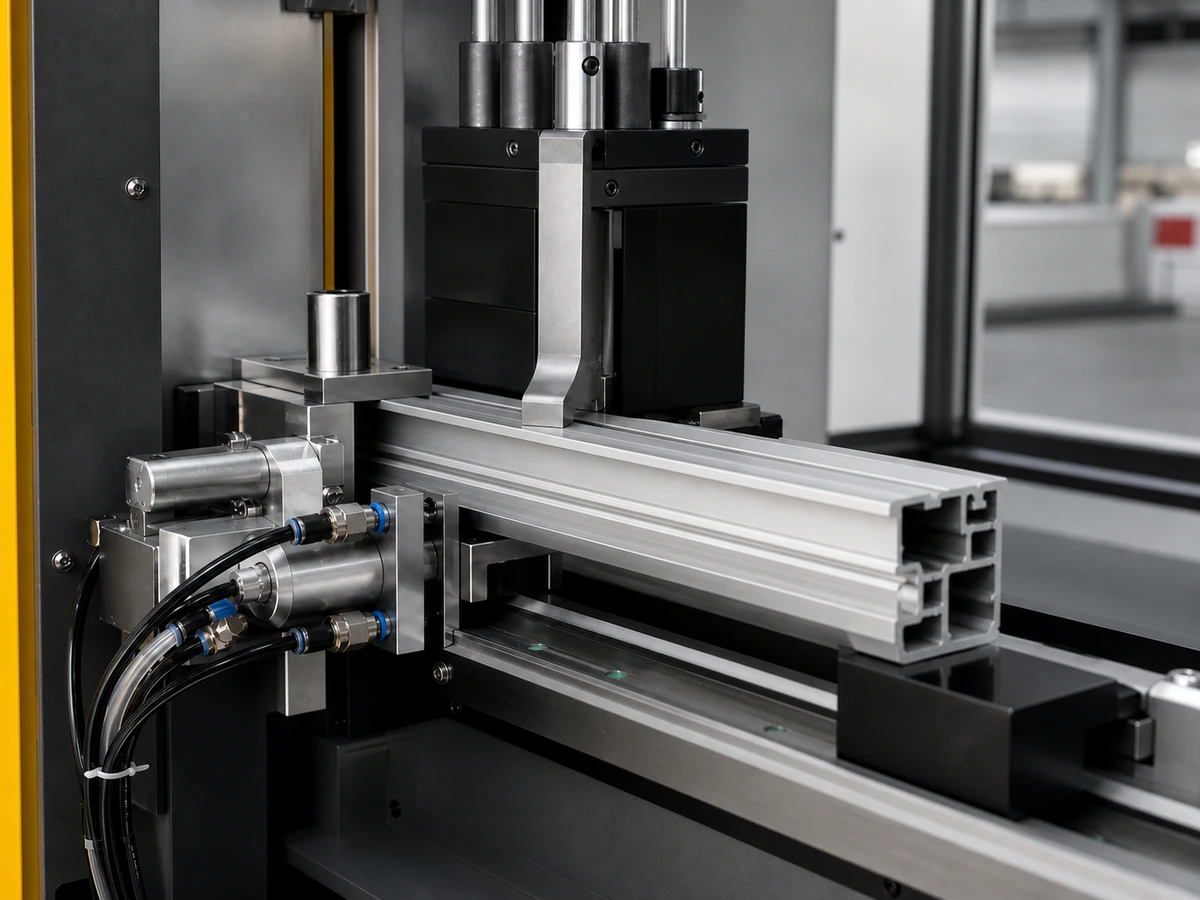
Quote cycle time for the whole job, not one saw cut
The aluminum saw multi-stroke feed return and regrip steps cost time. Request a timed sequence for the actual bar and cut list: load, index, clamp transfer, feeder return, cut, part discharge, and remnant removal. Separate automatic time from operator work. If the quotation gives only a saw-cut time or a one-stroke cycle, it cannot establish throughput for a job that needs multiple advances per part.
The idea is technically plausible: elumatec describes selectable one-, two- and three-stroke feed on one automatic saw, and INO Machinery describes multi-feeding on another. Those are other manufacturers’ designs. They show why the question is legitimate; they do not establish a function, stroke count, length capacity, or cycle time for a Jiurun quotation.
Turn the claim into an acceptance trial
- Send the supplier the actual extrusion drawing, alloy and temper, stock length, cut list, required quantity, finish condition, and measurable acceptance limits.
- Require a configuration sheet naming the feed unit, clamp roles, controller mode, supported stock range, minimum remnant, and any optional hardware or software.
- Ask for a video or witnessed trial showing the feeder release, return and regrip, then the cut of a part longer than one feed stroke. Include the final usable part from a bar.
- Measure representative parts across the run, record cycle time and manual interventions, and agree who supplies the stock and gauges before the trial.
A short Jiurun machinery video below shows an automatic aluminum saw feeding and cutting. Watch it to orient the discussion of stock movement and the cut station. It does not establish that the displayed configuration performs a multi-stroke regrip, meets your part length, or passes the acceptance checks above.
What to send with the RFQ
If your longest cut exceeds a quoted single-feed stroke, send JiurunCut the drawing, raw bar and finished-part lengths, profile section, quantity, cut tolerance, finish requirements, layout constraints, and a sample cut list. Ask for a written sequence and a trial plan on the exact proposed configuration. That evidence is what lets you decide whether repeated feeding is suitable for your order.