
An operator pauses a batch while a length of aluminum is somewhere between the infeed and the blade. The screen may say “paused,” but that word alone cannot tell the next shift whether the stock has reached its programmed position, whether a cut has been accepted, or what the next Start command will do. For a buyer, an aluminum saw cycle pause is therefore a machine-state question to settle before signing off an automatic line—not a promise to infer from a button label.
This guide concerns a deliberate, normal interruption of an automatic cutting job if the quoted configuration provides that function. A jam, guard opening, emergency stop, power failure, or maintenance intervention can follow a different recovery path. Ask the supplier to document the behavior of the exact controller, software, guards, infeed, saw, and outfeed being offered. A photograph or general demonstration cannot establish those details.
Aluminum saw cycle pause: put one stopped frame on the quotation
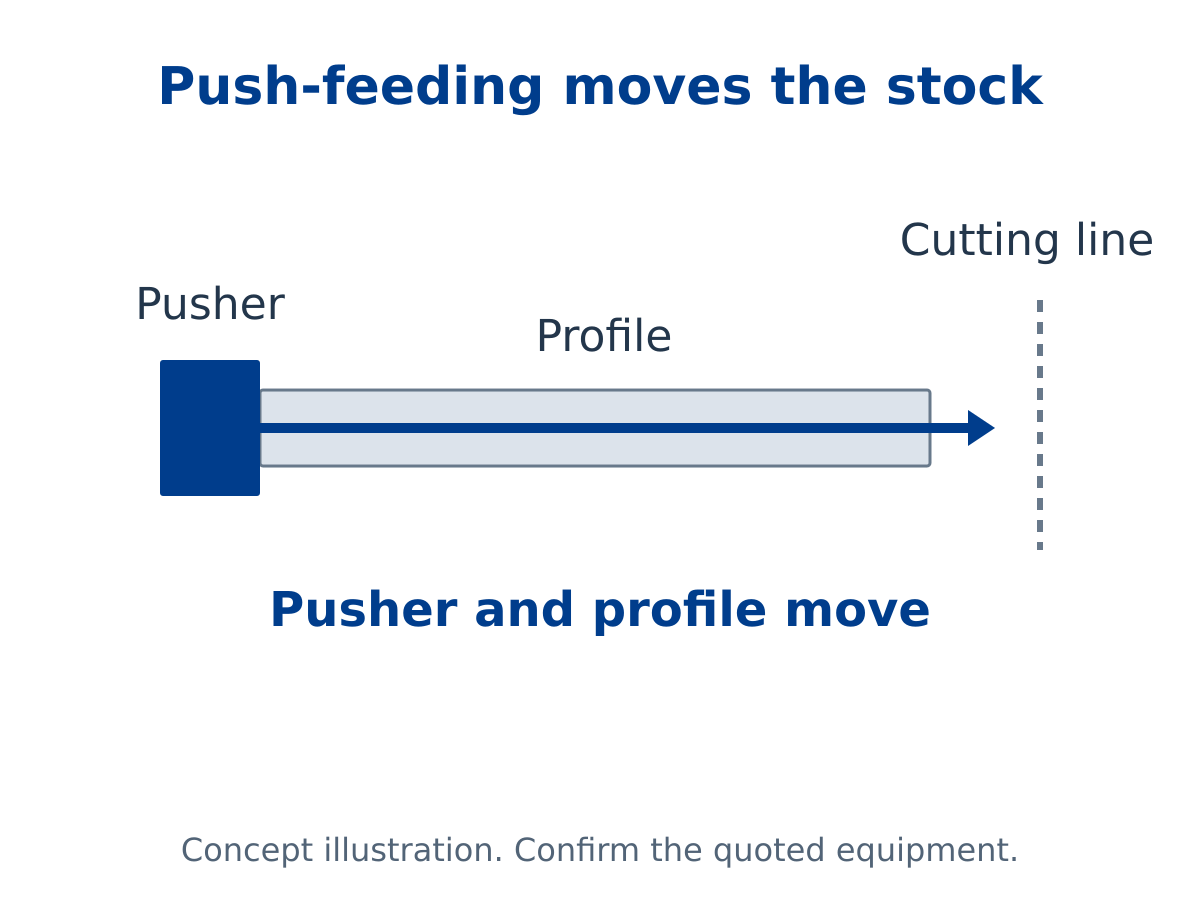
“The machine can pause and resume” is too broad for acceptance. Specify a moment in the batch, such as a pause requested after a feed begins but before the stock reaches the cut position. Ask the supplier to show, on the quoted machine, what remains energized and what comes to rest. Record the displayed job, target length, remaining quantity, feed position, clamp state, blade state, and whether an unfinished length is still under control. This is a request for a witnessed state, not a request to assume that every saw behaves alike.
Follow the material beyond the blade. Which piece is still raw stock, which piece has been cut, and which piece has already been counted as accepted? Where is each one physically located? A reliable answer lets the operator reconcile the controller’s counter with actual parts and tells the buyer whether a disputed first part needs inspection or segregation. If the line includes automatic loading, extraction, labeling, or sorting, those linked stations also need an agreed pause state; a saw-only answer leaves a gap in a complete line.
Separate pause, reset, and fault recovery
Control words have operational consequences. As one controller example, Siemens’ SINUMERIK 828D operating manual describes CYCLE STOP as stopping program processing at its current location, while RESET interrupts execution and the next start begins from the program start. The same manual tells users to observe the machine manufacturer’s information. That is a reason to ask for the saw builder’s exact sequence; it is not evidence that a Jiurun model uses Siemens controls or implements either command in the same way. See the Siemens operating manual.
For procurement, put four separate cases on the supplier’s response: planned pause during a normal job, a controlled stop at the end of a cut, a fault or jam, and loss of power. Ask which state is retained in each case and who must authorize the next movement. A fault acknowledgment, program reset, or recovery after power loss should never be silently described as a normal pause. If the proposed controller only stops at defined points, write those points down. If restart needs a new length reference or a scrap first cut, include that in the acceptance criteria and yield calculation.
What does Start do to the piece already in process?
Ask for the next commanded action at several points in a cycle: during feed, after positioning but before clamping, after clamping but before the cut, and after a cut but before the finished piece is recorded. The answers might differ by control architecture and machine configuration. The buyer needs a documented sequence for the offered line, including which movement occurs first, what the operator sees on the display, and whether the current part is completed, rejected, or counted. No universal “press Start again” instruction can substitute for that evidence.
An aluminum saw cycle pause should be described in a simple supplier state table. Its rows name the interruption point, physical stock location, clamp and blade state, displayed job and count, permitted operator action, first automatic movement, and disposition of the in-process part. The table is especially valuable when a long profile crosses several supports: the controller’s displayed position and the material’s actual position must agree before the next automatic movement. If the answer depends on an optional sensor, encoder, or software package, show that option in the quotation rather than assuming it is standard.

Witness a controlled interruption without bypassing safeguards
Request a factory or site acceptance demonstration on the quoted configuration with representative profile geometry, length program, support arrangement, and batch count. Agree on the test points with the supplier beforehand. At each point, record the display and material position before the pause, the visible machine state while stopped, the authorized restart action, the first movement, the next produced part, and the count afterward. Identify the part that bridges the interruption and inspect it to the purchase specification before accepting it. A clean video of ordinary running cannot replace this interruption record.
Keep the trial within the manufacturer’s operating procedure and the site’s safety rules. The UK’s Health and Safety Executive emphasizes suitable guards, interlocks, and clearly identifiable controls for work equipment. A planned pause is not permission to defeat those controls. If someone must reach into a hazardous area, clear a jam, or service equipment, stop the normal-pause trial and follow the applicable isolation procedure. In the United States, OSHA’s hazardous-energy standard addresses servicing and maintenance; local requirements and the site’s procedure govern the actual work. HSE’s machinery guidance provides additional general context.
Use running footage for context, not pause evidence
The Jiurun channel video below shows an automatic aluminum saw feed-and-cut sequence. It helps a buyer identify movements that may matter when defining pause points. It does not demonstrate a pause, a restart from an in-process cut, a specific quoted controller, a customer acceptance test, or measured safety or cutting performance.
Video: Jiurun Machinery’s automatic saw footage. The moving sequence is related visual context only.
Release the quote with a restart state table
An aluminum saw cycle pause becomes a clearer purchase decision once the evidence is explicit. Ask the supplier to attach the state table, operator procedure, software and option list, and witnessed test record to the quotation or acceptance plan. Mark who owns the first part after each pause and how the batch count is reconciled. If the machine cannot resume from a requested point, document the supported stop point and the cost of any restart scrap. That is a usable comparison between offers, even when both brochures say “automatic.”
Send Jiurun your profile drawing, stock length, target cut lengths, batch size, line layout, and the point at which your operators need to interrupt production. Ask for the planned-pause and restart behavior on the exact proposed configuration, including the first piece and the part counter. Request a configuration-specific cycle-pause review.