
Closed-groove aluminum profile cutting begins with a drawing and a supply-stage decision, not a setting on the saw. If a frame uses aluminum profiles whose T-slots are covered by an integral wall, tell the cutting supplier exactly which groove sections must remain closed and which will be opened later. A cut-to-length blank and a member ready for a slide-in fastener are different deliverables.
This guide is for buyers comparing a saw-cutting quote with a wider profile-preparation quote. It does not specify a universal groove-opening method. Use the selected profile manufacturer’s instructions and the approved assembly drawing for that operation.
Why closed-groove aluminum profile cutting changes the RFQ
Some profile systems are supplied with both open and factory-closed grooves. In item’s Line 8 family, a named 40 × 40 4NO variant has four closed grooves designed for selective opening. The same manufacturer’s page distinguishes these from other arrangements and explains that a closed wall can be opened partly or fully. That is a property of the specified item profile, not a feature of every T-slot extrusion.
The ambiguity arrives when a cut list says only “40 × 40 profile, cut to length.” One supplier may price square saw blanks with all groove covers intact. Another may include localized opening and edge finishing. Their prices describe different work, even when the nominal material and final length match. Begin with a controlled section drawing, part number or equivalent profile specification; a generic section photo cannot establish the wall design.
1. Identify the exact closed faces
Send an end view with a stable top, bottom, left and right orientation, or label the faces A through D. Mark each groove as open, closed, or subject to a separately defined opening. If a four-sided section has two closed faces, do not assume the receiving factory knows which two. The part can be rotated on a bench while the drawing’s intended face assignment remains fixed.
For profiles with a manufacturer’s “NO” or similar easy-opening designation, name the actual variant. Item’s catalogue identifies closed Line 8 grooves and compatible opening accessories for its own range. It does not authorize applying the same tool or method to an unrelated section. Confirm the supplier’s stock identity, finish and section orientation before discussing equipment capacity.
If more than one profile variant appears in a kit, list each separately. A profile with an already open groove and one with an integral cover may share outer dimensions yet have different handling and secondary-work needs. Keep the approved profile identity visible in the quotation and sample record.
2. Locate each required opening on the finished member
“Open the front slot” is incomplete when a bracket needs only a short entry region. Show the opening’s face, start and end points, length reference, and the relevant part end. State whether the region begins at the end face or lies within the member. If there are left- and right-hand pieces, give them separate part IDs or a controlled mirrored view.
The location should follow the assembly design, not a convenient saw stop. A dimension measured from the long point of a miter differs from one measured from the short point. For a square-cut member, name the end and the datum face. If there is a future hole or corner connector, show its relationship to the opening. Ask the responsible designer to resolve missing locations before the supplier prices secondary work.
Item describes a T-Slot Opener 8NO that removes a cover from the end face or another sufficiently sized opening on compatible profiles. Its product description illustrates why the access route and opening start matter. It does not prove the tool will suit your section, finish or intended opening length.

3. Separate cutting from groove opening in the supply route
Ask the supplier to mark which deliverable it offers: saw-cut blanks with the integral covers untouched, cut blanks plus a separately specified groove-opening step, or a cut-and-prepared kit with accepted openings and any approved hardware installed. None of these routes is automatically better. They allocate work to different stages and require different evidence.
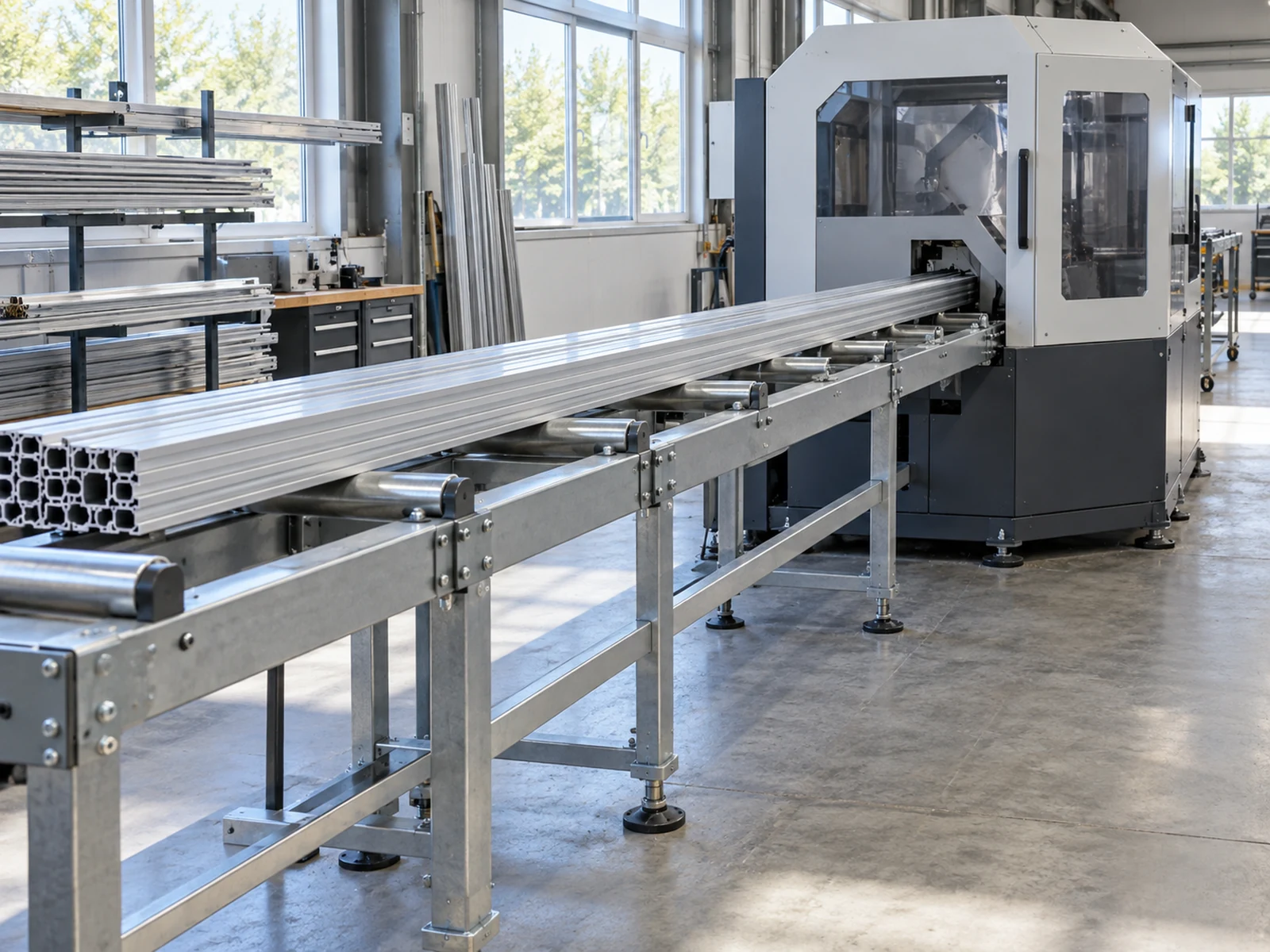
The cutting machine quotation should describe the actual material section, finished blank lengths, end geometry, support and handling arrangement, and first-off checks. Groove opening is a secondary operation unless the supplier specifically includes and validates it. Do not infer that a video of aluminum sawing also demonstrates selective slot opening.
A buyer that already has a qualified downstream preparation cell may deliberately purchase intact cut blanks. Record that boundary so the saw supplier is not asked to certify an operation it does not perform. If the buyer needs ready-to-assemble members, obtain a separate, explicit proposal for the opening, edge condition, inspection and packing stage. Identify which organization owns it.
4. Check hardware entry and end closure together
The opening plan should state which specified nut, connector or panel feature needs access to the groove and at what assembly stage. Some fasteners enter from a profile end; others have a different approved route. Do not choose hardware from the groove width alone. Our T-slot access guide explains the separate timing problem when an end becomes unavailable after frame assembly.
For a partially opened groove, ask whether the opening is intended for a connector, for a panel, or only for a later process. If the design depends on an intact outer surface elsewhere, mark those regions as no-opening zones. A shop that opens the entire groove to make assembly easy may deliver a visibly and functionally different member from the approved part.
Item’s 40 × 40 profile page describes localized exposure of the groove and recommends edge deburring for its example. Treat that as manufacturer-specific guidance. The acceptable edge condition for your delivered member, including appearance and safe handling, must be defined with the actual product and downstream team.
5. Accept the two stages with separate evidence
At the saw stage, inspect the defined blank: profile identity, section orientation, cut length reference, end geometry and the condition of grooves intended to remain closed. An accurate length does not prove the secondary opening is correctly located. Conversely, a correctly located opening does not replace the blank’s dimensional checks.
At the preparation stage, compare the opening’s face, position and extent with the approved drawing. Agree how edges and any displaced material will be reviewed. Trial the specified mating hardware only where the responsible design has approved that combination. A photograph of one accessible slot cannot prove every member in a future batch is accepted.
Keep a first-off sample or controlled inspection record tied to the same profile variant, process route and part revision as the quote. If the supplier substitutes a different groove design, restarts with different tooling or changes the opening route, ask for the affected checks again. The article makes no claim about Jiurun machine opening equipment or a guaranteed finish.
Compare the quotes on the same deliverable
| Quote row | Cut-only proposal | Cut plus opening proposal |
|---|---|---|
| Profile identity | Named closed-groove section and finish | Same controlled section and finish |
| Cutting scope | Length, ends, orientation and saw checks | Same blank checks |
| Groove work | Buyer retains selective opening | Named face and region opened in supplied stage |
| Acceptance | Blank inspected before handoff | Blank and opening checked separately |
| Unresolved item | Who performs later preparation? | What method, tooling and sample evidence are included? |
Do not compare the two prices as if they covered the same work. Include tooling, setup, handling, secondary inspection and packaging only where they are in the actual offer. Keep any missing decision visible rather than estimating it from a catalogue picture.
What to send with the inquiry
Provide the profile maker and variant or an approved section drawing; alloy and finish requirements; a marked end view identifying each face; the member list and quantities; cut lengths and end references; an opening map with face, location and extent; the specified mating hardware; the assembly point at which access is needed; and the handoff stage you want quoted. Include one representative sample or drawing revision for the first-off review.
A useful request is: “Please quote saw-cut blanks for the identified closed-groove profile and state whether selective groove opening is included. If included, identify the opening method and scope, the affected faces and regions, the agreed edge condition, and the first-off evidence. If excluded, identify the cut-blank handoff and the work left to our team.” This lets the supplier answer the real purchasing question without implying a feature its machine may not have.
Related equipment demonstration and sources
The following video is from Jiurun Machinery’s own channel and shows an aluminum profile cutting machine. It is a related cutting-stage illustration only; it does not show selective opening of a closed groove or verify this article’s profile, setup, customer, trial or performance.
Sources: item’s Profile 8 40 × 40 closed-groove variants and assembly guidance; item’s T-Slot Opener 8NO product description; item’s Profile 8 120 × 40 8NO technical sheet. The RFQ checklist and quote comparison above are purchasing guidance derived from the named product examples, not a universal profile standard.
Ready to define the saw stage? Send JiurunCut your section drawing and cut list. Ask for a proposal on the actual profile and keep any groove-opening work as a separately confirmed scope.