
A safety light curtain may need a support frame when its approved mounting location cannot be provided by the machine or an existing guard. It may also mount directly without a new frame. That decision belongs to the machine builder and safety integrator. For a cutting supplier, the useful starting point is narrower: which aluminum members, if any, have been approved for fabrication, and what must their cut ends and bracket interfaces be? This guide turns that decision into a practical request for quotation for safety light curtain support frame cutting.
Scope boundary: A straight, clean aluminum cut does not establish a safe protective field, an acceptable stopping distance, a correctly aligned sender and receiver, or compliance of the completed machine. Those outcomes require the selected device instructions, a machine-specific risk assessment, installation, and validation by qualified personnel. The guarding photographs and saw video below illustrate related equipment and cutting operations; they do not depict a validated light curtain installation.
Confirm the approved mounting route before ordering cut stock
Start with the actual light curtain and its mounting hardware. The SICK deTec4 operating instructions describe brackets that can attach to machine or profile frames and call for alignment and safety checks after installation. The Omron F3SG-SR/PG catalogue distinguishes fixed and adjustable mounting brackets. These examples show why a generic upright drawing cannot stand in for the specified device and bracket set; dimensions and adjustment provisions are not interchangeable.
Ask the integrator to identify one approved route: direct attachment to the machine, attachment to an existing guard frame, or a separate support structure. A separate frame introduces anchoring, stiffness, access, and cable-routing questions. Do not make the frame merely because a photograph shows an aluminum enclosure. If the approved design calls for steel or another material, request that design instead of substituting aluminum.
The featured photograph shows a general aluminum-framed machine guarding enclosure. It provides context for where an independent support might be discussed, but it does not show the light curtain, its brackets, its protective field, or an accepted safety configuration.
Release the bracket interfaces, then calculate member lengths
For each sender and receiver, the drawing package should name the device and bracket part numbers, the mounting side, the connection method, the adjustment allowance, and the reference datum. A profile slot may accept a specified fastener, or the design may require a drilled plate, tapped end, or separate adapter. Only the approved design can answer that question. Mark the slot direction and visible face on every member drawing so an otherwise correct length is not cut in the wrong orientation.
Record clearance for the bracket’s adjustment travel, cable exit, connectors, guarding panels, service access, and nearby moving parts. The integrator should also define the foot or anchor connection if a standalone frame is approved. Keep these as design inputs rather than assumptions made at the saw. A cut list that says only “two vertical aluminum profiles” hides the most consequential interfaces.
Separate three dimensions on the drawing: the finished cut length of each stock member, the assembled frame dimension, and the installed position of the light curtain. They are different measurements. Bracket thickness, end connectors, feet, and any machining after cutting may change the assembled dimension without changing the released saw length. Revision-control the bracket drawing and the cut list together.
Build a cut list a shop can actually quote
A useful cut list identifies each upright, cross member, base member, and approved spacer separately. Give the extrusion cross-section and material specification, stock condition, finished length, end angle, quantity, and tolerance from the released drawing. Flag handed parts and paired sender/receiver members. Identify the datum end, face that must remain cosmetically protected, and any slot or hollow-chamber orientation. State who owns deburring, drilling, tapping, labels, and assembly.
For a repeat order, add annual or batch volume and an agreed method of identifying revisions. For a prototype, tell the supplier which dimension remains provisional. A saw quotation can then distinguish a first-off sample from a production cut list. It cannot responsibly price an undefined safety assembly as if it were a pile of equal-length bars.
Check clamping and the first-off part against the released datum
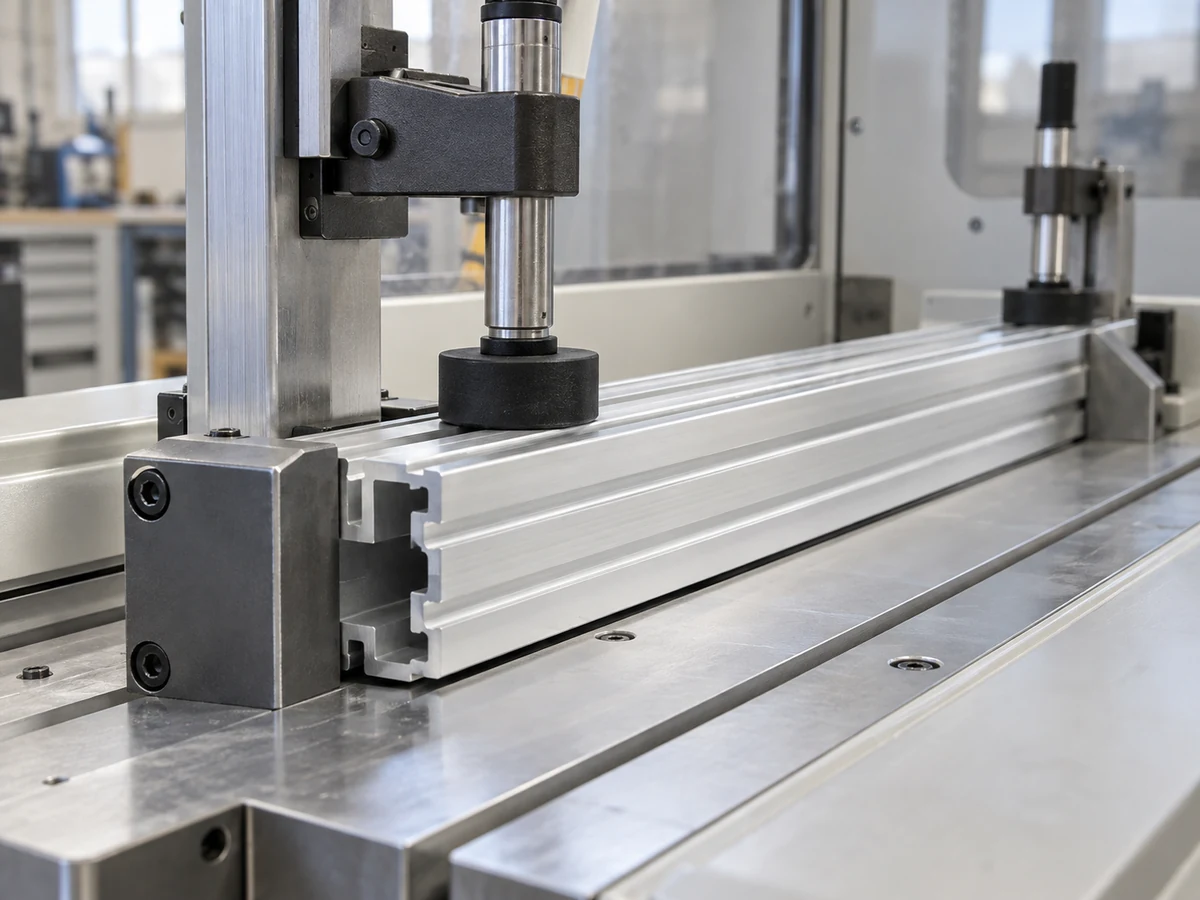
Before a production run, a cutting shop can review whether the selected extrusion is supported along the infeed and outfeed and whether its mounting face or slot edge can be held without damage. Thin walls and open slots may need a different contact strategy than a solid bar. These are process-planning considerations, not a promise that one pictured hold-down configuration suits the buyer’s profile.
Measure the first-off member against the drawing’s datum and acceptance method. Confirm the finished length, specified end angle, burr condition, face damage, and any orientation mark that the supplier is responsible for. If later holes or tapped ends locate an OEM bracket, coordinate their inspection with the party performing that operation. Keep the first-off record tied to the drawing revision and identify whether the inspected piece is the same material and section intended for the run.

End-face inspection answers a fabrication question. It does not answer whether a sender and receiver will align after mounting or whether the completed guarding performs correctly. The device maker’s instructions and the integrator’s acceptance plan govern those later checks.
Compare procurement scopes without mixing responsibility
- Direct OEM bracket mounting: the approved machine or guard has mounting points, so no separate aluminum cut kit may be required.
- Cut blanks: the supplier delivers identified, deburred members to released lengths; the buyer or fabricator handles secondary features.
- Prepared kit: the order also specifies the owner of drilled, tapped, or labeled bracket interfaces and their inspection records.
- Assembled support: a separate fabricator builds the approved frame to a released assembly drawing. The qualified integrator still owns placement, device setup, and safety validation.
Choose the scope that the released design supports. If a purchasing comparison bundles brackets, saw cuts, and installation into one price, ask for those deliverables and their acceptance criteria to be separated. This prevents a clean cut-end report from being mistaken for an installed safety-system sign-off.
Use the machine video for cutting context only
A cutting demonstration can help a buyer discuss material presentation, cut list control, and first-off inspection. It cannot certify an end use. Share the real extrusion drawing and order requirements before asking a machine vendor to recommend a saw or a cutting process.
Safety handoff stays with the qualified integrator
After fabrication, the integrator must follow the selected light curtain’s current instructions and the machine-specific risk assessment. That includes decisions about location and protective field, mechanical mounting, alignment, electrical integration, and validation after installation or modification. Features such as muting or blanking must be evaluated within the actual safety design. A saw supplier should provide only the agreed fabrication evidence, identify deviations, and avoid claiming that cut-member inspection proves the safety function.
Seven RFQ checks for a support-frame cut package
- Is a separate frame approved, and who approved it?
- What are the exact device, bracket, extrusion, and drawing revisions?
- Which cut lengths, end angles, datums, faces, and slot orientations are released?
- Who provides anchors, adapters, drilling, tapping, deburring, labels, and assembly?
- Which first-off checks and records are required for the cut members?
- What are the prototype quantity, batch volume, and revision-change procedure?
- Who owns installed alignment and functional safety validation?
With those answers, a saw supplier can quote the cutting work and flag any profile-handling issue early. To discuss a suitable aluminum cutting machine, send Jiurun Machinery the released profile section, cut list, quantities, and acceptance requirements through the contact page. Keep device selection and safety sign-off with the responsible machine builder and qualified integrator.