
Overbed table aluminum column cuts are a narrow purchasing item inside a much larger height-adjustable product. A buyer may need two straight extrusion blanks, machined and finished column members, a paired sliding unit, or a complete table. A saw quotation is useful only after that boundary is explicit.
Published product descriptions make the boundary clear. Spec Furniture’s overbed-table sheet describes a welded steel base and an adjustable column made from two extruded aluminum parts mechanically fastened to the base and top. Haworth lists an anodized aluminum column with a heavy-duty steel base. Bristol Maid describes an extruded aluminum column and distinguishes upper and lower extrusion options on a related overchair table. These are separate manufacturers’ designs, not evidence that they share one profile, mechanism, or cutting method.
Overbed table aluminum column cuts: what belongs in the RFQ?
Start with the assembly bill of materials. Identify each aluminum extrusion by its own part number and section drawing. Identify the steel base, tabletop, fasteners, casters, lifting mechanism, covers, and other bought-out parts separately. Do not request a saw price for the whole table when the saw supplier is only being asked to deliver column blanks. Equally, do not assume the steel base is aluminum because the marketing description highlights an aluminum column.
For a telescoping design, the outer and inner members may have different sections, lengths, visible surfaces, and downstream operations. Ask for a cut list that names them separately. If a manufacturer supplies a preassembled column, determine whether the buyer actually controls blank cutting or only purchases the completed unit. The purchase route determines which drawing and acceptance criteria the saw supplier needs.
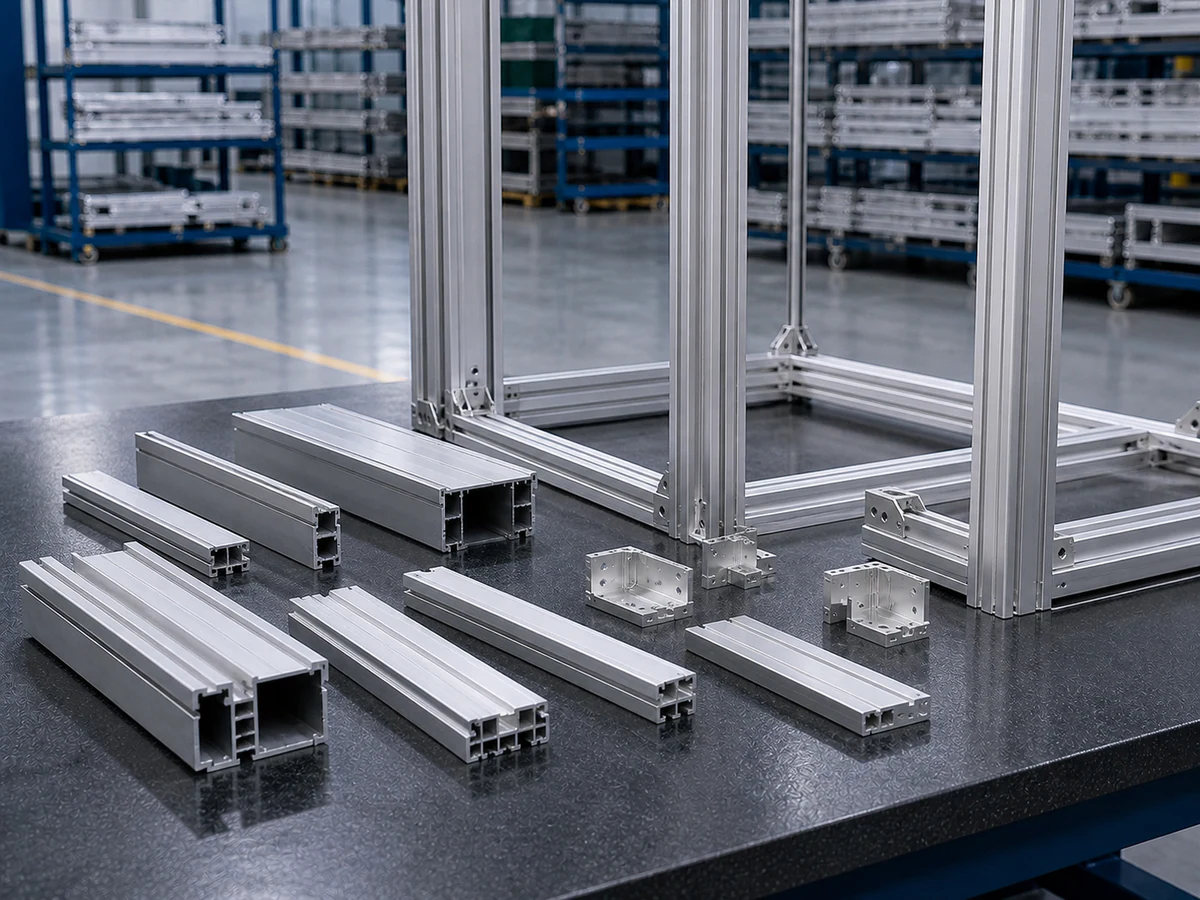
Separate straight cuts from the sliding interface
A straight saw cut establishes an end face and a nominal blank length. It does not by itself establish whether two extrusions slide smoothly together, how a gas spring or other actuator is retained, whether travel limits are safe, or whether a loaded tabletop remains stable. Those outcomes depend on the entire design, section tolerances, machining, assembly, and test procedure.
The RFQ should say which column faces are sliding or cosmetic and which are allowed to touch a clamp. If an open or hollow cavity is present, identify whether chips or burrs at the cut end could interfere with later assembly. Specify whether a part is deburred, machined, anodized, labeled, or paired after cutting, and name who performs each step. A generic “clean cut” requirement is too vague when a mating interface is involved.
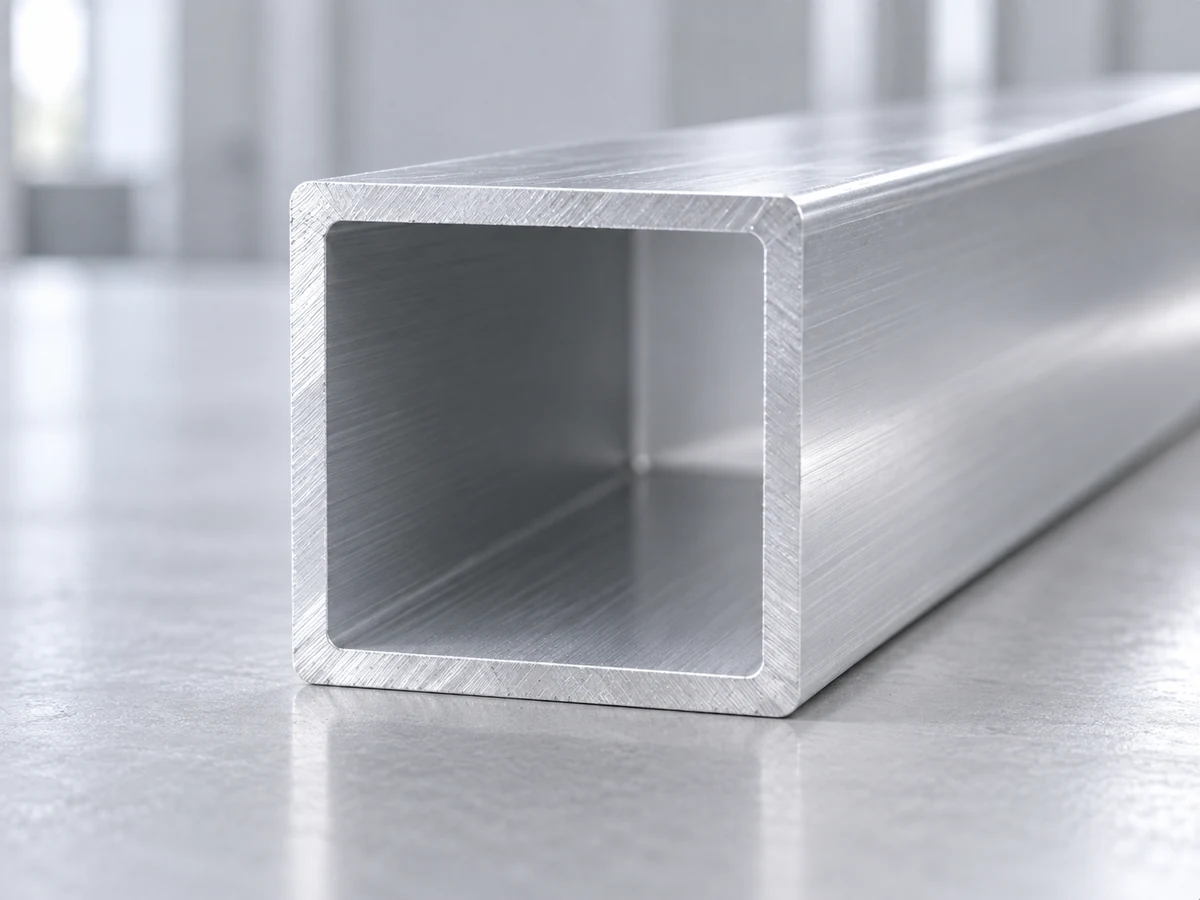
Use the actual section drawing for decisions about support and clamping. The square hollow section below is only a related geometry example. It is not a drawing of any of the overbed-table columns cited here, and its visible wall thickness must not be used as an RFQ dimension.
What should a column-blank drawing specify?
Request a separate released drawing for each blank. Confirm the section number, alloy and temper if controlled, finish condition, length and its datum, end angle, permitted burr, cosmetic surfaces, and any holes or slots that belong to a later operation. State whether length is measured on the free blank or after a subsequent assembly step. A finished table’s minimum and maximum height do not directly define either blank length; the geometry of the two members and the mechanism must be resolved in the product drawings.
- Part identity: upper or lower extrusion, revision, section drawing, and stock condition.
- Cut requirement: each blank length and tolerance, end-face datum, angle, burr or edge limit, and whether a sacrificial trial piece is allowed.
- Appearance: protected surfaces, marks allowed at clamp contact, finish timing, and packing method.
- Downstream boundary: drilling, machining, inserts, fasteners, coating, pairing, actuator installation, and final table assembly.
- Production mix: stock length, batch size, annual volume, distinct section count, changeover frequency, and scrap accounting.
- Acceptance: first-off approval, measurement method, sampling frequency, label format, and receiving check.
Do not silently substitute an outside dimension measured across rounded extrusion corners for a flat-face datum. If an end is hidden by a cap or base fitting, the cut-end specification may differ from that for a visible top joint. The drawing should resolve such differences before a cycle-time or cost comparison is treated as meaningful.
What a saw trial can and cannot prove
For overbed table aluminum column cuts, a representative saw trial can show whether the actual supplied section can be located and cut within an agreed blank specification. Bring both member sections, not just the easier one, if both will be cut on the proposed equipment. Record the stock condition, fixture contact, blade setup, first-off measurements, end quality, chip handling, and any marking. Repeat across the relevant cut lengths and changeovers rather than choosing one convenient sample.
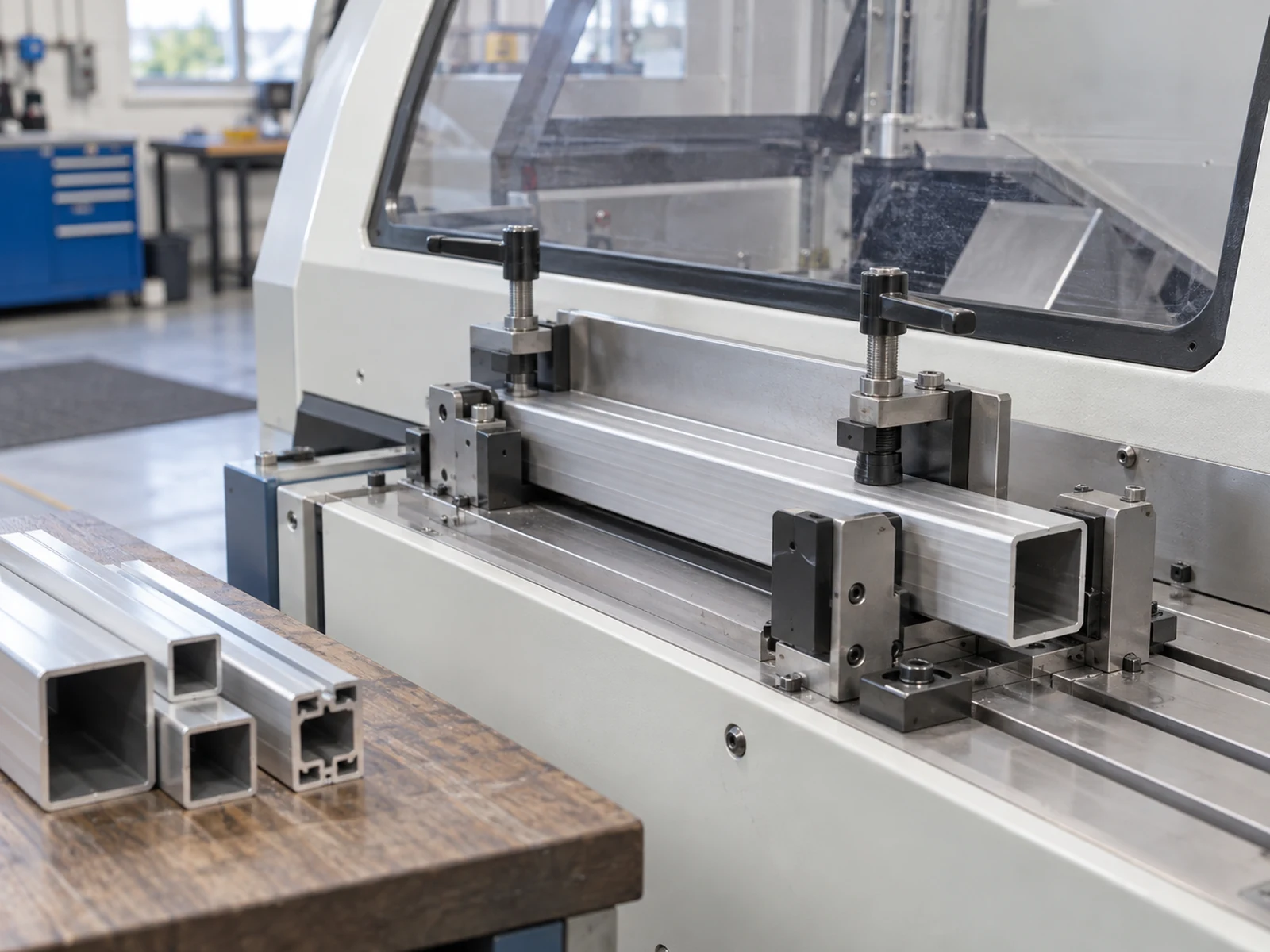
Clamping is part of the trial. A hollow member can be damaged by a poorly placed load, and a visible anodized surface needs a different handling plan from an unfinished hidden face. The related saw view below shows square-tube support and clamp contact; it is illustrative equipment context only. It does not show an overbed-table column or validate any column tolerance or surface requirement.
The paired-column fit, smooth movement, height range, load behavior, cleaning suitability, and product safety belong to the design owner and finished-assembly test plan. Blank cutting results cannot stand in for those checks. If an assembly trial reveals rubbing or misalignment, investigate the section, machining, fasteners, guides, and assembly datums before assuming the saw length alone caused it. The distinction between a free-state blank measurement and a restrained assembly check is discussed in our cut-part inspection guide.
Compare offers by deliverable, not table name
Ask each bidder to list what leaves its facility: raw cut blanks, deburred members, machined and finished extrusions, a paired sliding column, or a complete table. Price and lead time will differ because the operations and acceptance evidence differ. Compare offers only after identifying who supplies the aluminum stock, who owns first-off approval, how rejects are handled, and where dimensional and functional responsibility transfers.
A practical purchase sequence is to release the two extrusion drawings, obtain a blank-cut trial, approve the cut criteria, then validate the paired column and finished table under the product owner’s plan. If the buyer lacks member drawings, request them from the column or table designer first. A photograph and an advertised travel range are not enough to program a reliable cut list.
Related Jiurun equipment video
This Jiurun video shows an aluminum-angle saw operating on a related profile. It is a machine demonstration, not a cut of an overbed-table column, a recommendation of a specific configuration, or proof of the dimensions and tests in this guide.
Send the two member drawings
If your overbed-table design has aluminum extruded column members that need straight blank cuts, send JiurunCut the upper and lower section drawings, cut list, material condition, tolerances, surface requirements, and batch volumes. We can discuss a drawing-based saw trial and the boundary of a cutting quotation. Keep the steel base, actuator, sliding fit, and finished-table acceptance with the parties responsible for those parts and tests.