
Hospital bed aluminum side rail cutting begins with a boundary: a side rail is part of a bed system, not simply a length of aluminum. When a drawing calls for cut aluminum members, a fabricator still needs a clear boundary between a saw-ready blank and an approved rail assembly. That distinction shapes the purchase order, the cut list, the inspection record, and the decision about who accepts the finished bed system.
Some hospital beds use aluminum alloy guardrails; for example, WEGO Medical describes a bed with aluminum alloy guardrails. That example does not make any particular aluminum profile, cut blank, or machine setting suitable for another bed. Treat the bed OEM’s released design and quality process as the controlling source.

Decide what the order actually buys
Start by asking whether the buyer needs a complete approved rail assembly, a prepared rail component, or straight cut aluminum members for a later controlled operation. These are different deliverables. A saw shop can cut stock to a released length and preserve an identified datum. It cannot establish the behavior of latches, hinges, end fittings, spacing, attachment hardware, or the completed bed system by cutting alone.
A useful RFQ names the assembly and revision, then lists each individual member ID, material specification, profile drawing, cut length, quantity, end condition, and downstream process. If a drawing uses a nominal rail length but the purchase order expects finished assemblies, resolve that mismatch before quoting a cut-only operation. Do not infer a blank length from a picture of the assembled product.
Release the member list before releasing the saw program
A controlled member list gives the shop one answer to five questions: which stock is authorized, which end is the length datum, what end condition is required, how the member is marked, and where it goes after cutting. Put the drawing revision on the traveler and on the first-off record. If left and right members look alike but differ in holes, finish, or cut orientation, distinguish them by a unique part number rather than by a verbal note.
Ask the OEM or tier supplier to settle any allowance for later machining, deburring, coating, or end-cap installation. A cut blank dimension and a final assembled dimension can differ. Record the dimension that the saw operator is expected to measure; keep the final functional dimension in the downstream inspection plan. Where a cut face is a mating datum, specify how its squareness and burr condition will be checked. Where it is hidden by another controlled operation, avoid inventing a tighter saw tolerance for appearance alone.
Check the actual section and fixture contact
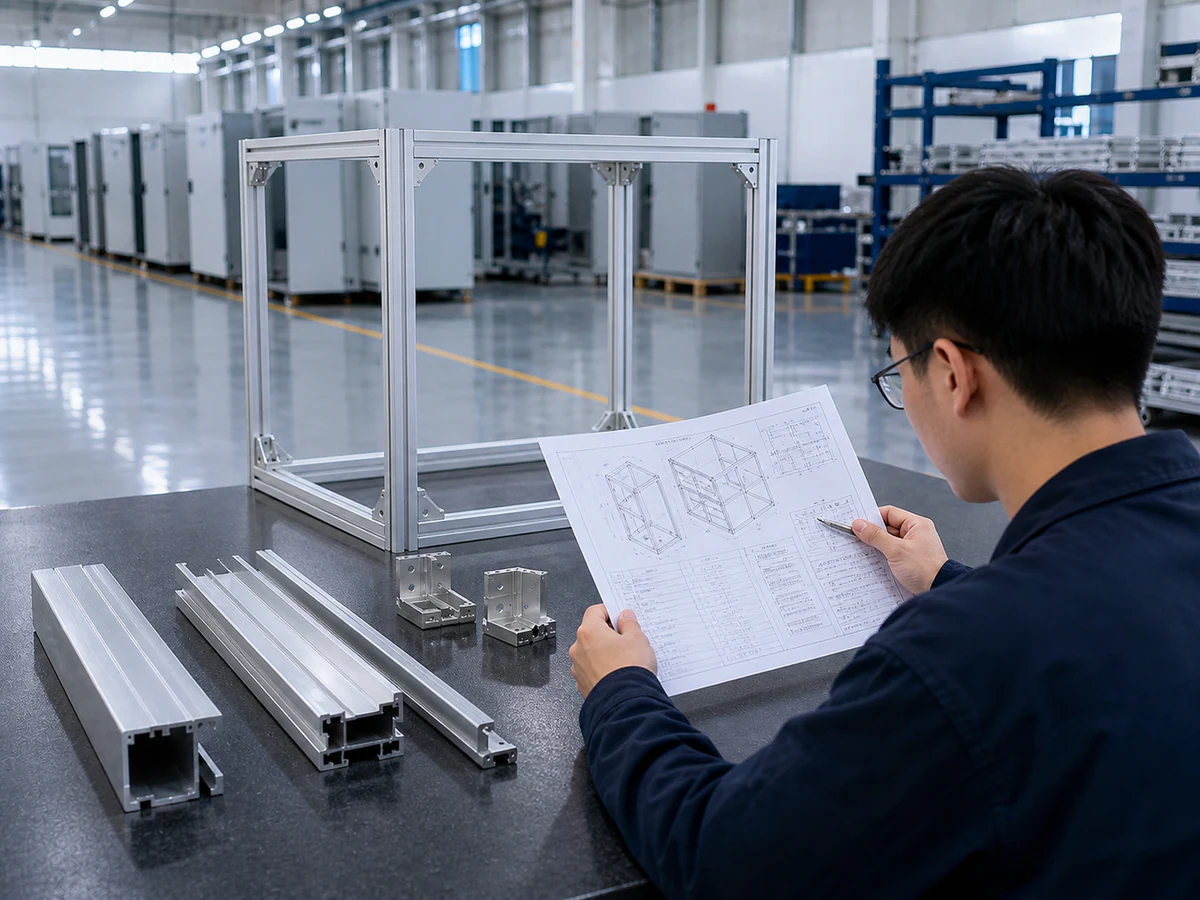
Hospital bed rail parts may include thin walls, grooves, decorative surfaces, and interfaces for hardware, depending on the approved design. A generic solid-bar setting does not tell the operator where to support such a section. Before production, compare the physical stock with the released profile drawing and mark the surfaces that may contact the saw vise, stop, and outfeed support.
For hospital bed aluminum side rail cutting, the practical first-off question is whether the clamp holds the actual section repeatably without changing its shape or damaging a functional face. Check the cut orientation, length datum, cut-face condition, and member identification on real material under the approved setup. If the stock differs from the drawing, stop that batch for the responsible engineer’s disposition; a saw setting cannot repair a wrong extrusion or an unapproved substitution.

Keep bed safety with the responsible system owner
The US FDA hospital-bed system guidance addresses entrapment assessment at the bed-system level. Its existence reinforces a manufacturing boundary: dimensions, attachments, and interactions of a completed bed require the responsible OEM’s engineering, risk-management, and regulatory process. A cut-length check is only one component inspection. It does not prove that a side rail is safe, compatible, or compliant.
For replacement or retrofit requests, ask for the bed maker’s approved part and procedure. Do not substitute a visually similar extrusion, modify a rail to fit, or treat a machine demonstration as a medical-device validation. Send any proposed design change, alternate profile, or dimensional deviation back through the authorized design-control route before making production stock.
Plan traceability and a clean downstream handoff
For hospital bed aluminum side rail cutting, keep the stock identity and material document tied to the released member number and revision. The cut traveler can then record quantity, first-off result, inspection method, disposition of rejected pieces, and the operator or station that performed the work. Protect the cut members from mixing between revisions or mirror-image variants. Package them so mating faces and finish-critical surfaces are not damaged during transport.
A good handoff states what was actually completed: for example, cut to the released blank length, visually checked for the specified end condition, and labeled for subsequent machining or assembly. It also states what remains: hole making, surface treatment, hardware assembly, functional verification, and bed-system acceptance as defined by the OEM. This lets the next team use the parts without mistaking them for finished medical rail assemblies.
Use a machine demonstration for the right decision
When planning hospital bed aluminum side rail cutting, ask the supplier to show how the real section will be supported, clamped, fed, and measured. Request a trial plan based on your released material, profile, length range, cut-face requirement, and batch workflow. Review the actual first-off pieces and measurement method with your own acceptance criteria. A catalog claim or a video of another profile is a starting point for questions, not proof for a hospital bed application.
The Jiurun Machinery video below is a related example of an aluminum cutting machine in operation. It shows equipment motion only. It does not show this hospital bed rail, an approved medical component, a customer trial, or verified performance for the application discussed here.
Hospital bed aluminum side rail cutting: RFQ checklist
- Released bed/assembly drawing and revision, with the responsible OEM contact for questions.
- Individual cut-member IDs, profile drawings, stock specification, and approved supplier or substitution rule.
- Blank lengths, quantities, cut orientation, end condition, datum, and inspection method.
- Surfaces to protect during clamping, handling, and packing.
- Downstream machining, coating, assembly, and acceptance steps, with their owners named.
- Batch identification, first-off approval, deviation process, and traceability documents.
If your hospital bed aluminum side rail cutting order calls for an industrial saw to produce approved cut members, send Jiurun the released profile, length range, and inspection requirements. We can discuss the cutting operation and sample-evaluation plan. The bed OEM remains responsible for the rail design and bed-system safety assessment. You can also review the aluminum cutting equipment range before defining a machine trial.