
Rolling grille guide extrusion cutting starts with the door assembly drawing, not a nominal opening height. The same job may contain an aluminum guide extrusion, trim, a wall angle, a free-standing support tube, floor hardware and a moving curtain. They are not interchangeable cut stock. An installation instruction that permits an adjustment to one component does not authorize trimming every adjacent aluminum part. A buyer deciding between a complete supplied grille package and factory-cut guide blanks should first identify the exact member, approved revision and party responsible for the assembled door.
This is a purchasing and manufacturing scope guide for an authorized aluminum extrusion. It is not an installation procedure or permission to alter a proprietary grille. The door maker, approved installer and project designer must control opening measurements, fixing, safety devices and final operation. A Jiurun saw trial can assess only the actual material and cut operation submitted for that trial.
Separate the guide extrusion from the complete grille
A rolling grille is a system. The curtain travels in guide assemblies that can differ by mounting arrangement and by side of the opening. A quote for cut aluminum guides does not include the curtain, shaft, brackets, operator, stoppers, trim, interlocks or installation responsibility unless the scope explicitly says so. Conversely, a complete door supplier may already deliver job-numbered guide parts made for the construction drawings. Check that package before creating a separate saw request.
The Clopay rolling-grille installation manual illustrates this distinction. It tells installers to keep components for individual door items together, compare opening dimensions with each unit’s job construction drawing and stop when they differ. Its guide diagrams show the aluminum extrusion alongside trim, mounting angles or tubes, packoffs and fasteners. This is a product-specific example of why an extrusion length cannot be derived from a generic opening measurement.
A separate Clopay Visionaire MicroCoil product page says that model’s guides are mill-finish aluminum. That describes a different named product, not proof that the installation manual’s dimensions or modification rules apply to every MicroCoil variant. Ask the product owner for the exact model, drawing and current instructions of the actual order.
Read the mounting style before releasing a cut list
In the Clopay manual, face-of-wall and between-jamb arrangements have different guide dimensions and assembly sequences. The guide may be fixed to a wall angle, a tube or a backup member. Left and right guide assemblies may also differ. Between-jamb wall mounting requires alignment of holes in the aluminum extrusion and backup flat or tube; the manual says its installation sequence cannot defer the guide extrusion in the same way available to some other mounts. These are practical reasons to label parts by unit, side and mounting style rather than issue a single unsorted length list.
Request an approved schedule with one row per part: door item number, manufacturer and model revision, guide profile and finish, left or right hand, mount type, incoming stock identification, finished end-to-end length, datum, end orientation, retained holes or notches, trim interface and mating hardware. Add the job drawing revision beside every dimension. If the quote involves a free-standing tube as well as an aluminum guide, use separate lines and separate material/process decisions.
Do not turn the installation drawing into an unapproved engineering change. In the example manual, the installer checks the specified guide spacing against the opening and stops if the dimensions do not reconcile. A saw shop should make the same discrepancy visible before cutting, not silently adjust a guide to make the parts fit. A site measurement is a check against the released drawing; it is not automatically the new manufacturing datum.
The field-cut example concerns a support tube, not every guide
One especially easy misread comes from the manual’s free-standing tube and slip-joint section. It provides a method for calculating and cutting a steel support tube to suit the slip-joint arrangement, including removing excess from the top to retain required holes or notches. That instruction is specific to that component and configuration. It is not a blanket rule to cut the adjacent aluminum guide extrusion to the same length, or to apply the same allowance to a different product.
For a procurement decision, ask the door supplier to mark each member as factory-finished, supplier-authorized field-adjusted, or separately manufacturable from released drawings. Record the authorized cut end. If a complete supplied grille arrives with marked parts, an extra factory cut can create a mismatch in a notch, a stop location or a trim interface. If an OEM authorizes replacement guide blanks or repeat cut stock, obtain that decision and the controlled drawing in writing before comparing saws.
Turn a guide profile into a real saw trial
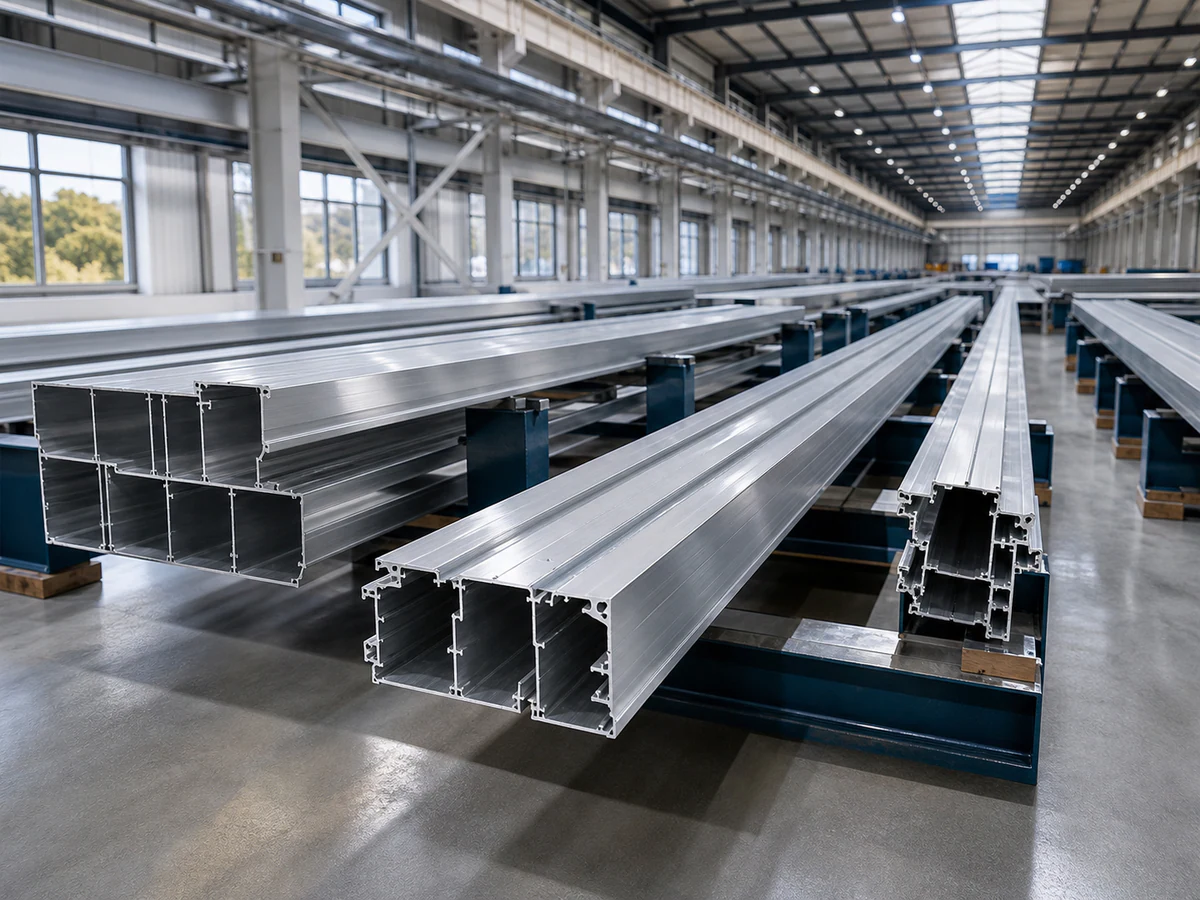
A named guide extrusion may have a thin lip, wear surface, pile-seal channel, screw groove, predrilled mounting holes or a notched upper entry. A photo of an open profile is not enough to approve support and clamping. Supply an end-view drawing and physical section, then identify the surfaces the clamp may touch and the surfaces that must remain unmarred. State alloy, temper and finish where controlled by the manufacturer; do not infer them from another door maker’s catalog.
For a trial, the machine supplier should document how the long input is supported, how profile orientation is maintained, where the stop references the part, how the cut end is protected, and how a short offcut is removed. The operator must have a safe method for guarded cutting and chip removal under the machine’s instructions. Test a difficult but representative length and section, not only the most stable stock. The result should be recorded against the exact setup and measured acceptance criteria; a generic cycle-time figure is not a released production rate.
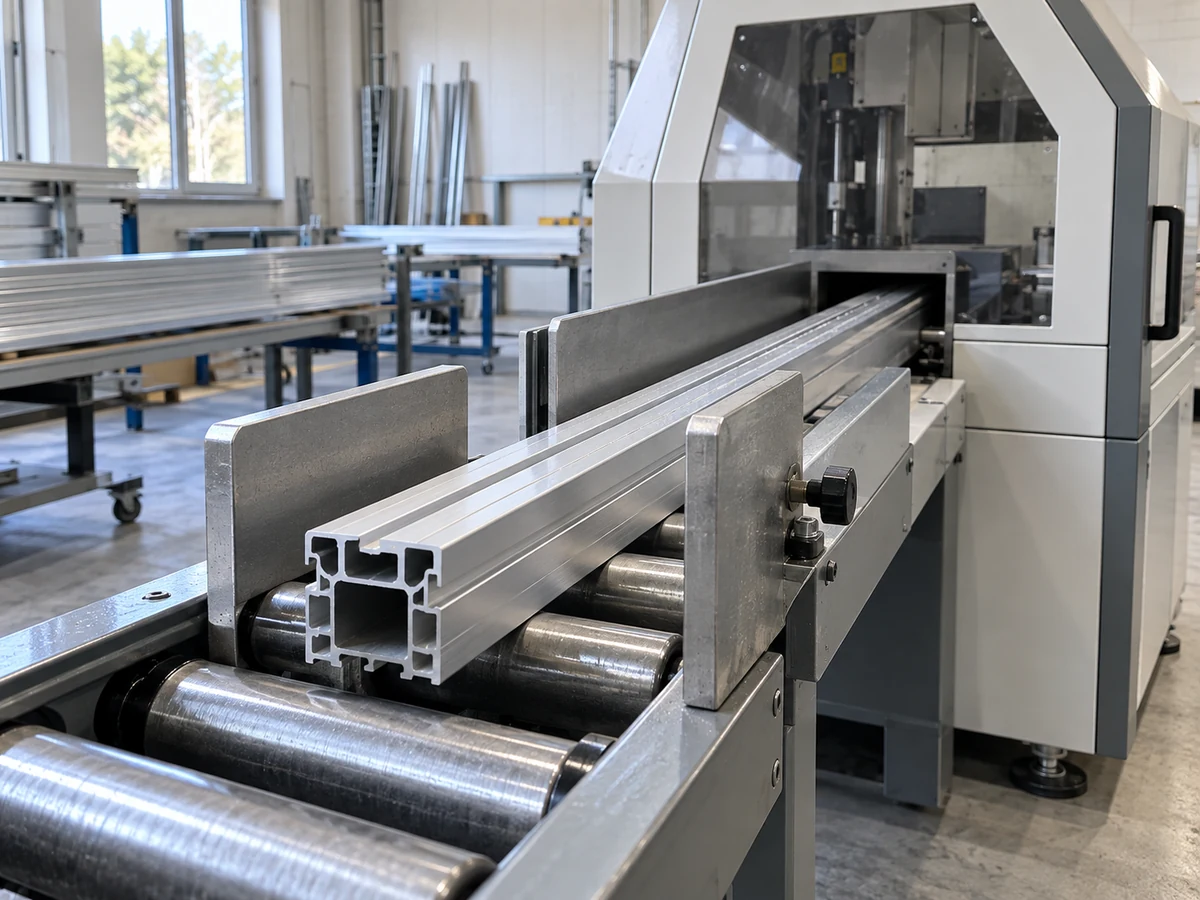
Compare a cut-only equipment quote with the actual released handoff. If drilling, notching, pile-seal installation, trim assembly or protective packaging is downstream, identify its supplier and inspection point. A saw may produce a sound metal end but cannot on that basis verify the complete guide assembly, installed clearances, anti-entrapment devices or curtain operation. Those belong to the responsible door system team.
Inspect the cut end as an assembly interface
Set first-off criteria before cutting. At minimum the plan should identify length datum and measurement method, end squareness or a released end shape, burr condition, damage limits on the guide contact surface, integrity of slots, holes and notches, and the fit of approved trim or mating parts. If the guide has a seal channel, check it with the specified seal rather than relying on a clean-looking cut face. Separate cosmetic inspection from dimensional and assembly checks.
The Clopay manual also discusses guide-center alignment, curtain entry at the upper guide and stoppers. This demonstrates why a metal length check alone is incomplete, but it does not let a saw supplier certify installed door operation. For a factory cut-blank order, the buyer should define who accepts the blank, who assembles it with genuine hardware and who performs the final installed checks. Retain a first-off piece identified to the specific profile and drawing revision, and isolate parts produced before approval.
Keep three bids on the same basis
Complete grille package: ask the door supplier what arrives prepared for the named opening, which guide assemblies and accessories are included, what site adjustment is allowed, and who installs and warrants the system. The unit’s item number and drawing govern acceptance.
OEM-approved precut guide blanks: obtain a written release for the exact aluminum profile and cut operation. Price identification, protected transport, end checks, first-off approval and any required secondary work. Specify whether the buyer or OEM supplies incoming extrusion and who owns scrap or a failed interface.
In-house saw cell: compare the cell only when recurring authorized guide production is real. Include changeover between profiles and lengths, long-stock handling, extraction, measuring, traceability, inspection labor and rejected parts. A lower cut cost per piece is irrelevant if the assembler cannot use the blank or if the modification is outside product approval.
Send every bidder the same controlled package: model and job drawing, approved profile and side designation, mounting style, sample stock, lengths and batch mix, finish protection rules, genuine mating parts and the acceptance boundary. Ask each supplier to mark inclusions, exclusions and assumptions. This allows a buyer to compare delivered value rather than a door-kit price against an isolated saw cycle.
Related machine video: process illustration only
The clip below is from Jiurun Machinery’s own channel and shows aluminum cutting equipment in operation. It can help a purchaser discuss feed, enclosure and first-off observation. It does not show a rolling-grille guide, a Clopay product, an approved modification, a customer order or verified performance for this application.
Decide whether there is a cut job at all
If the product owner supplies a complete, job-marked door with guides prepared to its drawings, follow that scope and resolve any site discrepancy with the manufacturer. If it permits a controlled replacement or repeat guide blank, quote the actual aluminum section and inspect the first-off interface. If volume justifies machine ownership, trial the approved profile and entire cut-to-handoff route before relying on a productivity claim. The key question is not whether aluminum can be sawn; it is whether this named guide component is authorized to be cut, to what drawing, and by whom.
For an authorized industrial cutting stage, send JiurunCut the released guide drawing, physical section, lengths and batch mix for a scoped machine discussion. The door system supplier and trained installer remain responsible for product approval, assembly, site installation and operational safety.