
Woodworking T-track cutting is a small part of a jig or fixture build, but it can create an expensive machine-buying mistake. A cabinet shop buying a few rails for its own router table has a different decision from an OEM filling repeat orders for hundreds of jig kits. Before requesting an aluminum saw quotation, decide whether the job is a finished accessory purchase, a simple cut-to-length service, or a repeatable factory operation on an approved extrusion.
This guide addresses purchasing and process planning for straight aluminum track. It does not treat a retail T-track, a structural T-slot frame member, and a multi-track fence as interchangeable. The exact section, fastener interface, finish, and mounting details come from the chosen supplier’s drawing and your released jig design.
1. Identify the track before pricing a cut
Start with the accessory that actually holds the work. A T-track may be a narrow channel fitted into a benchtop or fence, while a larger multi-track extrusion can form part of a jig fence. An adjustable measuring scale, predrilled fixing holes, or a supplied clamp changes what arrives in the box and what must remain usable after shortening. INCRA’s T-track range distinguishes regular and scale-equipped versions; Rockler’s Universal T-Track is sold as its own accessory system. Their names do not establish a common slot or bolt fit.
Ask the designer to record the supplier, exact part number and revision, track cross-section, stock length, mounting-hole pattern, compatible hardware, and whether the scale or finish is applied before cutting. Obtain a drawing or a physical sample. Do not set a saw clamp from a generic photograph of aluminum profiles.
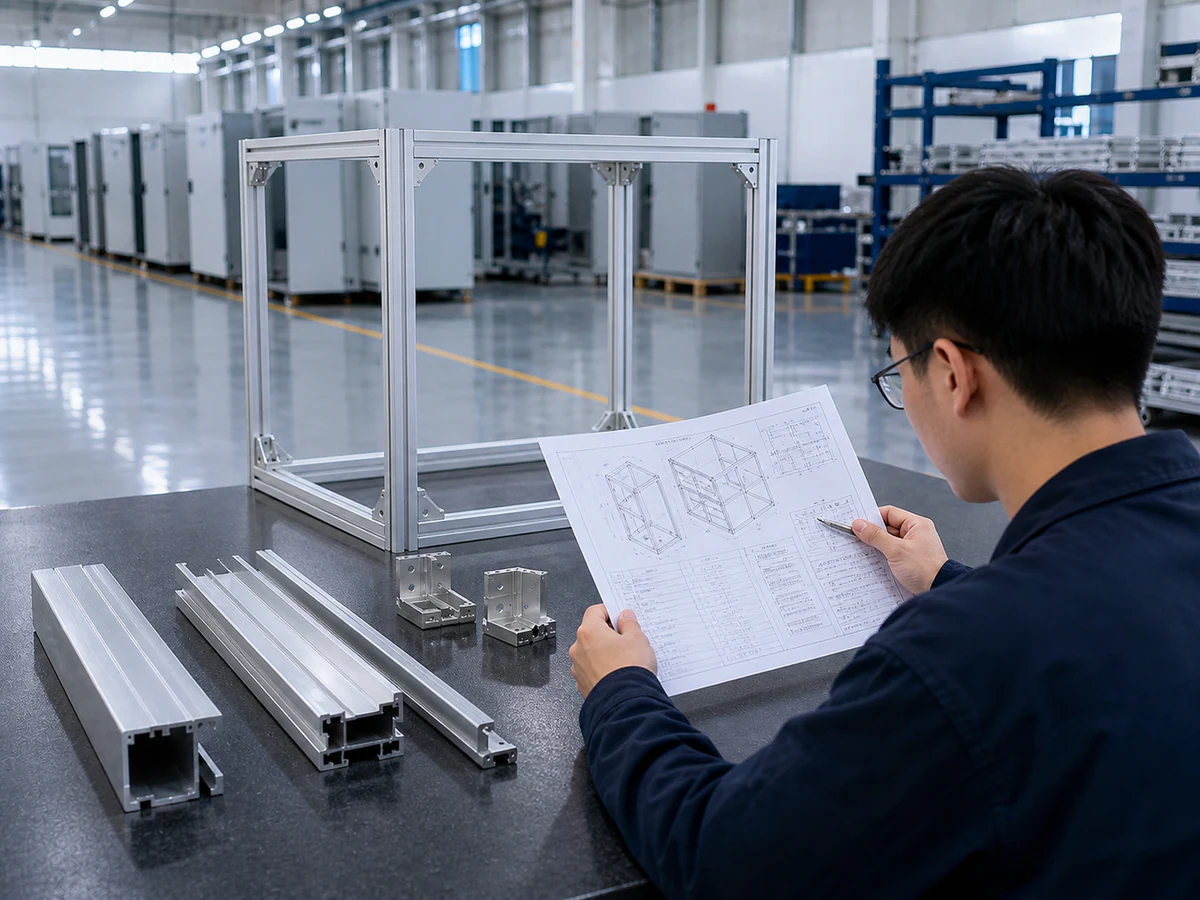
The featured photograph shows a related assortment of industrial aluminum sections. It illustrates why a buyer should compare cross-sections; it is not a photograph of the woodworking T-track specified in this article.
2. Compare three supply routes
- Buy finished lengths for one-off jigs or irregular demand. Confirm the accessory family, stock lengths, installation details, and waste.
- Order supplier-cut lengths for modest repeat batches without a dedicated saw cell. Agree the drawing revision, length datum, end condition, packing, and lead time.
- Cut approved stock in-house only when repeat demand and a released profile justify capacity. Verify safe workholding, first articles, labor, scrap, maintenance, and total cost.
Buying a saw to eliminate a few manual cuts rarely solves the purchasing problem. Include incoming inspection, material handling, space, trained labor, tooling, extraction or chip control, maintenance, and rejected pieces in the comparison. Ask the accessory supplier whether it offers the required finished length or a cut service. Both INCRA and Rockler describe track that users may shorten, but that fact alone does not justify industrial equipment for a small kit run.
3. Put woodworking T-track cutting details in the cut list
For an OEM batch, the cut list should identify each kit variant and track location. State quantity by finished length, permitted tolerance, the measurement datum, and which end is visible or butts against a stop. If the extrusion has a scale, define where the zero point belongs after cutting. If it has predrilled holes, show the required distance from each finished end to the nearest usable hole. A length-only order can arrive dimensionally correct yet fail to fasten to the jig.
Separate work that the saw can perform from later operations. A square end cut does not automatically create a new mounting hole, deburr a slot to your acceptance level, repair an anodized surface, or re-register a measuring scale. Mark which party owns those steps. The engineering drawing and an accepted sample, rather than an unqualified “clean cut” phrase, should define the finished condition.
4. Trial workholding on the actual narrow section
Narrow open channels can be awkward to support. The section may tip against a stop, crush at a thin lip, rotate under a clamp, or collect burrs where a sliding nut or bolt head must pass. These are risks to check, not claims that every T-track behaves the same way. Provide the actual stock and its intended finish to a machine supplier. Observe the feed reference face, stop contact, clamp pad position, support on both sides of the blade, and safe handling of the shortest cut and offcut.
Measure several first-off pieces against the released drawing. Check finished length, squareness, visible-face marks, burrs in the slot, slide of the specified hardware, and mounting-hole location relative to the cut end. Record the sample identity and machine setup. A trial on a thick structural T-slot bar does not prove performance on a narrow accessory rail. For the broader issue of which face a saw uses as its datum, see our back-fence contact guide.
5. Use the video as an equipment view, not a track test
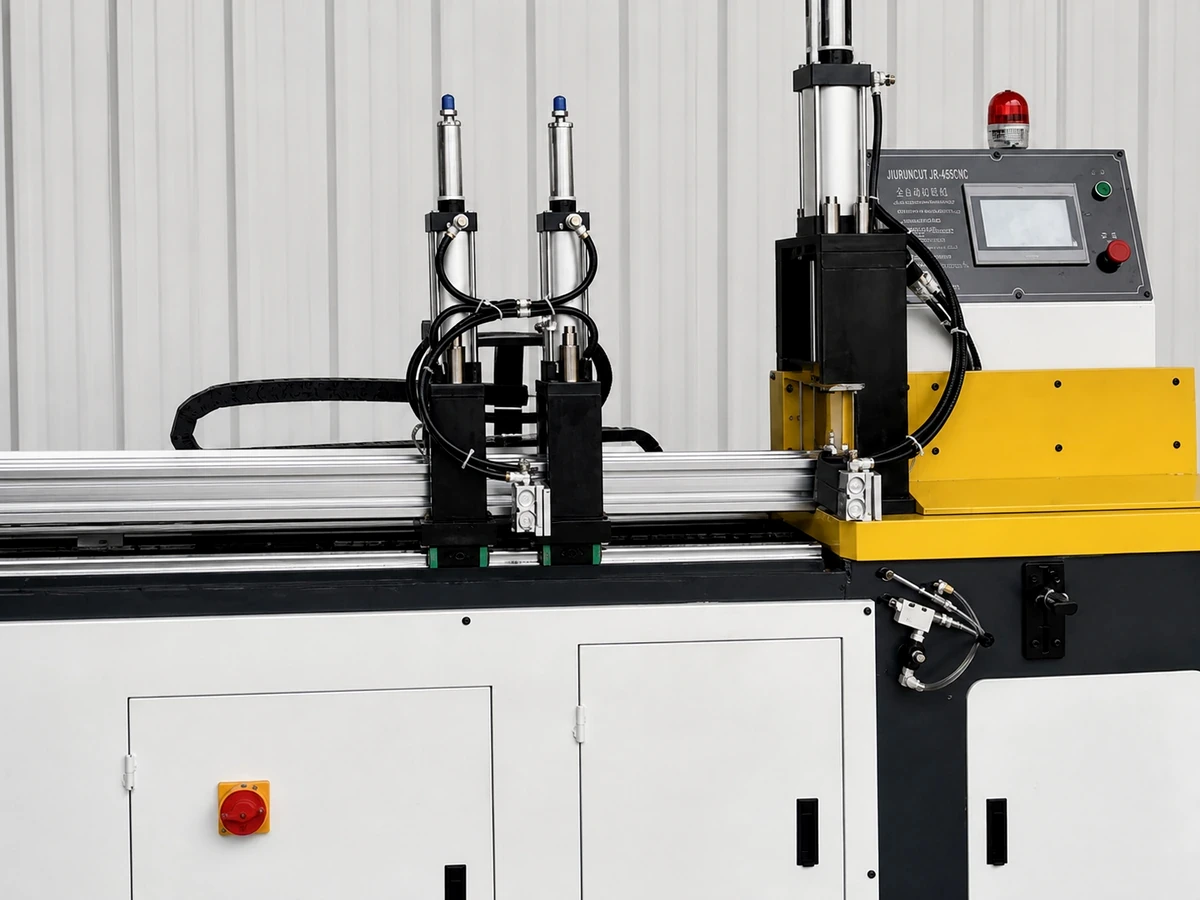
The following video from Jiurun Machinery’s own channel shows a JR-455CNC aluminum-profile cutting machine and its feed and clamping arrangement. It does not show the track, accessory hardware, production batch, or cut-quality evidence for this article. A buyer should still request a supervised trial using the exact approved section.
6. Calculate the break-even point using accepted kits
Compare the same output unit across routes: an accepted set of track pieces ready for one jig kit. The in-house estimate should include purchased stock, saw time, setup and changeover, labor, blade and maintenance expense, offcut waste, deburring, inspection, packing, and the value of floor space. The outsourced estimate should include cut-service charges, shipping, minimum orders, incoming inspection, and lead-time inventory. Keep one-time equipment and fixture costs visible instead of hiding them inside a piece price.
Demand variability matters. A shop making a few prototypes this quarter and no repeat kits next quarter may be better served by precut parts. An OEM with several recurring lengths and verified stock may benefit from in-house cutting, but only if a safe, repeatable setup and adequate utilization are shown. Sensitivity-check the decision at a low, expected, and high monthly kit volume. Include the cost of one rejected or reworked kit, not merely the aluminum scrap value.
7. Send a useful RFQ
Send the machine supplier the approved profile drawing and sample, finish condition, stock and cut-length range, quantities by length, hole and scale requirements, visible-face designation, end-quality criteria, downstream assembly check, and desired throughput. Ask which trial configuration and inspection method they propose. If a supplier cannot yet see the profile or the functional slot hardware, request a feasibility review before a performance promise or purchase decision.
For a supplier-cut route, send the same released drawing and acceptance sample, then ask for a quote on accepted kit-ready pieces. That keeps the two routes comparable. If the track is a proprietary retail accessory, confirm whether modification affects installation guidance or supplier support before replacing it with another extrusion.
Next step: Share the exact track part number, a cross-section drawing, kit cut list, and one physical sample with JiurunCut. We can discuss whether a saw trial is warranted for your production volume and which cut-end and hardware-fit checks should be recorded. The trial, not this illustrative media, determines suitability.