
Operator guidance workbench frame cutting is a narrow metal-part task inside a much larger station purchase. The operator may need a screen, tool holder, light, work surface, cable route and an approved production process; a saw supplies none of those functions by cutting an aluminum profile. For an OEM or integrator considering a saw, the useful question is which released frame members will actually be cut in-house, and what must happen before those members become an accepted workstation. These seven RFQ checks turn an attractive workstation concept into a testable cut-blank and kit specification.
1. Define the station and the purchased stage
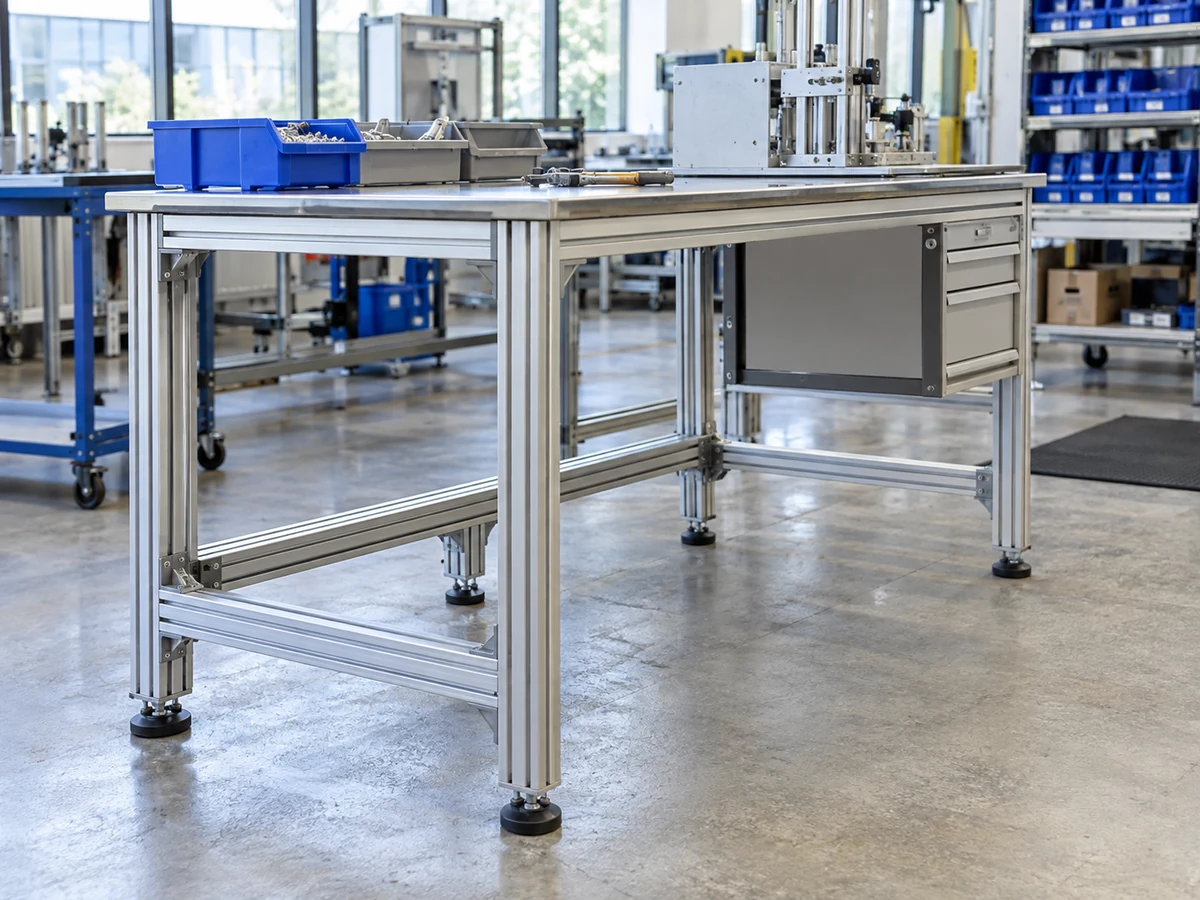
Start with the approved station layout, variant and drawing revision. Is the order for a complete equipped workbench, a preassembled bare bench, a prepared frame kit, or loose extrusion blanks? Those are different receiving units. For example, item describes one configurable work bench with aluminum-profile construction and choices such as uprights, overhangs and a cable duct; its product listing identifies the delivered basic bench as preassembled. That is a manufacturer example, not the design or supply status of your own station. State exactly which structure, accessories and integration work the proposed saw investment would replace.
An operator guidance project may add a display and connected tooling to a bench. The aluminum saw quotation should cover only the profile families, cut lengths, cut ends, lot identity and material handling that the buyer retains. The workstation owner still specifies screen position, human access, electrical equipment, tool process and any application-specific ESD or safety requirements. Do not convert the bench’s outside width into a saw cut length without a released assembly drawing and joint detail.
2. Release member records before choosing a saw
Ask for a line-by-line member schedule: station variant, profile system and cross-section, material and finish, stock form, cut length, quantity, end condition, locating face, slot orientation and part revision. Separate legs, front and rear rails, upper uprights, cross members, overhang supports and any screen-support profiles. A rectangular bench envelope is not a cut list. Connector thickness, end caps, foot plates and the method of joining can change the issued member lengths.
Keep an explicit link from every member to its assembly position. If an upright carries a display arm on one side and a tool balancer on the other, mirrored members may need different slot orientation or later holes even where their blank lengths match. Bosch Rexroth’s FRAMEpro description illustrates why the parts list matters: its profile-frame planning functions list strut profiles and the necessary sawing and drilling. The published tool describes its own workflow; your purchase order still needs the actual released drawings, revision and accepted part definitions.
3. Separate display mounting from the cut blank
A screen position can drive the length and orientation of an upright, but the saw does not establish whether the screen mount is suitable. item’s Monitor Arm example shows a separate arm assembly with a profile, joints, a monitor interface and cable ties. That particular product is only an example of distinct components and interfaces. For the buyer’s chosen monitor, ask who approves the attachment point, screen position, reach and cable routing, and which supplier provides the arm and fasteners. Keep electrical and display-performance acceptance outside a simple cut-blank claim.
Record any drilling, tapping, countersinking, connector machining, edge finishing and protective treatment as separate operations. Identify whether those features are already present in purchased stock, made after sawing, or supplied as bought accessories. A quote for square-cut bars cannot be compared with one for a labeled, drilled frame kit unless the receiving stage and remaining work are priced on the same basis. If the monitor location changes after approval, issue a new member revision rather than quietly using an old upright of convenient length.
4. Mark datum, clamping and visible faces
On each actual profile drawing, mark the datum face used to position the cut, the faces that may be clamped, exposed surfaces, critical slots and the orientation of an asymmetric section. Ask how full stock will be supported at the infeed and how a short cross member will be retained and removed. A clean nominal length is insufficient if a clamp marks the face used by a monitor-arm connector or if a chip remains in a slot needed for assembly. Define the acceptable burr and surface condition at the agreed receiving stage.
Do not infer a finished workstation’s dimensions from a machine brochure. Ask the saw supplier to show the proposed support, feeding and offload arrangement against the real extrusion sample. Record which operations are included: cutting, deburring, cleaning, segregation and packing can sit with different suppliers. If a different finish or wall thickness is specified for the next station variant, require a separate feasibility check before treating the first profile trial as representative.

5. Trial a complete member mix
For first-off acceptance, provide actual stock from the released profile family and include more than one convenient straight rail. Select the longest bench member, a short brace, an upright with a critical slot face and any finished visible profile. State the required sample count, changeover sequence and responsible inspector. Ask the supplier to show the cut method, datum, clamp contact, stock support, piece collection and how accepted samples are kept separate from offcuts. If only a short section is available, call the exercise a section trial rather than a full-bar production trial.
Measure drawing-defined cut length, end squareness or angle, burr condition, slot damage and visible-surface marks. Let the workstation owner dry-fit a representative set with the approved connectors and accessories. The saw trial can verify cut-part acceptance and expose kit-fit issues; it cannot certify ergonomics, display security, electrical operation, ESD behavior or the guidance process. Put every observed failure and the retest trigger on the first-off record.
6. Compare complete bench, kit and in-house cutting routes
Route A buys an approved, equipped or preassembled station from a specialist. Route B buys a prepared frame kit and performs accessory installation locally. Route C retains the released profile-cutting stage and sends blanks through drilling, assembly and integration. Compare these routes at one accepted receiving stage over the same production period. Count purchased stock, usable members, saw and fixture time, changeovers, downstream features, labeling, packaging, inspection and rejected pieces. A low quoted cost per saw cut is not necessarily a low cost per accepted guidance workstation.
For repeat variants, specify the minimum batch, revision cadence and what happens when a monitor mount or work-surface arrangement changes. Decide whether a package means one complete frame set or a bulk bundle of identical rails. Every kit should identify station family, position, revision, quantity and material lot according to the buyer’s traceability requirements. Keep purchased screens, arms, controls and tool fixtures in a separate supply line so a metal-parts quote does not silently absorb their integration obligations.
7. Operator guidance workbench frame cutting RFQ checklist
- Approved workstation family, layout revision and receiving unit: loose blanks, prepared kit, assembled frame or complete station.
- Member schedule with profile identity, stock length, issued cut length, end shape, orientation, quantity and revision.
- Annotated datum, clamp-safe and visible faces; slot and connector interfaces; end and surface acceptance criteria.
- Who supplies and verifies monitor arms, mounts, screens, tools, cables and any other non-saw components.
- Included and excluded post-cut work: machining, deburring, cleaning, finish protection, labeling, joining and packing.
- Representative long and short stock for a first-off trial, changeover count, inspection method and assembly-fit reviewer.
- Commercial comparison at equal accepted output, including usable members, labor, rework and version-change handling.
If the work concerns replacement of an existing bench top instead of a new guidance station frame, use the separate industrial workbench top replacement guide to determine whether the installed frame can remain. Do not recut the frame merely because the work surface or display changes.
What the Jiurun video demonstrates
The Jiurun channel video below shows a general aluminum-profile saw and feed process. It is relevant to discussing stock presentation, feeding and cut-piece handling. It does not show this article’s workstation, monitor installation, approved frame kit, customer trial or achieved performance. A buyer should request a trial with its released profiles and acceptance drawing before selecting a configuration.
Need a cutting route for a released workstation frame? Send JiurunCut the member drawings, real extrusion samples, stock lengths and first-off criteria. We can discuss the saw and trial scope for the cut-member work your team actually retains.