
Aluminum festoon T-track cuts are a small but consequential part of a moving cable-supply system. A cut rail can be dimensionally correct yet fail at a bolted joint, a trolley running face or an end-stop location. Conversely, a complete festoon package includes trolleys, cable saddles, tow parts, supports and application engineering that a saw station cannot supply. This guide helps a buyer issue a precise rail cut-blank RFQ and decide whether to order a factory-prepared track, outsource identified members or retain a saw process in-house.
First identify the actual system. Gleason describes an extruded-aluminum T-track whose trolleys run along the outside of the rail and whose sections bolt together. Duct-O-Wire lists aluminum track for pipe-type trolleys while describing other C-track families in galvanized or stainless steel. Those are different product constructions. A drawing marked only “festoon track” is not permission to substitute an aluminum profile, copy another supplier’s joint detail or apply aluminum cutting advice to steel stock. Gleason T-track catalog and Duct-O-Wire product overview provide examples, not specifications for the buyer’s project.
1. Define the purchased output before asking for a cut price
State whether the purchase is a loose straight rail blank, a rail cut and prepared for approved joints, a labelled set of segments for one run, or a complete festoon system. For every alternative, name who supplies the actual stock, bolts or connector plates, hangers, trolleys, end stops, cable and electrical work. In Gleason’s T-track example, the joint assembly, trolley, hanger and end-stop assemblies are separate catalog items; Duct-O-Wire likewise lists cut-length aluminum track alongside distinct joints, hangers and trolleys. A quotation for bare cutoff must not be compared as though it included those parts or installed operation.
If the system owner controls the proprietary section and warranty, buying approved cut-length track from that owner may be the safest commercial route. An outsourced saw shop is a realistic second route only when the design owner permits that manufacturing stage, releases the section drawing and accepts a measurable incoming rail condition. An in-house saw becomes relevant when the buyer repeatedly processes an approved family of straight sections and can own identification, fixtures, inspection and rejected material. Decide the route against the same accepted handoff, not a per-cut price alone.
2. Freeze the real extrusion and its running surfaces
Ask for the section ID and revision, manufacturer or design-owner authority, actual material and temper, stock length, incoming finish and a representative physical piece. Mark the faces touched by wheels, anti-lift rollers or connectors, and the faces a saw fence or clamp may contact. The selected rail may be a T profile with external running surfaces, an aluminum pipe-trolley track, or a different approved extrusion. They do not share one safe fixture merely because all are called rails.
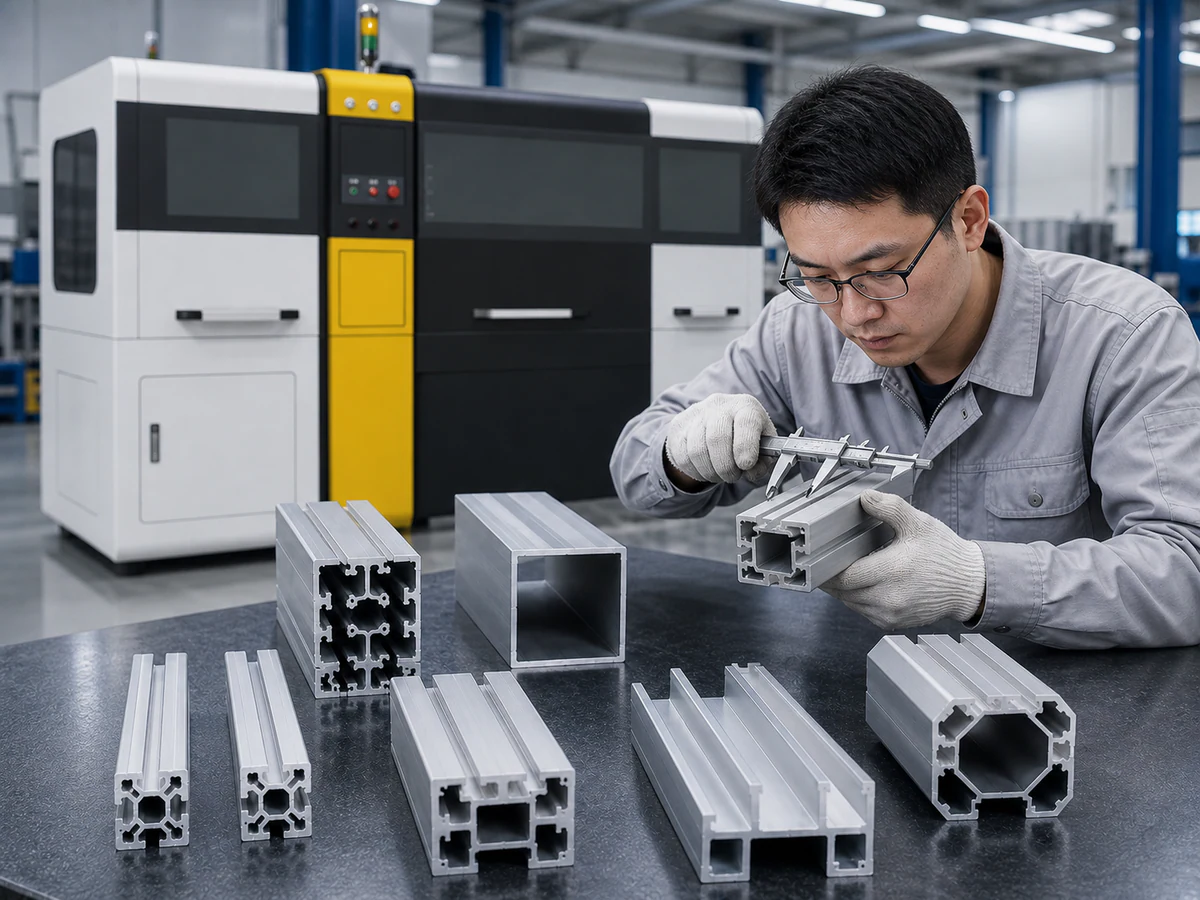
A sample cross-section helps distinguish an open lip, thin wall, closed cavity and any asymmetric flange before a trial. Record any protective coating, surface treatment or damage limit on the approved drawing. The designer, not a generic photo, sets rolling clearance and joint geometry. Protect those identified faces when receiving and staging stock, and reject a substituted section before optimizing its cut cycle.
3. Convert the run layout into an authorized segment schedule
An overall crane travel distance or installation span is not a saw stop length. The installed run may include storage length for trolleys, end clearance, support positions, joints, a tow arm and a terminal stop. The system designer should turn that layout into individual rail drawings. Each schedule line needs a part ID, revision, straight or preformed condition, rail orientation, source stock length, required cut length and datum, end form, joint position, quantity and receiving stage. Mark left and right or upstream and downstream ends if they differ.
Gleason’s catalog lists standard aluminum T-track sections and says customer-specified lengths can be cut; it also shows a bolted joint using holes in the track sections. Duct-O-Wire’s Aluma-Track catalog lists standard sections, cut lengths, joints and curved-track options. These examples explain why a segment length, joint feature and curve are separate order lines. A saw cut does not create factory-preformed curvature or an approved hole pattern. Request the design owner’s current joint drawing rather than copying a catalog image into a job traveler. Duct-O-Wire Aluma-Track catalog.
4. Keep cutoff, drilling, bending and assembly in separate scopes
Write an operation route for each member. A straight cutoff may be followed by end deburring, chip removal, hole punching or drilling, joint hardware installation, curved-section supply, coating repair and system assembly. Identify which station performs each operation and what evidence the next station receives. If stock arrives with prepunched holes, define the length datum relative to those holes. If holes are added after sawing, the rail blank must retain enough material and identity for that operation. Neither assumption belongs in a saw quotation unless confirmed by the actual released design.
Place steel brackets, mounting supports and cable equipment on their own bill-of-material lines. A manufacturer’s catalog may show a steel hanger used with an aluminum track, but that does not make the complete assembly an aluminum-cutting job. Keep the crane, hoist or host machine approval with its responsible integrator. The saw supplier should only claim the metal-cut result it measures.
5. Trial the longest relevant straight stock with the real contact faces
For an in-house or outsourced cutoff route, run a witnessed trial with the approved rail section rather than a convenient generic extrusion. Include a long incoming piece, a short finished segment if one is in the mix, and any thin or exposed running lip that limits clamp force. Inspect infeed and outfeed support, fence contact, clamp position, blade exit and offcut control. Agree the measurement datum and acceptance limits from the released rail drawing before cutting. A low-burr generic sample or a machine brochure cannot establish suitability for this section.
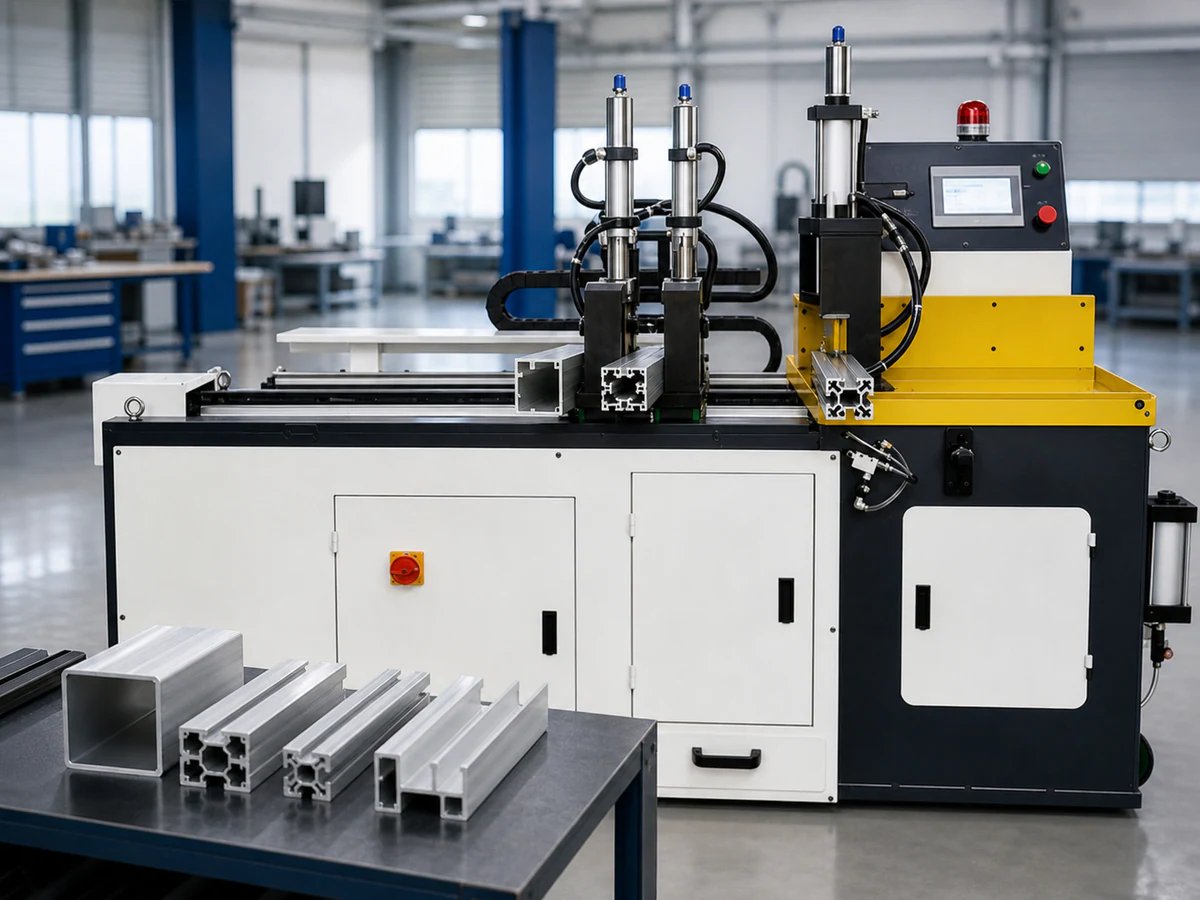
Record the first-off rail ID and batch, stock condition, setup photo, measured length at the named datum, cut-end condition, protected running surfaces and any nonconformance. When the joint is part of the purchased output, fit a representative pair with the actual authorized connector and have the system owner check continuity through the transition. A bare end-length inspection and a trolley roll-through are different acceptance steps. Do not infer system load capacity, motion reliability, cable life, electrical safety or installation compliance from a saw trial.
6. Pack identifiable run sections and preserve the joint face
Every accepted segment should carry its section ID, drawing revision, run or kit number, position, orientation and batch. State whether labels may touch the running face or a finished visible surface. Protect cut ends and joint interfaces against transport dents; segregate curves, straight rails, connector sets and rejected pieces. At receiving, reconcile the member count against the segment schedule and check that the next assembler has the correct joint hardware and installation instructions from the system designer.
For repeated production, count accepted, correctly identified run sections rather than total saw strokes. Include stock yield, changeovers, inspection, secondary holes, packing and rework in the same-period cost comparison. Buying a complete, factory-prepared rail package may be more economical when the order is intermittent, proprietary joints dominate or field rework would be costly. An in-house saw deserves investment only when the retained cut-member portfolio and actual trial justify its full operation.
Aluminum festoon T-track cuts: RFQ checklist
- Identify the actual track manufacturer or design owner, system family, section revision and permission to cut stock outside the approved supply chain.
- Send the cross-section drawing and real sample, material and incoming condition, protected running faces and allowed clamp contact.
- List each straight or curved member separately with part number, quantity, datum, end form, orientation and joint/hole responsibility.
- Name the delivery stage: loose cut blank, prepared joint member, labelled run kit or complete installed festoon system.
- Require a representative first-off record on the longest and most delicate relevant stock; assign connector fit and trolley roll-through to the system owner.
- State packaging, traceability, rejection handling and receiving criteria, with brackets, trolleys, cable and controls listed separately.
Send JiurunCut the approved aluminum section, sample stock, segment schedule and desired cutoff stage if you want to discuss a saw process. We can review support, clamping and first-off evidence for the actual aluminum profile. We do not supply or qualify a complete festoon system through a cut test. For a broader decision on feeding long stock into a saw, see our stock staging interface guide and confirm that any suggested equipment is trialled with your real material.
Related aluminum cutting-machine video
The Jiurun Machinery channel clip below shows an aluminum-profile feeding and cutting machine. It illustrates a related equipment process only. It does not show the festoon rail in this article, an approved fixture or model for that rail, a customer project, a witnessed trial, trolley operation or performance proof.
Sources and scope
The Gleason T-track catalog identifies one aluminum T-track construction and its separate joint and trolley assemblies. Duct-O-Wire’s system overview distinguishes aluminum pipe-trolley track from steel C-track families; its Aluma-Track catalog illustrates cut-length, curved, joint and hanger supply options. They are manufacturer-specific references. The buyer’s released rail drawing and system integrator remain the authority for any project acceptance.