
Emergency vehicle rack frame aluminum cuts begin with a released equipment layout, not with a saw setting. A response-vehicle upfitter may use extruded members to support cabinets, drawers or removable equipment. The cutting supplier can quote repeatable blanks only after the vehicle integrator identifies the exact section, cut datum and part handoff. A sound-looking extrusion is not evidence that a rack is restrained, accessible or safe in a vehicle. Those judgments belong to the responsible vehicle and equipment designers.
The distinction matters because a vehicle equipment rack is more than a rectangular frame. Its members may carry drawer slides, shelves, latches, panels or mounting plates; the finished system must meet a vehicle-specific layout and acceptance plan. item’s emergency-services examples show aluminum-profile vehicle upfits, stowage racks and pull-out systems. They establish that this construction route exists, not that any particular profile, mounting method or Jiurun saw has been approved for a buyer’s vehicle. This guide addresses the cut-blank RFQ that comes before that approval.
Define the rack, the vehicle and the supply boundary
Ask the upfitter for the vehicle type, body variant, compartment location, design revision and named approval owner. Is the order for a fixed compartment rack, a drawer subframe, a removable equipment module or a workshop trolley that will travel separately? These are different purchase units. A welded or assembled rack, a kit of cut profiles and a box of loose saw-cut blanks have different labor, inspection and liability boundaries. Put the delivered state on the RFQ and on each drawing.
Identify which parts the saw supplier must actually deliver: horizontal rails, uprights, crossmembers, drawer-support members or short spacers. List every part number, hand, revision and quantity per vehicle, then show how many vehicles or kits form a batch. Do not use the vehicle’s nominal compartment width as a blanket cut length. Liners, brackets, panels, end caps and fastener access can all change the member length. A vehicle engineer must release the installed geometry.
Also identify the interface to any existing mounting points and surrounding service equipment. A rack designed for one body style may obstruct a door, hose, battery compartment or maintenance panel in another. The cutting process can preserve a dimensional blank; it cannot validate compartment clearance, load retention or emergency access. Those checks must remain in the upfitter’s design and test plan.
Release the approved extrusion family before quoting the blank
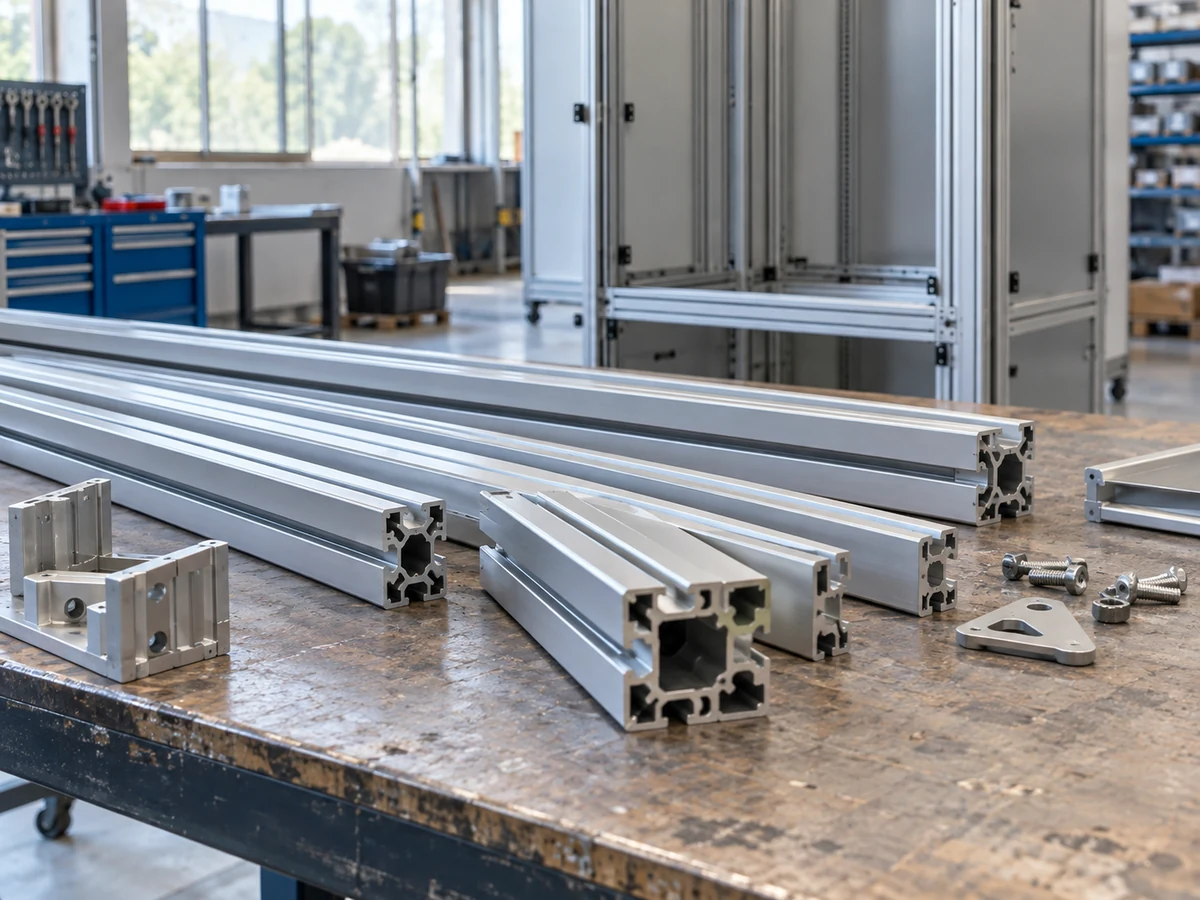
Send a section drawing and, preferably, a physical sample from the intended stock. Mark overall width and height, wall thickness, open slots, internal webs, corner radii, core bores, visible faces and any installed accessories. An apparently similar T-slot profile from another series may accept different fasteners or corner connectors. item describes groove size, modular dimension and core bore as distinct profile features in its profile-system guide; the buyer must release the exact family and revision in use rather than treat a catalog picture as a substitute drawing.
Specify the alloy and temper if controlled, source stock length, finish, coating or anodizing state and protective film. Tell the cutting supplier whether the profiles arrive bare, finished or with slot covers installed. A finished visible rail may need different supports, blade selection or handling from an uncoated structural member. If the rack uses non-aluminum components, list them separately. The existence of aluminum in one item system does not prove every emergency-vehicle rack is made of it.
Turn the layout into a controlled cut list
Give each blank an end-to-end drawing dimension and a clear datum. State whether a dimension is overall finished length, a distance between connector faces, or a post-machining dimension that cannot be verified at the saw. Identify end A and end B, and whether each is square, mitered or otherwise prepared. A mirror-image left and right member should have different identifiers, even if the nominal lengths match. Note the permissible length variation and the agreed measuring method rather than applying a single generic tolerance to every assembly.
Where a member spans between two uprights, show whether its ends butt against the uprights, enter a connector or overlap a mounting plate. Where a corner is mitered, distinguish a full saw-cut end from a local notch or drilled feature. The circular saw may produce an approved end face; it does not automatically add tapped holes, reliefs, countersinks or a drawer-slide pattern. Assign those secondary operations to a named process and record the sequence.
Supply a bill of materials with cut count per rack, planned batch size, expected repeat orders, maximum and minimum profile lengths, cut orientation, scrap rules and part marking. If the supplier proposes nesting several part numbers from one stock bar, verify that its optimization does not mix revisions or change the required grain or surface orientation. A low material-waste figure is useful only if every shipped member is the correct revision and passes inspection.

Separate rack-frame cuts from vehicle restraints and sliding hardware
A rack frame member is not the same as a cargo tie-down track or a drawer runner. If the project includes a standardized L-track for restraint fittings, quote that rail and its hole or fitting pattern as a separate item. Our aluminum L-track cutting guide covers that distinct purchasing decision. Likewise, a pull-out drawer slide may be a purchased assembly with its own rated travel, stop and mounting instructions. Do not let a rack-frame cut list silently absorb those components.
The upfitter should provide the vehicle attachment drawing, fastener schedule, mounting-substrate details and installation authority. Ask where access holes, cable paths, doors and removable panels must remain clear. Confirm whether the assembled system requires vibration, restraint, electrical, corrosion, cleaning or other project-specific assessments. The responsible manufacturer or qualified integrator defines and performs those assessments. A cut-profile sample cannot prove a rack’s load rating, crash behavior or compliance with any emergency-vehicle standard.
When comparing a loose-cut-member route with a complete modular system, count the interfaces that the buyer must still engineer. A profile supplier may offer compatible connectors, fittings and CAD data; a saw supplier may only supply prepared blanks. Neither route replaces the released vehicle design. If the rack will carry medical or rescue equipment, keep equipment approval and safe stowage in the vehicle integrator’s scope rather than describing a cut blank as a certified product.
Trial the real stock and protect functional surfaces
Before production, trial actual stock from the intended supply route. Show the cutting supplier the surfaces that may be supported and clamped, and those that must remain unmarked for sliding hardware, seals, visible finish or connector engagement. Hollow and asymmetrical profiles can twist or crush when contact is poorly placed. Ask for a proposed support and clamp plan, including any insert or backup, and inspect a first-off part for movement, end squareness, burrs, scratches and coating damage.
Measure first-off length and end condition using the drawing’s datum and acceptance method. Compare multiple part numbers, especially the longest and shortest members, mirrored cuts and small batches that require frequent changeover. Retain the first-off specimen, stock lot, drawing revision and machine setup record. A good trial on one convenient extrusion is not proof that a different rack section or finish can be cut the same way.
After the cut-blank checks, the integrator must assemble representative members with the actual connectors, panels and hardware. Verify fit, drawer travel, door clearance and service access under the approved vehicle procedure. Keep a record of who accepted each stage. This separates a saw supplier’s dimensional evidence from the completed rack’s vehicle-level performance and safety assessment.

Compare three buying routes before selecting a saw
First, buy a complete approved rack or modular kit if the project calls for one design owner and a finished assembly. The supplier may already provide compatible connectors, drawings and part identification. Ask exactly what documentation, installation work and acceptance remain with the buyer. Second, outsource the released cut and secondary machining to a qualified fabricator when volumes are irregular or the rack design is changing. Quote the required acceptance and revision controls, not simply price per cut.
Third, consider in-house cut-blank production if the upfitter has stable drawings, repeatable batches and a team to control first-off inspection, part traceability, stock handling and downstream assembly. Send Jiurun the actual extrusion sample, section drawing, cut list and expected batch pattern for a cutting-stage review. Ask what support, feed and clamping arrangement would require an actual trial. Do not infer that the model shown in a general video is approved for the buyer’s section, vehicle or performance target.
Evaluate total accepted-kit cost. Include stock sourcing, offcut management, protective handling, secondary operations, assembly time, rejected members, revision changes and the evidence needed to release a vehicle installation. A low machine cycle time does not settle the procurement choice if the rack’s fit and installation work dominate.
Emergency vehicle rack frame aluminum cuts: Eight RFQ checks
- Identify the vehicle/body variant, compartment and responsible rack-design approver.
- Define the delivered item: loose cut blanks, machined members, a kit or an assembled rack.
- Release the exact aluminum extrusion family, revision, stock source, finish and connector system.
- Issue a part-numbered cut list with quantities, handed parts, datum and both end conditions.
- Separate rack frame, cargo restraint track, drawer slides, fasteners and vehicle mounts.
- Mark permissible support and clamp faces, visible surfaces and handling protection.
- Specify first-off dimensions, cut-face condition, sample retention and change control.
- Assign vehicle fit, attachment, load and any applicable compliance checks to the qualified integrator.
An RFQ with those eight decisions lets a saw supplier discuss a real cutting stage. If the profile, mounting scheme or design authority is unresolved, close that gap before ordering production blanks. The process can then be compared on accepted parts rather than on unqualified promises about a complete vehicle installation.
Related aluminum-profile feeding and cutting video
The Jiurun channel video below shows a long-profile feeding and cutting machine. It is a related equipment-process illustration only. It does not show this emergency vehicle, rack, approved profile, customer, fixture trial, load rating or compliance result.
Illustrative cutting workflow; no emergency-vehicle application or safety claim.
Send the released rack-frame cut packet
When the upfitter has approved the rack design and aluminum section, send Jiurun the profile sample, drawings, cut schedule and batch plan. We can review the cutting stage and identify questions for a representative trial. The vehicle manufacturer or qualified integrator remains responsible for the complete rack, its installation and acceptance.
Source notes
item’s emergency-services solutions show examples of aluminum-profile vehicle upfits, racks and pull-out equipment storage. Its aluminum-profile guide explains how modular dimension, groove and core bore distinguish profile families. They are examples of design approaches, not evidence of Jiurun equipment use, a universal cut list or approval for a buyer’s rack.