
An aluminum saw for server rack frames addresses one specific manufacturing step: cutting approved aluminum members to a defined blank or kit length. It does not by itself establish a 19-inch mounting interface, equipment clearance, rail-hole pattern, airflow, load rating, door fit, or a finished network enclosure. Before discussing a saw, the buyer should identify whether the purchase is for cut frame members, a prepared rail-and-frame kit, or a complete rack. That scope decision changes the drawing package, trial plan, and acceptance evidence.
Separate the rack standard from the cut-member drawing
The familiar 19-inch interface concerns equipment mounting, not every external cabinet dimension. Rittal’s 19-inch profile-rail overview identifies the 482.6 mm mounting system. A Rittal network/server rack product page illustrates how a finished enclosure can have front and rear mounting levels in addition to its frame and accessory system. These examples are third-party references, not a claim that a JiurunCut saw produced their products or that one frame drawing fits every rack.
Ask for separate controlled drawings for the cut member, the assembled frame, the mounting rail, and the finished enclosure. A saw can be reviewed against a member length, section, cut orientation, and blank-end requirement. The 19-inch mounting plane, vertical hole pattern, equipment depth, and door or cable clearances need their own assembly-level controls. Do not transfer a final interface tolerance straight onto the saw quotation without identifying which dimension the saw actually creates.
Check whether the retained member is aluminum
Server and network racks may combine aluminum and steel parts, formed sheet, fasteners, hinges, and accessory rails. Do not assume the full rack is an aluminum extrusion just because one visible part is silver. For each line item, record material, starting form, section drawing, finish stage, stock length, and supplier ownership. The frame post may be an extrusion while the 19-inch mounting rail is separately punched or formed. A saw proposal should cover only the approved aluminum items that actually require cutoff.
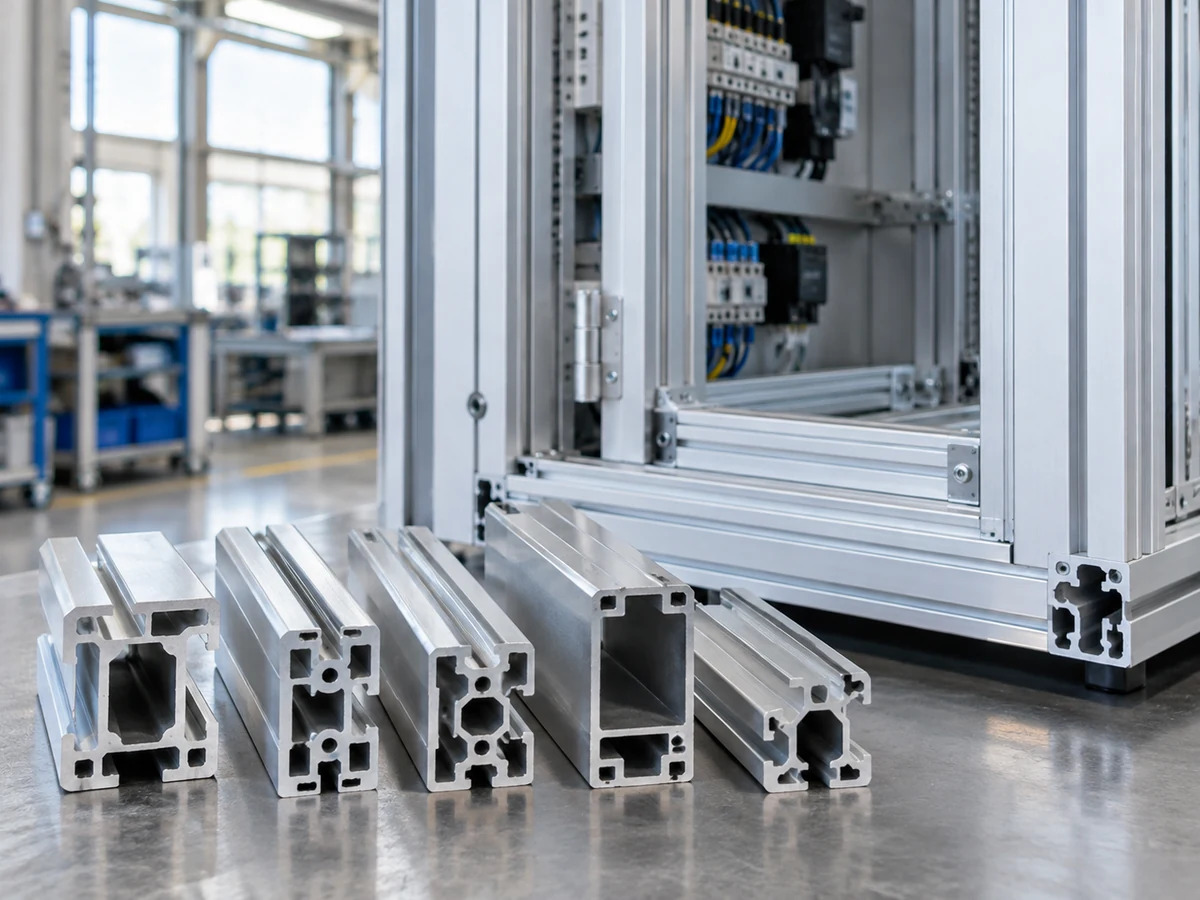
The image below shows loose aluminum profile sections beside an industrial control cabinet. It is a related frame-member illustration, not a server rack, a verified mounting rail, or a photograph of this article’s customer material. It helps distinguish long stock members from the assembled equipment around them.
Build the cut list by part family and orientation
Request a bill of materials and cut list that distinguish upright posts, top and bottom frame members, depth members, door frame pieces, accessory supports, and any rail blanks. Put the part number and drawing revision on each line. Record the profile section, finished and retained blank lengths, end geometry, finish allowance, quantity per rack, and the orientation that matters for slots or internal channels. If a part needs miters, notches, holes, or tapping, separate those processes from the saw’s straight or angled cutoff scope.
A useful cut-list review asks where the assembly datum sits. Does the buyer measure between outer frame faces, from a connector shoulder, or to a hole center created later? The answer may change the retained length and facing allowance. Designate the saw’s measurement datum on a blank, and leave drilled-hole spacing and rack-unit pitch to the operation that creates those features. Mark handed or mirrored pieces so a correct-length blank is not fed into the wrong later setup.
Shorter members can be a more demanding saw case than the longest upright: they may need repeatable feeding, safe clamping, part ejection, and unambiguous identification. Give the supplier the shortest retained length, largest section, mixed-family changeovers, and realistic batch sizes. Ask how the proposed handling route keeps finished blanks separated from offcuts.
Keep fit, cooling and load claims outside the saw result
A finished rack has more than cut-member dimensions. Mounting plane location, rail spacing, hole pattern, side-panel and door swing, cable path, ventilation, grounding or bonding provisions, and rated load belong to the system design and its verification. Schneider Electric’s 19-inch enclosure documentation separately discusses mounting rails, equipment envelope, airflow and cabling. It does not provide a universal cutoff tolerance for aluminum frame stock.
Compare one first-off cut frame member with its member drawing; then assemble a representative frame to check squareness and mating. Finally, use the system owner’s controlled method for mounting, door, cable, airflow and load checks. Keeping those gates distinct prevents a clean saw face from being represented as proof of rack compatibility.
The next photo is another industrial control-cabinet example. It shows doors and frame interfaces that prompt the correct assembly questions, but it is not a server enclosure, a JiurunCut test, or a claim about any 19-inch mounting geometry.

Specify a representative saw trial and RFQ
For an aluminum saw for server rack frames, give the supplier actual stock sections and a controlled cut list, then ask for a trial on approved material rather than an unspecified demonstration. Define a sample that includes a long upright, a short depth member, and any difficult changeover or angled end. The first-off and later cuts should be labeled by part number and revision. State the measurement method, allowed blank length deviation, end condition, visible handling damage limits, and who measures each sample.
| Decision item | Buyer evidence | What the saw review can answer |
|---|---|---|
| Stock and profile | Actual aluminum section, alloy/temper per drawing, length and condition | Clamping and support feasibility |
| Member geometry | Retained blank length, datum, end cut and allowance | Cutting setup and first-off measurement |
| Mix and output | Quantities per family, short lengths and changeovers | Feed, handling and identification approach |
| Rack-level fit | Frame, mounting rail, door, cable and equipment drawings | Downstream assembly test plan, outside saw-only proof |
Record feed and handling time as well as the cut itself, and document interruptions, scrap, end-of-bar remainder and inspection effort. The quickest single cut is not a trustworthy total cost or throughput estimate for a mixed rack kit. If the supplier proposes a different machine or tooling set, require a version-specific quotation and a trial that states what was actually tested. Do not infer a JiurunCut model’s capacity or performance from this general article.
View a related Jiurun Machinery saw demonstration
The official channel video below shows a saw station as a general equipment example. It can help a buyer frame questions about stock support, clamping and cut-part handling. It is not a server-rack member trial, does not identify this article’s material or selected model configuration, and cannot verify rack mounting geometry, customer fit, output rate or load performance. A buyer should request a witnessed run and assembly check for the actual drawing.
Five questions before releasing a rack-frame cut order
- Which BOM lines are actually aluminum cutoff parts, and which are purchased or formed parts?
- What is the retained blank datum and allowance for each frame-member family?
- Which holes, notches, finishes and assembly operations happen after sawing?
- What short-member and changeover cases must the supplier demonstrate?
- Who signs off 19-inch mounting, door, cable, airflow and load requirements at system level?
Next step: Send JiurunCut the approved aluminum-member sections and cut list through the contact page. Ask the supplier to state the saw-only deliverable, proposed support and handling route, and a sample trial plan. Keep the assembled rack and mounting-interface approval with the responsible rack designer or integrator.