
Outsourced aluminum cutting offcuts can change the real cost of a cut-piece order. A supplier may price finished lengths from its own stock, cut bars supplied by the buyer, or charge a conversion fee while returning usable remnants. Those quotations are not comparable until both parties agree who owns the material left after cutting, what must be returned, and whether any scrap value is already included in the piece price. This guide gives purchasing and production teams a practical way to settle that boundary before comparing a subcontract quote with an in-house saw.
The purpose is to create an auditable commercial and physical handover. It is not a universal scrap-price formula, a recycling claim, or a legal interpretation of title. Put the agreed ownership, credit and acceptance terms in the actual purchase documents and have the responsible buyer and supplier approve them.
Separate the four outputs of a cutting order
Start with an approved extrusion drawing, alloy and temper, stock form, finish, length schedule, and cut-end acceptance. Then name four different outcomes. Accepted pieces meet the released part specification. Reusable remnants are remaining lengths that can be identified, protected and cut for a later approved order. Process scrap may include short unusable ends, chips and other recoverable aluminum that cannot be released as the specified part. Rejected pieces fail an agreed requirement and need a separate disposition and responsibility decision. Calling all four “offcuts” hides who pays for a bad part and what the buyer can actually reuse.
A remnant is only useful if its profile, alloy, lot or heat identification where required, usable length, surface condition and revision remain known. A pile of visually similar sections is not an inventory balance. Our remnant-return guide addresses the separate shop-floor decision of routing a remnant back to the saw or into controlled storage; the issue here is what the outside cutter must return or account for under a purchase order.
Write the material-owner and quote boundary first
If the supplier buys the extrusion and sells accepted cut pieces, ask whether the quote is a complete piece price with all yield and scrap assumptions in the supplier’s scope. Do not assume the buyer earns a separate scrap credit. If the buyer furnishes bars, state when custody transfers, whether ownership remains with the buyer, who bears handling loss, and what happens to every returned remnant or recoverable scrap lot. If the supplier both supplies stock and separately offers a scrap credit, ask for a clear basis that prevents the same material value being counted twice.
A customer-supplied bar is not a free input. Its purchase cost, inbound freight, packaging, inspection, storage and working capital still belong in the buyer’s comparison. Our customer-supplied stock saw guide covers the machine-side handover when the buyer plans to cut that stock internally. For outsourced cutting, add the supplier’s custody, reconciliation and return obligations to the same material identity.

Choose an outsourced aluminum cutting offcuts route
Return identified remnants. This route is useful when the buyer can store and reuse them in later approved work. Specify a minimum reusable length or a job-specific release rule, the information to place on each bundle, protective packaging, return frequency and freight responsibility. Do not pay to return pieces that cannot be identified or economically used in the buyer’s real order mix. A retained remnant inventory needs a named owner and a retirement rule.
Credit recoverable scrap. If the buyer is entitled to a credit, write down what enters the credited stream, whether segregation by alloy or finish is required, the measurement unit, weighing location, contamination exclusions, valuation basis, timing and supporting record. An agreed credit may be a fixed commercial term or a documented adjustment under the contract; it is not automatically a published market price. Ask who pays for sorting, transport and processing, because a gross scrap value is different from a net credit on the invoice.
Include all residual material in the piece price. A supplier may retain offcuts and quote an all-in accepted-piece price. This can be simple to administer if the purchase order names the output quantity, quality and delivery point. It does not mean the cutting operation produces no waste or that the buyer has a separate claim to recycling proceeds. Compare the all-in price with the other routes at the same accepted-part stage and forecast mix.
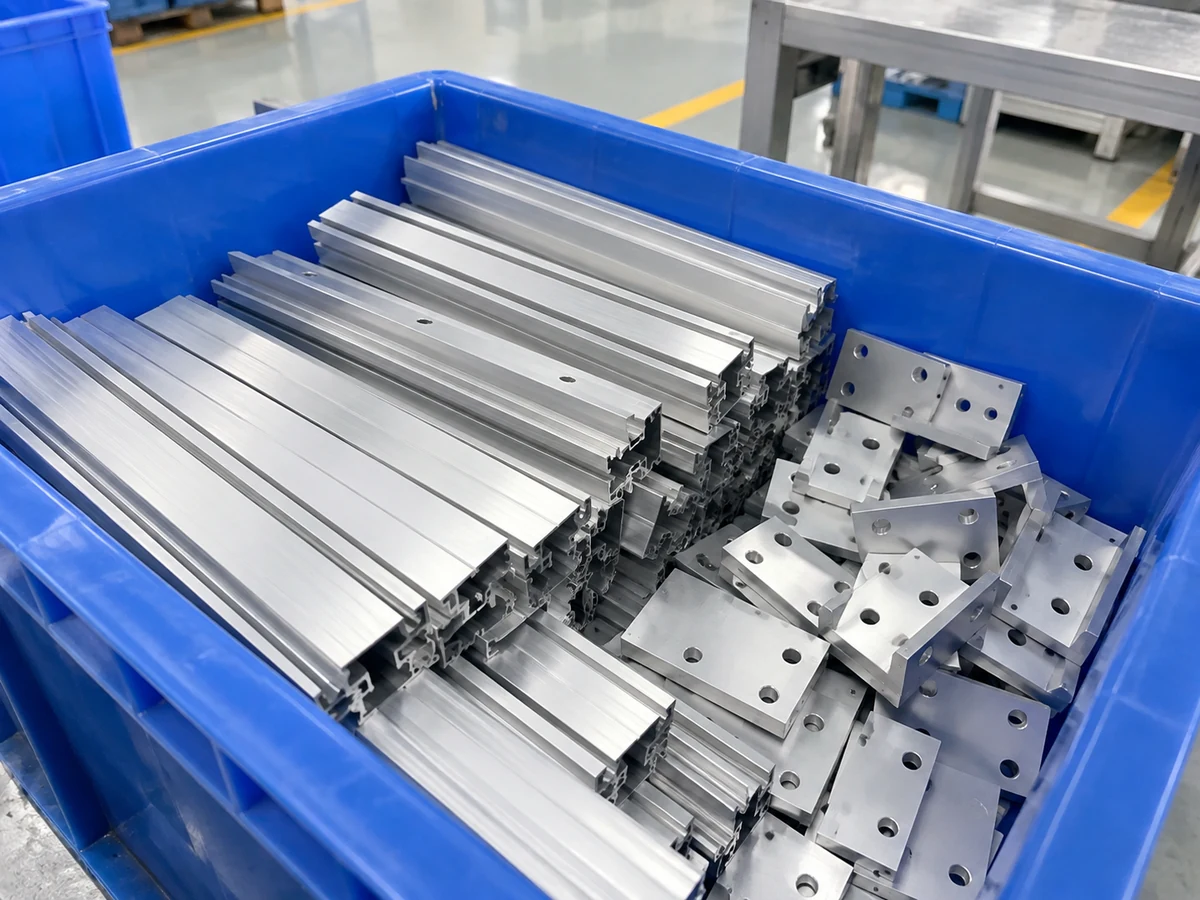
The Aluminum Association’s secondary-production overview explains why alloy-segregated scrap can retain more value than mixed material. Hydro’s aluminum recycling guidance distinguishes process scrap from post-consumer scrap and notes the importance of alloy requirements and sorting. Neither source sets this order’s credit, proves that a photographed bin contains a specified alloy, or guarantees a recycling outcome. Those are supplier-specific facts to document.
Reconcile material without inventing a yield
For each released order or agreed batch, record the incoming bar count and stock lengths, source lot, accepted piece count and lengths by part number, returned usable remnants, supplier-held residual material, rejected pieces and any credited stream. Keep units consistent. Count and length may be enough for one uniform profile, but a mixed profile family or multiple alloys needs separate records; weight can require agreed scales and tare rules. The practical goal is a traceable explanation of where the purchased input went, not a mathematically perfect yield claimed without measurement.
Do not charge a reject to “normal offcut” by default. If a piece misses cut length, has a damaged visible face, or fails a specified end condition, the acceptance record should say whether it can be reworked, replaced from remaining stock, or rejected at supplier cost. Likewise, a deliberate trim allowance and the saw kerf belong in the agreed process plan rather than being presented as a recovered remnant. A buyer comparing quotations should ask each bidder to state its assumptions instead of applying one generic yield percentage to every section and length mix.
Compare quotations at the same accepted stage
Choose the comparison point before calculating cost: for example, a labeled and dimensionally accepted cut member delivered to the buyer’s receiving location. Then use the same part drawing, quantity, length mix, forecast window, packaging and inspection basis for each route. The worksheet below identifies what must be requested; it does not predict which route is cheapest.
| Question | Supplier stock, all-in pieces | Buyer stock, return remnants | Buyer stock, scrap credit |
|---|---|---|---|
| Material at start | Supplier identifies approved section and lot | Buyer issues identified bars and custody record | Buyer issues identified bars and custody record |
| Accepted output | Piece schedule, end and finish acceptance | Same accepted-piece requirement | Same accepted-piece requirement |
| Residual route | Supplier’s stated all-in scope | Identified usable lengths returned by agreed rule | Defined recoverable stream measured for credit |
| Evidence at close | Delivery and quality record | Delivery plus remnant balance and receipt | Delivery plus segregation, weight and credit record |
| Buyer costs to include | Piece price, freight and receipt work | Stock, conversion, returns and inventory work | Stock, conversion and net documented credit |
When comparing with an in-house saw, add stock purchase, saw capacity or capital, setup and operator time, tooling and maintenance, inspection, sorting, remnant storage and scrap handling. For subcontracting, include conversion charges, minimums, freight both ways when applicable, lead time, receiving inspection and rework exposure. Avoid a comparison that deducts a hypothetical credit on one route while ignoring the actual sorting or return cost on another. Our angle cut-to-length supply-route guide gives a section-specific example of comparing stock, prepared pieces and a hybrid; this article isolates the residual-material terms that the broad route comparison can miss.
Release a small trial with a closeout record
Before a volume award, send the supplier the actual approved section, a representative cut list with both long and short pieces, protected-face instructions, end acceptance and a proposed offcut disposition. Ask for a first-piece result and a batch closeout that identifies delivered accepted parts, any returned remnants, rejects and the credited or supplier-retained residual stream. Examine the physical labels and packing at receipt. If the trial cannot keep two similar alloys or revisions separate, a more detailed credit clause alone will not fix the operational control.
The same trial can inform an in-house saw decision: use the real stock and part schedule to test feeding, clamping, cut-end checks and output handling. A general equipment video is not evidence that a particular alloy, wall, finish or quote route has been qualified.
Video: general Jiurun Machinery cutting equipment
This video from Jiurun Machinery’s channel is general cutting-equipment footage. It does not show or prove the material ownership, alloy, quote terms, machine configuration, customer order, trial cut, scrap quantity, credit, cut quality or performance described here. Request separate written and physical evidence for your own purchase.
Send an RFQ that exposes the residual-material rule
Provide the approved drawing and revision, alloy and temper, bar source, forecast and batch size, cut list, functional and visible faces, acceptance method, packaging and delivery point. Ask each bidder to identify who supplies and owns stock, who owns accepted and rejected pieces, which residual material is returned or retained, how a credit is calculated and evidenced, and when the lot is reconciled. Require the bidder to state any exclusions or minimum charges. The answer should be attached to the quoted supply boundary, not left in a verbal side conversation.
Considering an in-house cut route? Send JiurunCut the actual profile drawing and sample, length and quantity mix, protected faces, desired remnant route and acceptance checks through the contact page. We can discuss a saw trial and quote scope for those inputs. Final suitability, cut quality and material balance depend on your tested parts and agreed records.